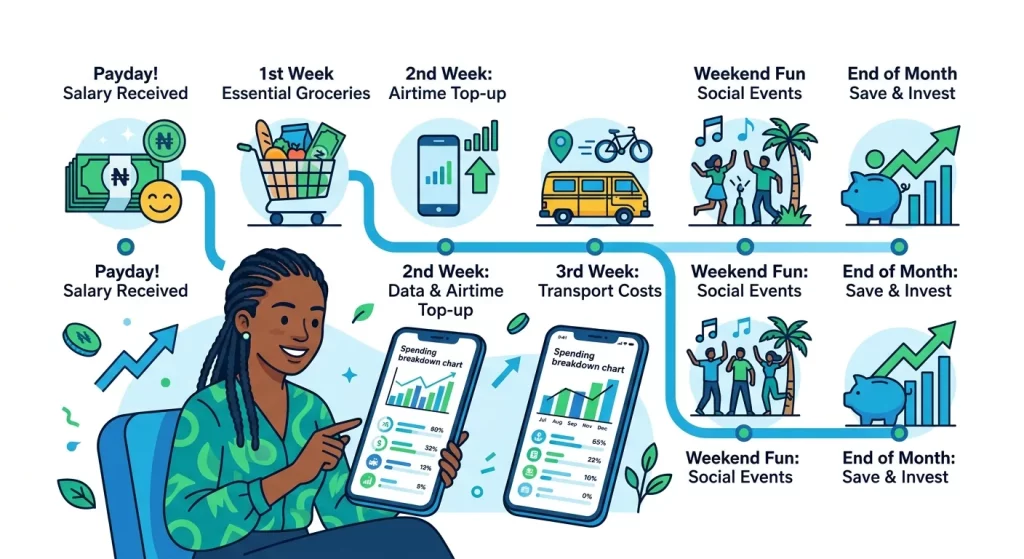
Millions of Nigerians follow the same exhausting cycle: salary arrives, bills disappear it, spending finishes the rest, and by the 20th of the month, the loan app is open again. The problem is rarely how much you earn. It is the invisible traps that drain money so quietly you never see them coming.
This guide names those traps directly — no vague advice, no condescending “just save money” lectures. Real patterns that real Nigerians fall into, and concrete ways to break out of them so that borrowing becomes a choice, not a monthly emergency.
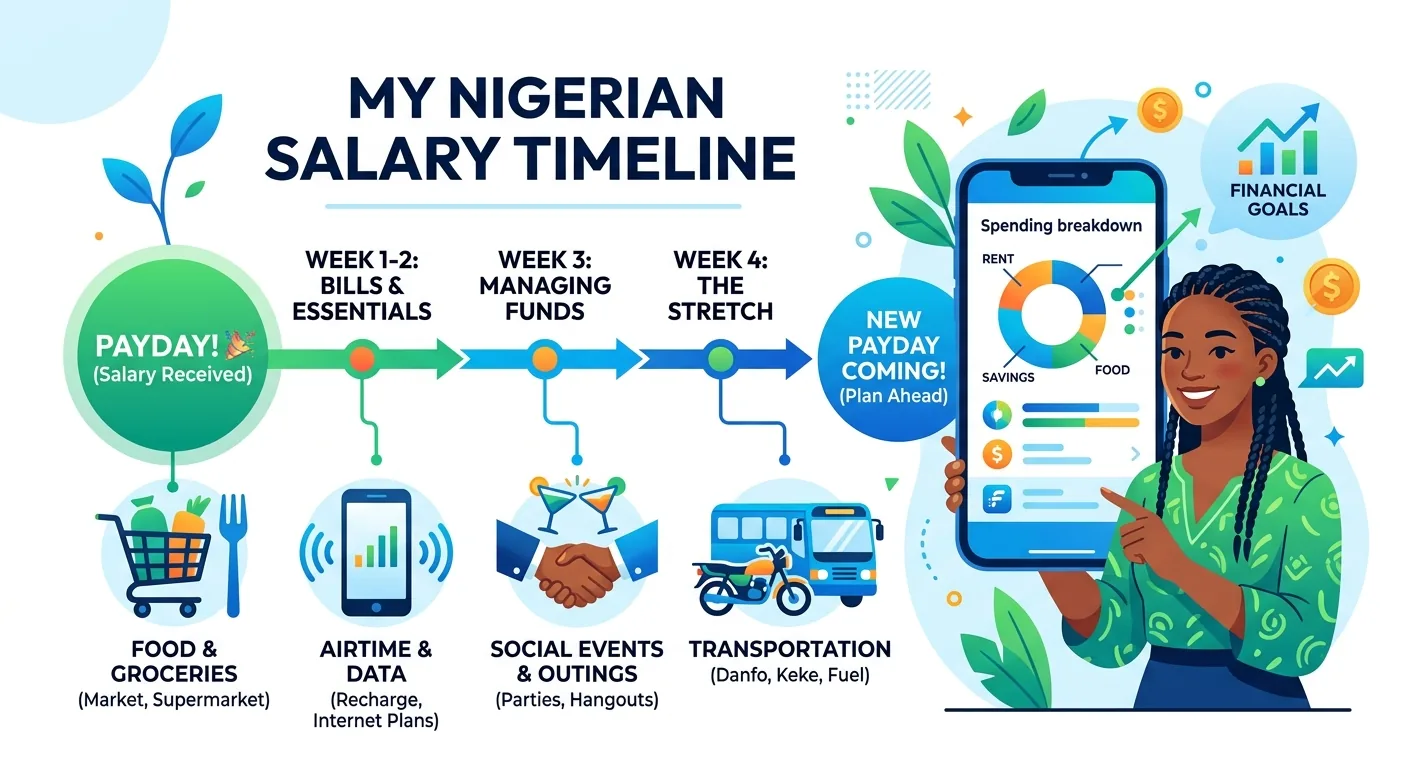
Trap #1 — The “Small Small” Spending Illusion
Here is how this trap works: no single purchase feels significant.
₦300 on bole and fish. ₦150 for pure water. ₦600 for a bike ride you could have walked. ₦500 airtime top-up because the last one finished mysteriously. ₦200 for chin-chin while waiting. ₦1,000 for a movie you watched twice.
Individually, none of these feel like financial decisions. Together, they silently absorb ₦5,000 to ₦12,000 from your monthly take-home — and you would never be able to trace exactly where it went. According to the National Bureau of Statistics (NBS), Nigerian households consistently underestimate discretionary spending by 20 to 35 percent when surveyed about their budgets.
This is what behavioural economists call “death by a thousand cuts” — not one big mistake, but dozens of tiny, untracked ones.
The fix: Track everything for just seven days. Use a notepad, your phone notes, or any free expense tracker. Do not judge. Just write it down. By day seven, patterns will appear that will genuinely shock you.
Trap #2 — Pressure Spending: Aso-ebi, Owambe, and Village Obligations
Nigerian social culture is beautiful — and financially dangerous if you are not intentional.
Aso-ebi for a colleague’s wedding: ₦8,500. Transport to Abeokuta: ₦3,200. Spraying money on the dance floor: ₦5,000. Unbudgeted food and drinks: ₦2,000. That one Saturday wiped ₦18,700 from someone earning ₦85,000 a month — before rent or savings were addressed.
Add December travels, school resumption kitting for younger siblings, the elderly aunt who needs money for her knee, and the neighbour who knows you just got paid — social obligations alone can consume 30 to 40 percent of a modest salary. This distinction between genuine obligation and social pressure disguised as obligation is central to making smart spending decisions in Nigeria’s high-pressure social environment.
The fix: Create a fixed monthly “social budget.” When that amount is spent, you have a ready answer: “I’ve used my social budget this month.” Practise saying it. It is not rude. It is responsible.
Trap #3 — Airtime and Data as Silent Budget Killers
Here is a quick calculation most personal finance guides skip.
₦500 on airtime three times a week = ₦6,000 per month. A ₦2,500 data bundle every two weeks = another ₦5,000. That is ₦11,000 per month on airtime and data alone — over ₦132,000 annually. In 2026, data is not a luxury. But unplanned, reactive buying means you are always paying per-unit rates instead of bundle rates — consistently paying more for the same access.
The fix: Switch to a monthly data and airtime plan that covers your actual average usage. Most Nigerians save ₦2,000 to ₦4,000 per month from this single change alone.
Trap #4 — Eating Out Every Day Because “It’s Just ₦500”
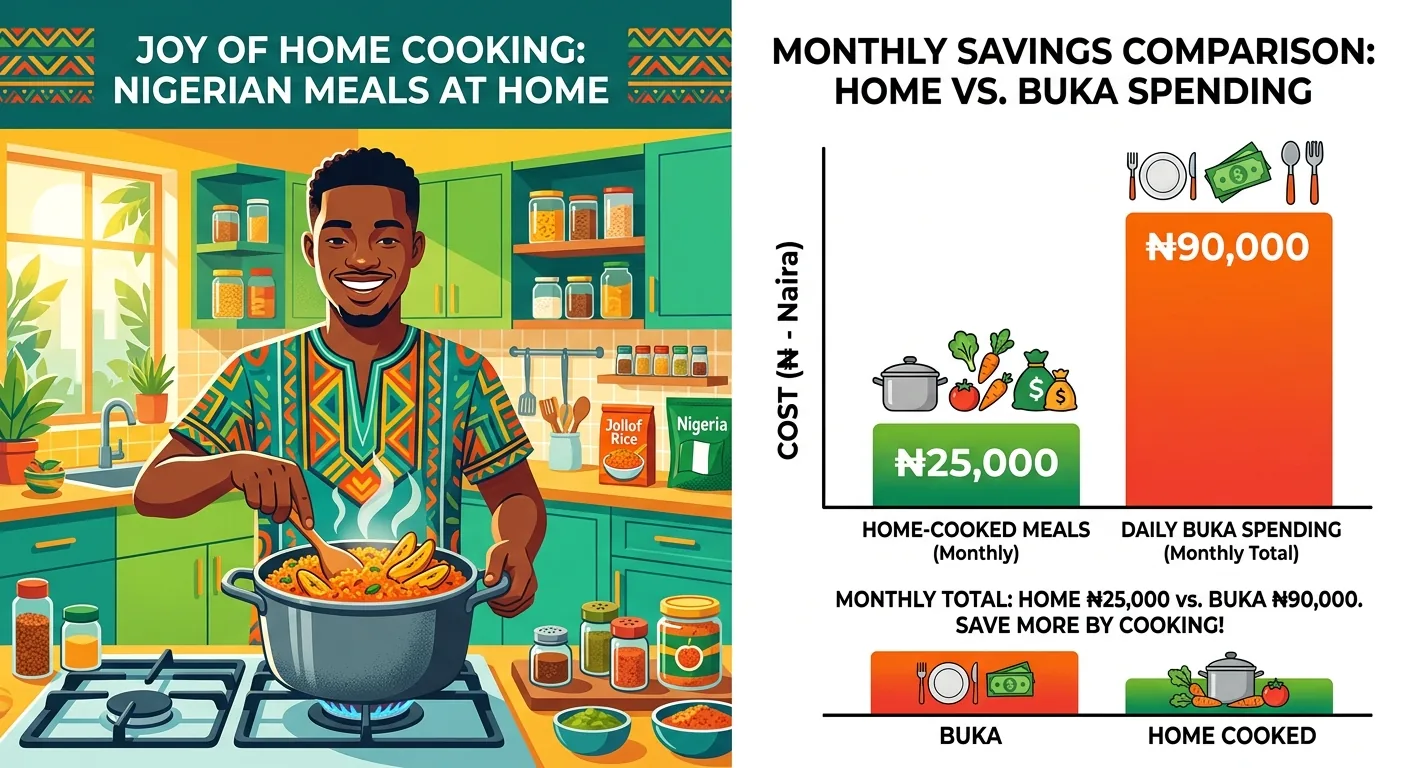
Breakfast from the woman downstairs: ₦500. Lunch at the buka: ₦800. Evening suya: ₦700. That is ₦2,000 in one day — ₦60,000 in a month on food alone. For someone earning ₦80,000, that is 75 percent of their salary before rent or transport.
A pot of jollof rice with chicken that costs ₦5,500 to make at home feeds you for three days. The equivalent in buka meals would cost approximately ₦7,200. The savings are mathematically real and repeatable.
The fix: You do not need to cook every meal. But cooking even half your meals changes the numbers dramatically. Batch cooking on Sundays — rice, stew, beans — saves both money and time. This one habit alone is a cornerstone of smart spending decisions for Nigeria’s urban workforce.
Trap #5 — Paying Loan Interest on Non-Emergencies
This trap is the one that keeps the loan cycle running month after month.
Taking a ₦20,000 loan at 20 percent monthly interest to buy a new earpiece. Taking ₦15,000 because your data finished. Taking ₦30,000 to buy shoes for an owambe. These are not emergencies — they are wants. And when you finance wants with high-interest loans, you are spending tomorrow’s money today AND paying a penalty for doing so.
That ₦20,000 loan at 20 percent interest means you repay ₦24,000. The ₦4,000 lost to interest tightens next month’s budget — which drives you back to borrow again. The Central Bank of Nigeria (CBN) has repeatedly flagged the rapid growth of digital lending and the risk of over-indebtedness among low-to-middle income earners precisely because this cycle is so easy to enter.
The fix: Before any loan, ask: Is this an emergency or a want? Genuine emergencies — hospital bills, rent deadline, transport to work — can justify borrowing. Wants can usually wait 2 to 4 weeks until you have the cash. This single question is one of the most valuable tools for smart spending decisions any Nigerian borrower can apply.
Trap #6 — The “I’ll Balance It Next Month” Lie
Every Nigerian has told themselves this. “I’ll overspend this month and be more careful next month.” But next month arrives with its own rent, its own data bills, its own social obligations. The balance never happens — and what you actually do is carry a permanent deficit that borrowing partially fills each cycle.
Two months of “I’ll fix it next month” and you are carrying debt you cannot see clearly anymore.
The fix: Identify right now — this week — one specific expense you can reduce immediately. Not a vague intention. A specific cut: “I will not buy food outside more than three times this week.” Specificity converts intention into actual behaviour change and is the backbone of real smart spending decisions in Nigeria’s economic environment.
Trap #7 — Keeping Up With People Earning More Than You
Your colleague just bought new AirPods. Your friend upgraded her phone. Your brother sent home ₦50,000 for the family meeting. The pressure to match is real, socially embedded, and one of the most destructive financial habits Nigeria’s working class quietly carries.
The technical term is lifestyle inflation by proxy — your spending inflates not because your income grew, but because visible consumption around you creates pressure to match it. What you do not see: your colleague bought those AirPods on credit. Your friend is three months behind on rent. A 2023 report by EFInA found a significant share of Nigerian adults borrowing from digital lenders were doing so for social and discretionary spending — not emergencies.
The fix: Build your spending decisions around your income, not your peer group’s visible consumption. One useful question before any non-essential purchase: “Would I buy this if nobody I know would ever see it?” If the answer is no, you are buying status, not value.
How to Break the Pattern in 30 Days
You do not need a complicated financial overhaul to start making smart spending decisions in Nigeria. You need five specific, sequenced actions.
Week 1 — Audit. Track every naira for seven days. No filters. Write down everything including ₦50 biscuits and ₦200 for the okada man. Do not budget yet — just observe.
Week 2 — Cut one trap. Review your data. Identify the single trap costing you the most. Focus only on reducing that one leak. Do not try to fix everything at once.
Week 3 — Create three budget lines. Assign a fixed naira amount to: (1) essential bills and food, (2) social and discretionary spending, (3) loan repayments and savings. These three buckets create more clarity than most complex budget templates.
Week 4 — Set a borrowing rule. Write down your personal rule for when borrowing is acceptable before the pressure arrives. Emergency only? Up to what amount? Having the rule documented prevents emotional, reactive decisions that restart the cycle.
By month-end: Review honestly. Even ₦5,000 unspent is ₦5,000 you did not need to borrow — and that is a real win.
For deeper guidance on building healthier financial habits, explore LendSafe’s personal finance resources — designed specifically for the Nigerian borrower who wants to borrow less, not more.
Final Word — Borrow Smart, Spend Smarter
Borrowing is not the enemy. In a country where salaries arrive late and emergencies give no warning, access to fast, transparent credit is genuinely necessary. But the goal is to borrow by choice for real emergencies, not by default because every month runs dry.
When you identify and close even two or three of the spending traps above, something shifts: the loan app stops being the first thing you open at the end of the month. It stays as a backup — which is exactly where it belongs.
LendSafe is built for the moments when real emergencies hit — fast approval, transparent terms, no hidden fees. If you are currently working through a debt cycle and need responsible credit, visit LendSafe here before your next application.
The smartest loan you will ever take is the one you genuinely needed — not the one the end of the month forced you into.
Frequently Asked Questions
Why does my salary finish so fast in Nigeria?
The most common reasons are untracked micro-spending, reactive airtime purchases, pressure spending on social events, and daily food costs that compound faster than most people realise. Most Nigerians are not overspending on one big item — they are leaking money across ten small ones simultaneously.
How can I stop borrowing every month in Nigeria?
Start by identifying which of the seven traps above is your biggest leak. Fix one trap at a time. Create a three-line spending plan and write a personal borrowing rule before you are in a desperate moment. The goal is to make borrowing a decision, not a default.
Is it bad to use loan apps in Nigeria?
Not inherently. Short-term credit tools like LendSafe serve a genuine purpose when used for real emergencies. The problem is using high-interest loans to fund wants and routine expenses — that behaviour directly feeds the debt cycle.
What is a realistic spending plan for someone earning ₦80,000 per month?
A practical framework: 50 percent (₦40,000) for essential needs, 20 percent (₦16,000) for social and discretionary spending, 20 percent (₦16,000) for savings or loan repayments, and 10 percent (₦8,000) as a buffer for unexpected costs. Always allocate savings first — before spending begins. This is the foundation of consistent smart spending decisions for any Nigerian income level.