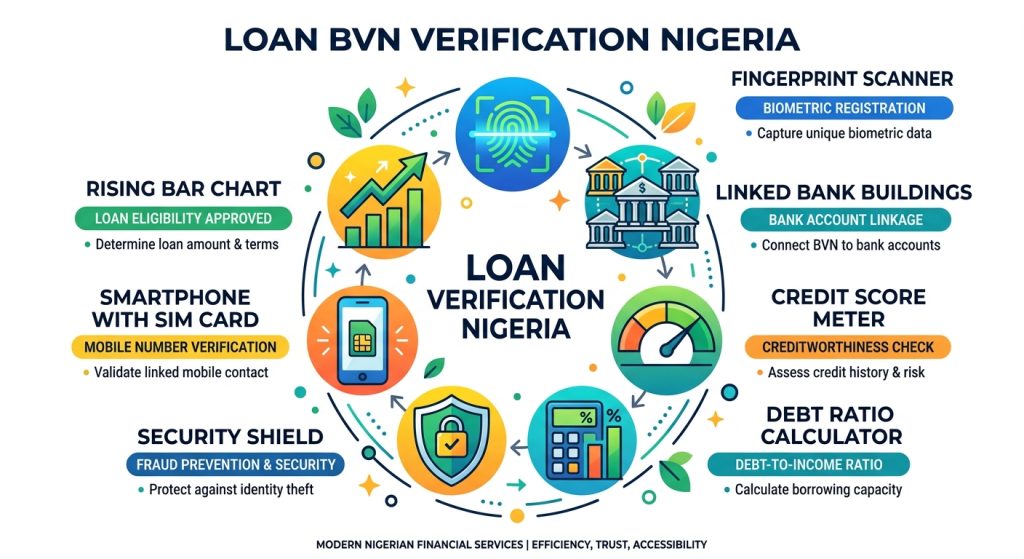
If you have ever applied for a loan in Nigeria and wondered why it took longer than expected — or why you were declined despite having a steady salary — the answer often lies inside your BVN profile. Loan BVN verification Nigeria lenders run is far more thorough than most borrowers realise. Most people focus on their bank balance or salary slip, completely unaware that lenders are running a deep background check through the Bank Verification Number system the moment you hit “apply.”
Your BVN is not just a number. It is a digital identity passport that connects every financial account, transaction, and credit history you have ever had in Nigeria’s banking system. When a lender plugs your BVN into the Nigeria Inter-Bank Settlement System (NIBSS) or a licensed credit bureau, they pull up a detailed picture of your financial life — far beyond what you voluntarily disclose on any application form.
This guide breaks down exactly what lenders see, why it matters, and what you can do to put your best financial foot forward before applying.
Why Loan BVN verification Matters for Applications in Nigeria?
The Central Bank of Nigeria launched the BVN policy in February 2014 under the CBN Circular BSD/DIR/GEN/LAB/06/010. Since then, it has become the backbone of financial identity verification across all Nigerian banks and licensed fintech lenders. By 2023, over 57 million BVNs had been enrolled, according to NIBSS official records.
For lenders, BVN verification serves three core purposes:
- Identity confirmation: Confirming you are who you claim to be
- Credit risk assessment: Evaluating your likelihood of repaying
- Fraud prevention: Checking whether your profile has been flagged for suspicious activity
The CBN Consumer Protection Framework requires all licensed lenders to conduct adequate KYC (Know Your Customer) checks — and BVN verification is the minimum standard. The FCCPC’s Limited Interim Regulatory/Registration Framework for Digital Lending further mandates that digital lenders use verified identity data before disbursing any loan.
Now, here are the seven things lenders check inside your BVN profile that most borrowers never see.
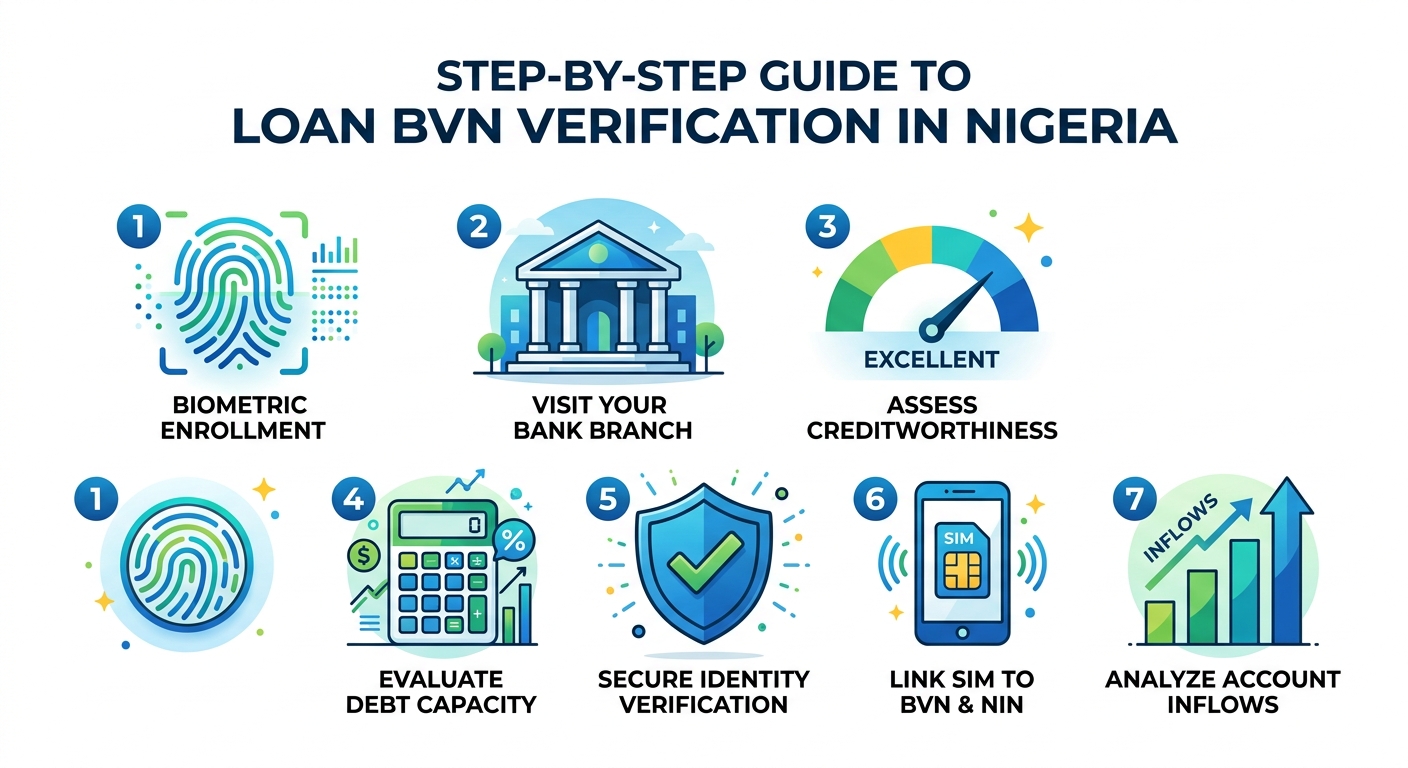
7 Things Lenders Check Via BVN Verification in Nigeria
1. Your Full Identity Data and Biometric Match
What the lender sees:
When a lender queries your BVN, they receive your registered full name, date of birth, phone number, and biometric fingerprint hash. Every detail you entered during BVN enrollment at your bank comes up — and it is cross-matched against what you submitted on your loan application.
What this means for you:
If your application says your name is “Emeka Okafor” but your BVN is registered as “Emmanuel Okafor Chukwu,” the system flags it as a mismatch. Even a middle name discrepancy can trigger a manual review or outright rejection — especially for salary loan applications where your employer’s records must also align.
Practical example:
A salary earner applying for a ₦500,000 personal loan at a Lagos-based fintech discovered her application was delayed for five business days because her BVN had her maiden name while her HR records carried her married name. The fix required a formal name change request at her bank — a process that takes five to ten working days.
Tip: Visit your bank and confirm your BVN name matches every other official document you plan to submit.
2. Your Linked Bank Accounts and Financial Footprint
What the lender sees:
NIBSS connects your BVN to every bank account registered under that number across all financial institutions. Lenders can see how many accounts you have, which banks hold them, and whether any accounts are dormant, restricted, or recently opened.
What this means for you:
A borrower with five active accounts spread across GTBank, Access Bank, Kuda, OPay, and Wema Bank signals financial complexity. Lenders may investigate why you need multiple accounts. Conversely, a salary earner with a single, active account receiving consistent monthly credits is seen as stable and easier to assess.
Practical example:
A borrower who opened a new account two weeks before applying for a ₦300,000 loan and moved their salary into it will raise an alert. Lenders want to see at least three to six months of salary history in the account they are assessing.
3. Your Credit History Across All Bureaus
What the lender sees:
Nigeria has three licensed credit bureaus: CRC Credit Bureau, First Central Credit Bureau, and CreditRegistry. Your BVN is the key that unlocks your credit report across all three. Lenders see your entire loan history — every loan you have taken, every missed payment, every default, and every restructured facility across all lenders, not just the one you are currently applying to.
What this means for you:
If you took a ₦50,000 loan from a microfinance bank in 2021 and defaulted, that information lives in the credit bureau system tied to your BVN. A salary loan lender checking your BVN in 2025 will still see it. CBN’s credit bureau framework requires bureaus to retain negative information for seven years.
Positive impact: A clean repayment history on a ₦200,000 loan previously repaid over 12 months significantly boosts your creditworthiness and can unlock higher loan amounts or lower interest rates.
4. Existing Loan Obligations and Debt-to-Income Ratio
What the lender sees:
Beyond credit history, lenders check your active loan portfolio — every loan you are currently servicing. This includes buy-now-pay-later (BNPL) facilities, mobile loans from apps, bank overdrafts, and corporate loans. The system aggregates your total monthly repayment obligations.
What this means for you:
Most Nigerian salary lenders apply the one-third rule — your total loan repayment obligations should not exceed one-third of your net monthly income. If you earn ₦180,000 net and are already repaying ₦70,000 monthly across two existing loans, a new lender offering you another ₦100,000 loan at ₦35,000/month will likely decline because your total obligations (₦105,000) would exceed the 33% threshold set by CBN guidelines for salary-deductible loans.
5. Blacklist and Watchlist Status
What the lender sees:
Your BVN is cross-referenced against the CBN’s watchlist, the NIBSS blacklist for fraud-related accounts, and internal lender databases that share information on defaulters. If your BVN appears on any of these lists, the verification process stops immediately.
What this means for you:
Being blacklisted is not always about intentional fraud. Some borrowers are flagged because a loan app reported them after a legitimate dispute, or because their account was used in a suspicious transaction they were unaware of. Once blacklisted, no CBN-regulated lender can legally disburse funds to you without further investigation.
How to check: Request a formal status inquiry at your bank or contact NIBSS directly to verify your BVN status before applying for any loan.
6. Phone Number Consistency and SIM Registration
What the lender sees:
Your BVN has a registered phone number. Lenders cross-check whether the phone number on your application matches your BVN-registered number and whether that number is active, SIM-registered, and consistent across platforms. This is particularly important for digital lenders who send OTPs and repayment reminders to that number.
What this means for you:
Nigeria’s NIN-SIM linkage policy means your phone number is now tied to your National Identification Number (NIN), which further connects to your BVN. A mismatch — for example, using your wife’s number on the application but having a different number on your BVN — triggers a fraud flag.
Practical example:
A borrower applying for a ₦150,000 quick loan via a fintech app was rejected because he had changed his phone number without updating his BVN. He received no OTP and the lender’s system could not authenticate him.
7. Transaction Behaviour and Account Inflows
What the lender sees:
With open banking and account statement analysis tools, many modern lenders go beyond BVN to request your bank statement or use bank statement APIs (like Mono or Okra) that connect to your BVN-linked accounts. They analyse your average monthly inflows, spending patterns, cash-out frequency, and whether your salary is consistent.
What this means for you:
A borrower who earns ₦250,000 monthly but withdraws the entire amount in cash within 48 hours every month is harder to assess than one who keeps a running balance and uses transfers. Lenders want to see financial management, not just income.
Positive behaviour signals:
– Regular salary credit on the same date each month
– Utility bill payments via direct debit
– Savings deposits or investment transfers
– Low frequency of failed debit attempts
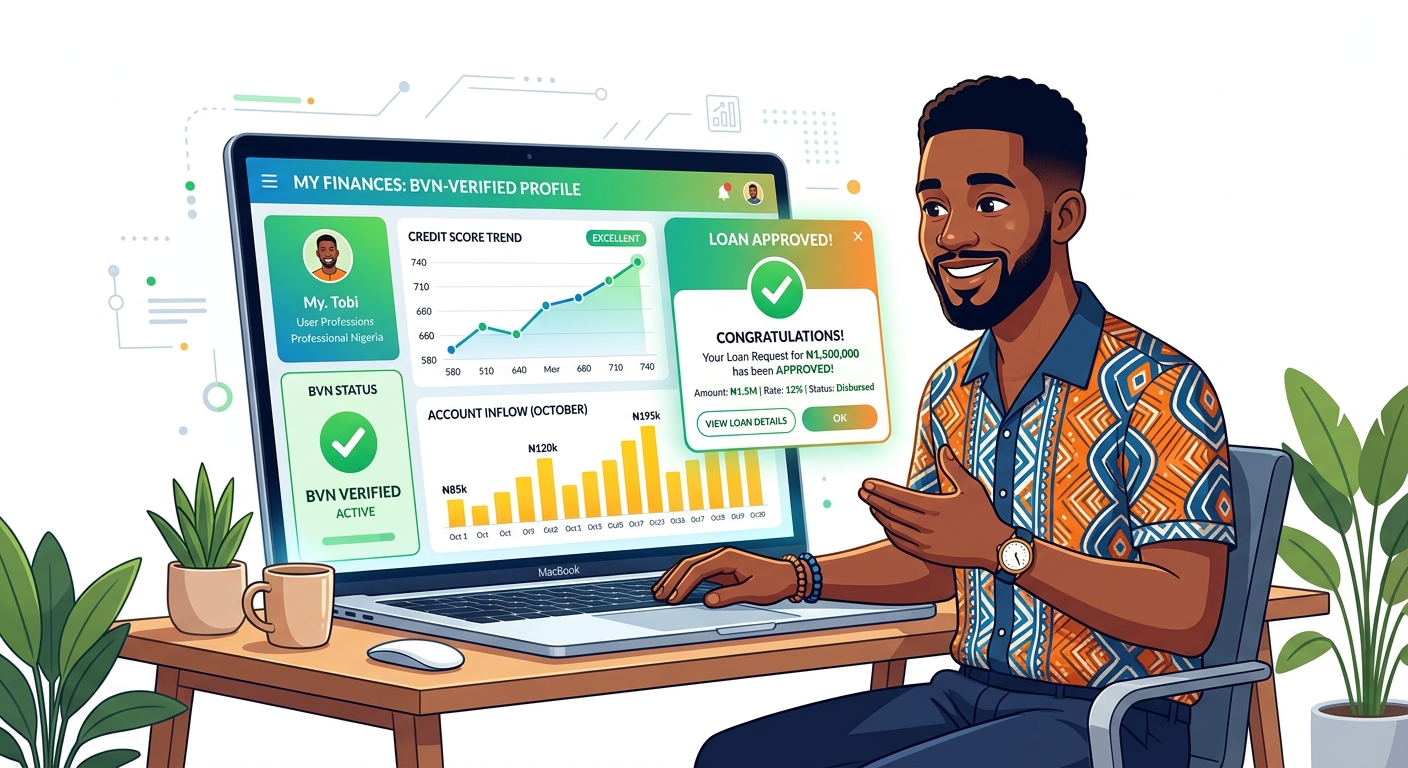
How to Prepare Your BVN Profile Before Applying
Getting loan-ready in Nigeria is not about gaming the system — it is about ensuring your financial profile accurately reflects your true creditworthiness. Here are practical steps:
1. Verify your BVN details are correct
Dial *565*0# on your registered line to check your BVN. Then walk into your bank and request a BVN data printout. Check that your name, date of birth, and phone number are all accurate and match your official documents.
2. Pull your credit report before your lender does
You are entitled to one free credit report per year from any of the three licensed bureaus. Visit CRC Credit Bureau or CreditRegistry. Review your report for errors, disputed accounts, or outdated information.
3. Clear any outstanding loan defaults
If you have defaulted on any loan — even a small ₦10,000 mobile loan — contact the lender, negotiate a settlement, and request a written confirmation of repayment. Settlements take 30 to 90 days to reflect positively on your bureau report.
4. Consolidate multiple accounts
If you have dormant accounts linked to your BVN, formally close them at the respective banks. A clean, focused banking profile is easier for lenders to assess and demonstrates financial discipline.
5. Stabilise your salary account
Ensure your employer pays your salary into one consistent account for at least three consecutive months before applying. Avoid switching salary accounts close to a loan application.
6. Update your BVN-linked phone number
If you have changed your number, visit your bank immediately with your NIN, old and new SIM cards, and a valid ID to update your BVN-registered phone number.
7. Use a reputable loan comparison platform
Before submitting multiple applications (which create multiple credit inquiries that can lower your score), use a trusted aggregator. Visit SmartLoans.ng to compare verified lenders and find the best rates for your profile without unnecessary bureau hits.
Common Reasons BVN Verification Fails — and How to Fix Each
| Reason | What Happens | Fix |
|---|---|---|
| Name mismatch | Application stalls or gets rejected | Update BVN name at your bank; takes 5–10 working days |
| Outdated phone number | OTP not delivered; identity unverifiable | Visit bank with NIN and new SIM to update |
| Active default on credit bureau | Instant decline by most lenders | Settle the debt and request bureau update from lender |
| BVN not linked to the account | Verification cannot proceed | Link BVN to all active accounts via your bank’s app or branch |
| Watchlist/blacklist status | Automatic rejection | File a formal dispute with NIBSS and the reporting lender |
| Thin credit file (no history) | Lender cannot assess creditworthiness | Start with a small secured loan or credit-builder product |
| Multiple recent applications | Too many bureau inquiries lower your score | Space out applications by at least 90 days |
Final Thoughts: Your BVN Is Your Financial Reputation
Loan BVN verification in Nigeria is not a bureaucratic hurdle — it is a comprehensive financial health check that tells lenders far more about you than your payslip ever could. The borrowers who consistently get approved for the best loan terms are not necessarily the highest earners. They are the ones who understand what lenders are looking for and maintain their BVN profile accordingly.
Before your next loan application, invest an hour into reviewing your BVN data, pulling your credit report, and cleaning up any discrepancies. That one hour could mean the difference between a ₦1,000,000 approval at 18% per annum versus a rejection — or worse, a predatory loan from an unregistered lender.
For a curated list of CBN-licensed and FCCPC-registered lenders in Nigeria, visit SmartLoans.ng and compare your options before you commit.
Sources: CBN BVN Policy Framework | NIBSS BVN Enrollment Data | FCCPC Digital Lending Framework
Disclaimer: This article is for educational purposes only. Interest rates and regulatory thresholds are subject to CBN policy updates. Always verify current terms with your chosen lender.