The Number Deciding Your Loan Fate Right Now — And You Probably Don’t Know It
You apply for a loan on a Friday evening. Your electricity bill is overdue. Rent is seven days away. You fill the form, submit your BVN, and wait.
Declined.
No reason given. Just a polite message saying your application was “unsuccessful at this time.”
What just happened? In most cases, a credit bureau report happened. A lender pulled your credit score Nigeria profile — a number built quietly from your entire financial history — and that number did not pass their internal threshold. You never saw it. Nobody called to explain. The decision was made in seconds, and you were left confused.
This is the daily reality for millions of Nigerians in 2026. Credit bureaus have been operating in Nigeria since 2008, collecting data from commercial banks, microfinance institutions, mobile lenders, and now FCCPC-registered fintech loan apps. Your repayment history, your outstanding balances, and how many times lenders have queried your profile — all of it is sitting inside a database right now.
The smart move is not to wait until you get declined. The smart move is to check your credit score Nigeria today, understand exactly what it means, and know how to fix what is dragging it down. This guide covers all of that — including the step-by-step process for checking both CRC and FirstCentral bureaus.
What Is a Credit Score and Why It Matters More in Nigeria Today
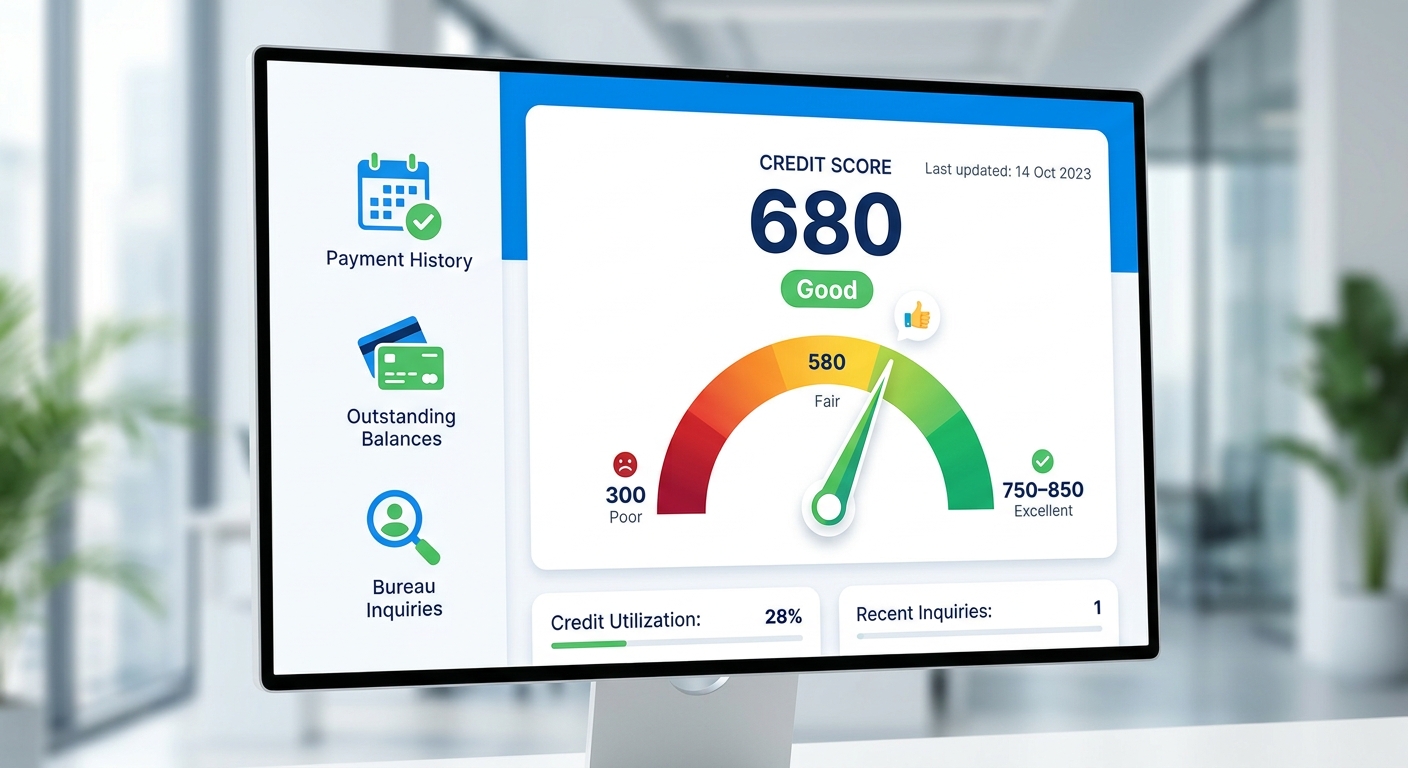
A credit score Nigeria lenders reference is a three-digit number that summarizes your borrowing and repayment history. In Nigeria, scores typically range from 300 to 850, though different bureaus apply slightly different scoring models.
The higher your score, the lower the risk you appear to lenders. The lower your score, the harder — and more expensive — it becomes to borrow.
Here is why your credit score Nigeria matters significantly more in 2026 than it did five years ago:
- The Central Bank of Nigeria (CBN) has mandated all licensed lenders — commercial banks, microfinance banks, and FCCPC-registered loan apps — to report customer data to accredited credit bureaus, dramatically expanding the volume and accuracy of data in the system.
- Fintech lenders who previously approved loans based purely on BVN are now cross-referencing bureau data before disbursement.
- Even loan apps advertising “instant approval, no collateral” are running soft or hard bureau checks in the background without explicitly disclosing it.
- According to the National Bureau of Statistics (NBS) Financial Inclusion Survey, over 38 million Nigerian adults have accessed formal or semi-formal credit products — meaning tens of millions of Nigerians now have a credit footprint, whether they know it or not.
- A single default from 2022 can still appear on your report today if it was never formally resolved with the reporting lender.
This system is not designed purely to punish borrowers. When you understand how your credit score Nigeria is built, you can actively use that knowledge to your advantage — shaping a profile that makes lenders compete to approve you.
Who Actually Holds Your Credit Data in Nigeria
Three credit bureaus are currently licensed by the CBN to operate in Nigeria. Each collects data from overlapping but not identical sets of lenders.
1. CRC Credit Bureau
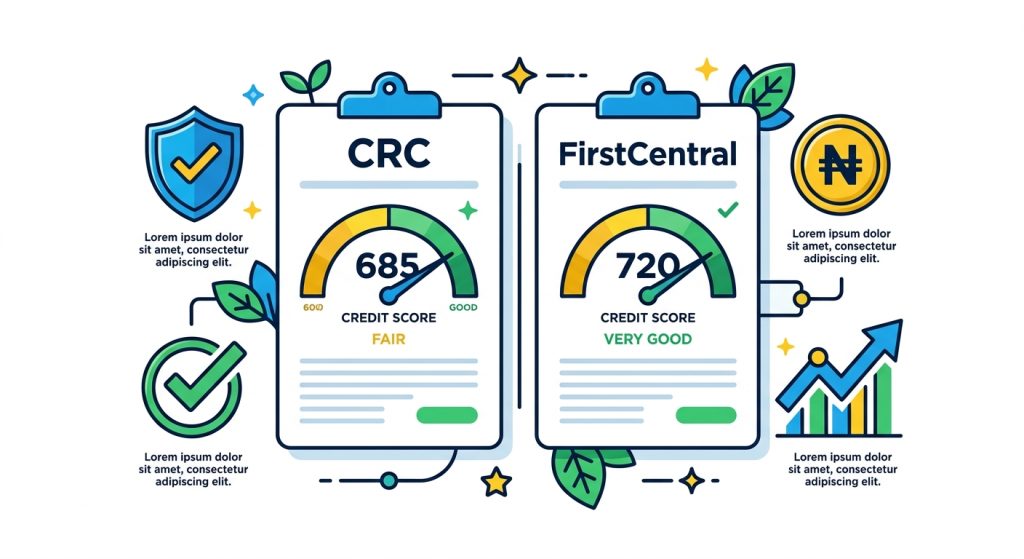
The largest and most widely integrated bureau in Nigeria. Commercial banks, mainstream microfinance institutions, and a large share of fintech lenders report to CRC. If you have ever taken a formal loan from a Nigerian bank, your credit score Nigeria data almost certainly exists here. CRC is the bureau most Nigerian lenders query first.
🔗 crc.com.ng
2. FirstCentral Credit Bureau
The second major bureau. Used heavily by digital lenders, salary-advance platforms, and cooperative lenders. Many lenders report to both CRC and FirstCentral simultaneously, meaning your profile may exist on both with slightly different information.
🔗 firstcentralcreditbureau.com
3. CreditRegistry
Smaller but CBN-accredited. Less commonly queried by everyday retail lenders, but still active and still holding data.
🔗 creditregistry.ng
The practical rule: Check both CRC and FirstCentral. Do not assume that because you look clean on one bureau, your credit score Nigeria profile is clean on the other. A missed repayment reported by one lender may only appear on the bureau that specific lender reports to — and lenders who query both will see both pictures.
Credit Score Ranges in Nigeria — What Your Number Actually Means
While each bureau uses a slightly different scoring model, the general framework across Nigerian credit bureaus works as follows:
| Score Range | Classification | What It Means for Borrowing |
|---|---|---|
| 750 – 850 | Excellent | Easy approvals, best interest rates, high credit limits |
| 670 – 749 | Good | Most lenders approve; competitive loan terms available |
| 580 – 669 | Fair | Some lenders approve with conditions or higher rates |
| 500 – 579 | Poor | Difficult approvals; high interest rates; low limits |
| 300 – 499 | Very Poor | Most lenders decline; alternative-data lenders apply |
The “thin file” problem: If you have never borrowed formally — no bank loan, no registered loan app, no bureau-linked cooperative — your credit score Nigeria may be zero or simply absent. Lenders call this a thin file. Thin-file borrowers face near-identical challenges to low-score borrowers because lenders cannot assess their repayment risk.
Real calculation example: If you borrowed ₦100,000 from a licensed microfinance bank, repaid every installment on time over 6 months, and the lender reported each payment correctly to CRC — that single loan, cleanly repaid, can shift a thin file into the 580–620 range. That is enough to qualify for larger products with better terms.
How to Check Your CRC Credit Report — Step by Step
Under CBN regulations, every Nigerian consumer is entitled to access their credit score Nigeria information. CRC offers both free and paid report options. Here is exactly how to get yours:
Step 1: Visit crc.com.ng from your phone browser or desktop
Step 2: Navigate to “Consumer Credit Report” in the individual section
Step 3: Register with your full legal name, BVN, active email address, and phone number
Step 4: Verify your identity via OTP sent to your BVN-registered phone number
Step 5: Request your credit report — the basic consumer version is free once per year under CBN consumer protection guidelines
Step 6: Download or view the full report
What your CRC report will show:
– A complete list of all credit accounts linked to your BVN
– Repayment history on each account (paid on time, 1–30 days late, 31–60 days late, 60+ days late, written off)
– Outstanding balances on active accounts
– Hard inquiry log — every lender who has pulled your file, with timestamps
– Adverse markers: defaults, write-offs, and collection referrals
Read every single line. Errors on Nigerian credit reports are more common than most people expect, and each undetected error is silently costing you loan approvals.
How to Check Your FirstCentral Credit Report — Step by Step
Step 1: Visit firstcentralcreditbureau.com
Step 2: Select the “Individual” category and create an account
Step 3: Enter your BVN, full legal name, and contact details
Step 4: Verify your identity via OTP
Step 5: Access and download your consumer credit report
FirstCentral’s interface differs slightly from CRC’s, but the data structure is comparable. Review for the same key items: account history, repayment behavior, outstanding amounts, lender inquiry log, and adverse markers.
Important tip: Pull both reports on the same day and download PDFs immediately. Comparing reports from different dates introduces inconsistencies. If you find an account on FirstCentral that does not appear on CRC — or vice versa — note it specifically. It tells you which lender reported where and which bureau you need to contact if you need to dispute that entry.
What Lenders Actually See When They Pull Your Report
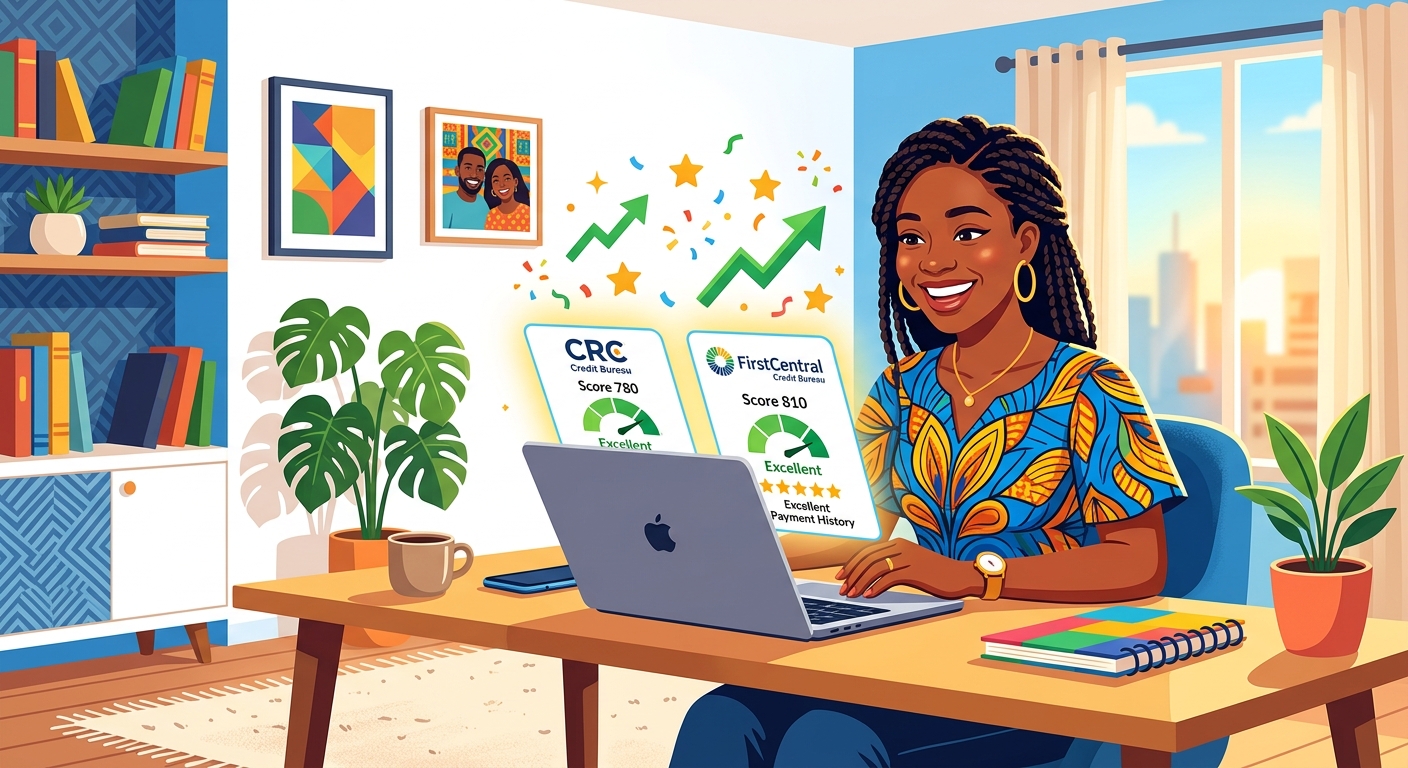
When a lender — whether a commercial bank or a loan app — queries your credit score Nigeria profile, they receive far more than just a number. Here is the full picture:
1. Your credit score
The three-digit summary of your overall repayment risk at the moment of query.
2. Your credit account history
Every registered loan you have taken: lender name, loan amount, disbursement date, repayment schedule, and current payment status.
3. Your inquiry history
Every hard inquiry is logged with the date. If you applied to ten loan apps in one week, every subsequent lender can see that activity. Multiple inquiries within 30 days can knock 15–25 points off a mid-range credit score Nigeria lenders already consider borderline.
4. Debt-to-obligation ratio
Total unpaid debt across all active accounts. A borrower earning ₦150,000/month with ₦120,000 in active obligations is a far higher risk than one with ₦20,000 in obligations — regardless of score.
5. Adverse information
Defaults, write-offs, court judgments linked to debt, and collection referrals. Under current CBN guidelines, adverse information can remain on your credit score Nigeria file for up to seven years unless successfully disputed and removed.
The picture lenders see is far more detailed than most Nigerians imagine. A loan app you used in 2021 and deleted is almost certainly still visible on your file today.
5 Things Hurting Your Credit Score Nigeria Without You Knowing
1. That loan app you borrowed from once and deleted
Deleting the app does not close the account. If there was a disputed final installment, a system-generated fee, or a repayment timing error, the account may show as delinquent on your bureau report right now.
2. Letting someone borrow using your BVN
Your BVN is your credit identity in Nigeria. If another person borrowed using your BVN — even with your permission — every repayment failure on that loan is permanently attached to your credit score Nigeria profile.
3. Applying to multiple lenders simultaneously
Each hard inquiry reduces your score slightly. Ten applications in one month can meaningfully damage a borderline credit score Nigeria and make every subsequent approval harder.
4. Loan rollovers recorded as new loans
Some lenders record rollovers as entirely new loan accounts rather than extensions. Your bureau report may show three or four separate active accounts when you believed you had one ongoing loan, inflating your apparent debt load.
5. Closed accounts with residual charges
Accounts technically marked “closed” but with small outstanding fees, penalty charges, or accrued interest continue to age negatively on your report. A ₦500 platform fee left unpaid on a ₦30,000 loan you fully repaid can flag an account as unresolved for years — silently dragging your credit score Nigeria down.
How to Dispute Wrong Information on Your Credit Report
Errors on Nigerian credit reports are not rare — they are common. A loan you repaid fully showing as outstanding, a lender you do not recognize, a BVN mis-match — these happen across both major bureaus.
Disputing on CRC:
– Log into your CRC consumer account
– Navigate to the “Dispute” or “Challenge Information” section
– Submit the specific item you are challenging with supporting documentation: bank transfer receipts, app payment confirmations, loan closure letters from the lender
– CRC is required under CBN Credit Reporting Regulations to investigate and respond within 21 working days
– If the lender confirms the error, CRC must update your record within that period
Disputing on FirstCentral:
– Log in and locate the dispute submission section
– Provide the specific incorrect entry details and all supporting evidence
– Follow up at 21 working days if no response has been received
The single most important habit: Keep all repayment evidence indefinitely. Bank alerts, in-app receipts, email confirmations, screenshots — save everything. Nigerian bureau dispute processes are entirely evidence-driven; without documentation, disputes rarely succeed. A dispute that clears one adverse entry can meaningfully lift your credit score Nigeria into a better tier.
Your Credit Score Nigeria Is Low But You Need a Loan Today — Here Is What to Do
A low credit score Nigeria does not mean zero options. It means you need to be deliberate and strategic.
Option 1: Use a lender that weighs alternative data
Several licensed Nigerian lenders do not rely solely on bureau scores. They assess your bank transaction history, BVN-linked account behavior, income patterns, and repayment track record on their own platform. Your credit score Nigeria matters less here than your demonstrable current financial behavior.
Option 2: Borrow a smaller amount first and repay perfectly
If your score sits in the 480–550 range, applying for ₦200,000 and getting declined repeatedly makes your file worse. Apply for ₦30,000–₦50,000 from a lender that assesses alternative data, repay every installment on time or early, and let that clean record improve your bureau profile over 60–90 days.
Real calculation: A borrower with a 510 credit score Nigeria who takes a ₦40,000 loan and repays all four bi-weekly installments on time can realistically move to the 555–580 range within two months — crossing into the “Fair” tier where significantly more lenders and better rates become accessible.
Option 3: Resolve the specific negative item before applying
If your report shows one specific default with one specific lender, contact that lender directly. Settle the outstanding amount, collect written confirmation of account closure, and formally request they update your bureau entry. This targeted action can shift your credit score Nigeria measurably within 30–60 days of the update being submitted.
Option 4: Stop all unnecessary hard inquiries immediately
Every declined application adds another hard inquiry to your file. Pause. Pull your reports from both bureaus. Identify the specific items dragging your score down. Fix what is fixable. Then apply to one lender whose profile matches your current situation. Scattering applications across ten platforms simultaneously makes a weak credit score Nigeria substantially worse.
Check Your Score. Know What Lenders See. Then Borrow Intelligently.
Your credit score Nigeria is not a life sentence — it is a snapshot. A snapshot you can understand, challenge, and improve with deliberate action.
The first step is information. Pull your CRC and FirstCentral reports today. Read every line. Dispute every error with documentation. Stop the behaviors that silently lower your score. And when you are ready to borrow, choose a lender that sees your full financial picture — not just a three-digit number.
Every section of this guide gives you a concrete action:
– Check your CRC credit score Nigeria report at crc.com.ng
– Check your FirstCentral report at firstcentralcreditbureau.com
– Dispute errors within 21 working days using documented evidence
– Repay small loans cleanly to rebuild a damaged or thin profile
– Apply to lenders who use alternative data when your score is in recovery
The Nigerian credit system is more sophisticated than most borrowers realize — which means borrowers who understand their credit score Nigeria hold a genuine advantage over those who do not.
Frequently Asked Questions
Q: Is my credit score Nigeria the same across CRC and FirstCentral?
Not necessarily. Each bureau builds your score from the data it receives from the lenders that report to it. If different lenders report to different bureaus, your scores can differ meaningfully between them.
Q: Does checking my own credit report lower my score?
No. Checking your own report is a soft inquiry and does not affect your credit score Nigeria. Only hard inquiries — generated when a lender formally queries your file for a credit decision — affect your score.
Q: How long does a default stay on my Nigerian credit report?
Under CBN credit reporting guidelines, adverse information including defaults and write-offs can remain on your credit score Nigeria file for up to seven years from the date of the adverse event, unless successfully disputed and removed earlier.
Q: Can I build a credit score if I have never borrowed before?
Yes. Taking a small loan from a CBN-licensed lender that reports to a credit bureau and repaying it cleanly is the most direct method to build a credit history from a zero or thin-file position.
Q: What BVN information appears on my credit report?
Your BVN serves as the unique identifier linking your identity to your credit accounts. It is used as a matching key to pull all accounts associated with your identity across the Nigerian credit score system.
This article is for educational purposes only. LendSafe is a licensed digital lending platform. All loan applications are subject to individual eligibility assessment. Borrow only what you can realistically repay.