You borrowed from three apps. Now all three want their money on different dates. Here is the only plan that gets you out.
The right loan repayment strategies Nigeria borrowers actually stick to depend on psychology as much as mathematics. This guide covers both proven methods in full — with real naira numbers.
You Are Not Alone — But You Are Running Out of Time
Picture this: It is the 18th of the month. Your Opay wallet just got debited ₦8,400 by one loan app. Your phone shows a missed call from a number you recognise as a recovery agent. A third app — the one you used for school fees last month — sends a push notification: “Your repayment of ₦12,500 is due in 3 days.”
Your salary hits on the 25th.
This is not a hypothetical. This is the daily reality for hundreds of thousands of Nigerians juggling two, three, sometimes four personal loan apps simultaneously. The loans were not taken carelessly — they were taken for real reasons: hospital bills, rent, a broken phone, school fees. But repayments stack fast, and before long you are borrowing from App B to repay App A, then from App C just to stay afloat.
There is a way out. It requires a written plan, not willpower alone. That plan is built on proven loan repayment strategies — and the two most effective worldwide are the Snowball Method and the Avalanche Method.
Step One: Take a Full Inventory of Every Loan You Owe
Before applying any loan repayment strategies Nigeria borrowers use, you must know precisely what you are dealing with. Open your notes app right now and record every active loan with four details:
- Lender name (e.g., PalmCredit, Carbon, FairMoney, Branch)
- Outstanding balance — what you still owe today
- Monthly interest rate — check the app dashboard or your original loan agreement
- Next due date — when is the next automatic debit scheduled?
Here is what a realistic multi-loan picture looks like for Emeka, a civil servant earning ₦95,000 per month in Lagos:
| Loan App | Balance Owed | Monthly Rate | Due Date |
|---|---|---|---|
| App A (FairMoney) | ₦15,000 | 12% | Sep 22 |
| App B (PalmCredit) | ₦40,000 | 9% | Sep 28 |
| App C (Branch) | ₦8,500 | 7% | Oct 1 |
| App D (Carbon) | ₦60,000 | 8% | Oct 5 |
Total debt: ₦123,500
Total monthly interest generated if nothing is paid ahead: approximately ₦13,000+, with App A alone adding ₦1,800 every single month at 12%.
This is the battlefield. Now let us talk about fighting your way out.
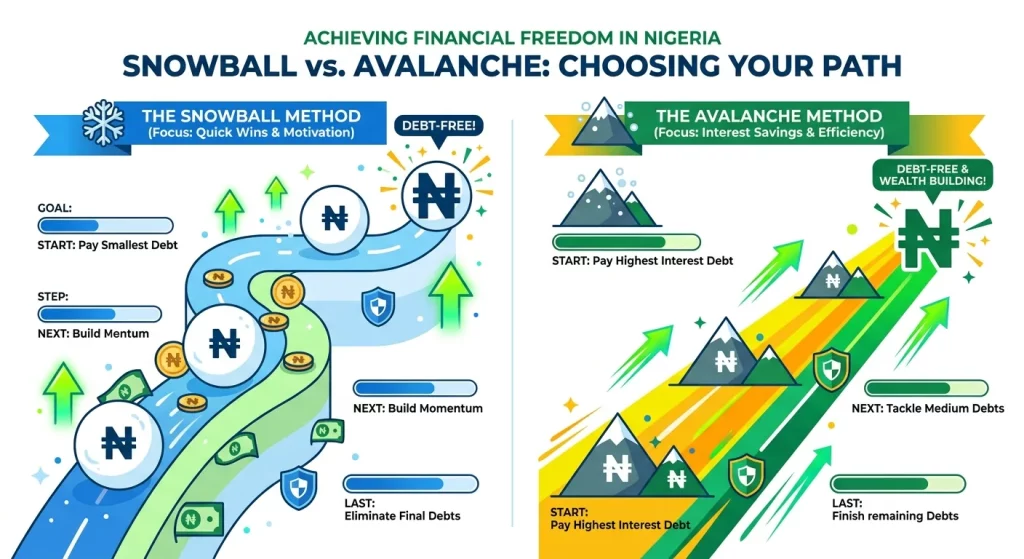
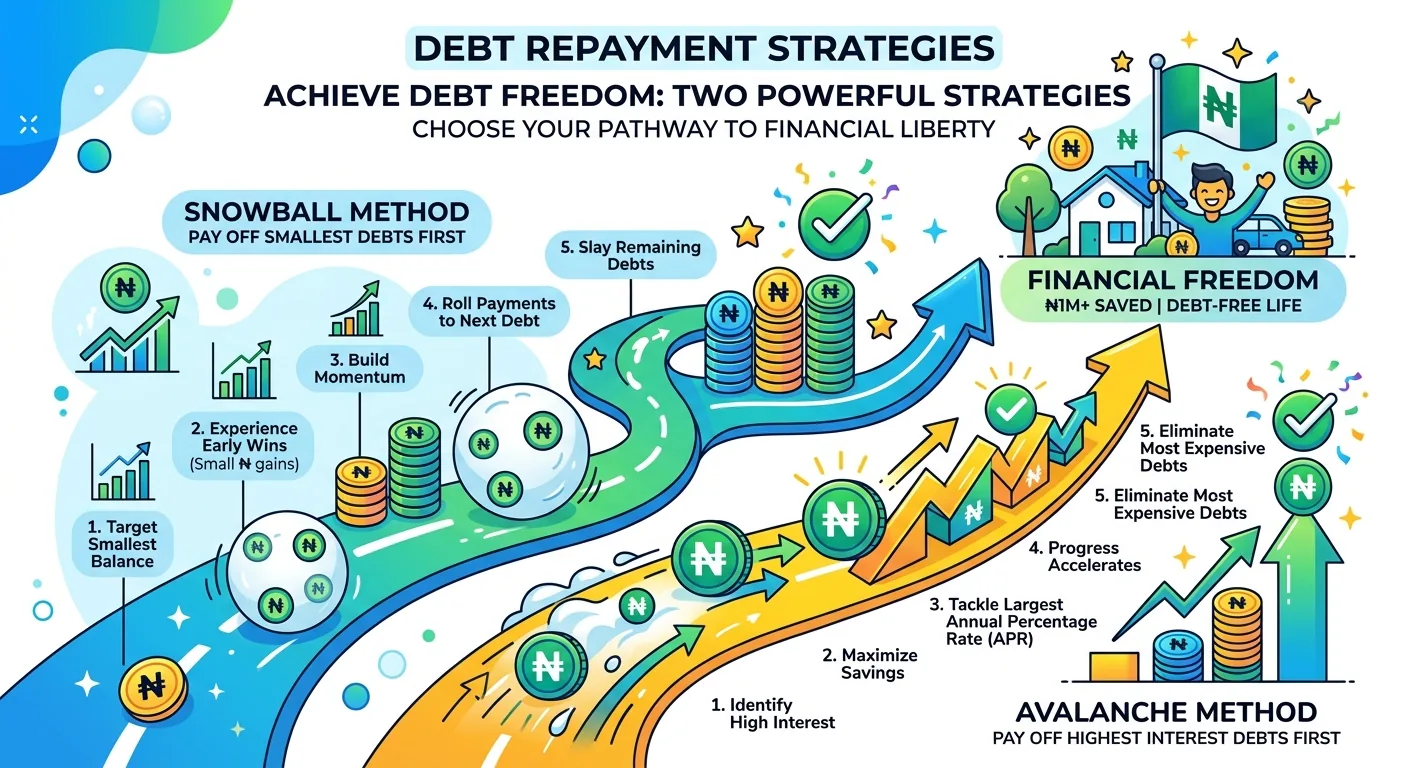
The Snowball Method: Small Wins First
The Snowball Method works on one core psychological principle: early wins create unstoppable momentum.
How it works:
– List your loans from smallest balance to largest — ignore interest rates entirely
– Pay the minimum required on every loan except the smallest
– Direct every extra naira toward that smallest loan
– Once cleared, redirect all payments to the next smallest
– Repeat until all debts are gone
Applied to Emeka’s situation — Snowball order:
1. App C — ₦8,500 ← attack this first
2. App A — ₦15,000
3. App B — ₦40,000
4. App D — ₦60,000
Emeka has ₦18,000 left after rent, transport, food, and minimum repayments. He throws ₦9,500 extra at App C. It is cleared in one cycle. That is one fewer debit date, one fewer recovery call, one fewer push notification draining his mental energy.
Snowball advantage: Psychological relief. As one of the core loan repayment strategies Nigeria borrowers actually complete, Snowball works because eliminating even one lender removes a real pressure point and sustains motivation to continue.
Snowball disadvantage: You may eliminate the smallest loan even when it carries the lowest interest rate — meaning you pay more total interest compared to the Avalanche method. The emotional win carries a mathematical cost.
The Avalanche Method: Let the Maths Win
The Avalanche Method is the mathematically superior approach among loan repayment strategies. It targets the loan carrying the highest interest rate first, regardless of balance size.
How it works:
– List your loans from highest interest rate to lowest
– Pay minimums on all loans except the highest-rate one
– Pour every extra naira into that high-rate loan
– Once cleared, attack the next highest rate
– Repeat until debt-free
Applied to Emeka’s situation — Avalanche order:
1. App A — 12% rate ← attack first, even though balance is only ₦15,000
2. App B — 9% rate
3. App D — 8% rate
4. App C — 7% rate (cleared last despite being the smallest balance)
By prioritising the 12% loan, Emeka stops the fastest-growing debt from compounding further. Over a realistic 4-month repayment horizon, the Avalanche method saves him an estimated ₦3,200 to ₦5,800 in total interest — a meaningful amount on a ₦95,000 salary.
Avalanche advantage: Pure cost savings. In Nigeria, where monthly loan rates of 8–15% are standard across licensed digital lenders, high-rate debt compounds aggressively. The Avalanche method cuts that compound growth at the root.
Avalanche disadvantage: Progress feels invisible when the highest-interest loan is not the smallest balance. Emeka might spend six weeks attacking App A before clearing it while three other apps remain active. Slow visible progress is the number-one reason Nigerians abandon structured repayment plans.
The Honest Nigerian Verdict: Which Strategy Should You Use?

Here is the direct answer most financial content avoids when discussing loan repayment strategies Nigeria borrowers face:
If you are disciplined and trust the numbers → use Avalanche.
If you are emotionally exhausted and need early proof it is working → use Snowball.
If you are uncertain → start with Snowball to build momentum, then switch to Avalanche once you have cleared two small loans.
This hybrid approach works particularly well because the emotional weight of multi-app debt in Nigeria is measurable, not just anecdotal. Being harassed by recovery agents, having your contact list called, watching your CRC Credit Bureau score deteriorate — these create genuine anxiety that derails even the most logical plan.
According to a 2023 EFInA Access to Finance survey, over 40% of Nigerian digital loan borrowers reported holding more than one active loan simultaneously. Of those, the majority cited inability to track repayment dates — not inability to repay — as a key driver of default. Structure, not income, is often the missing piece.
Research from sub-Saharan Africa also shows that borrowers who achieved at least one full payoff in their first month of a structured plan were 63% more likely to complete their entire repayment journey. That is the Snowball effect, quantified.
The best debt repayment plan in Nigeria is ultimately the one you execute consistently.
Where Does the Extra Naira Actually Come From?
Both loan repayment strategies require directing extra money at your target loan each month. On a ₦95,000 Lagos salary, that can feel impossible. Here are five concrete sources:
1. The Weekend Override
Cut one habitual weekend spend for eight weeks. Regular suya and drinks on Saturday: ₦2,500–₦4,000. That is up to ₦8,000 freed per month with one decision.
2. Subscription Audit
Cancel or pause one streaming subscription (₦2,900–₦5,800/month). Switch to weekly mobile data bundles to stop invisible auto-renew charges.
3. Transport Restructuring
Adjusting commute timing by 45 minutes to avoid peak-hour ride-hailing surge can save ₦1,500–₦3,000 monthly.
4. One-Time Lump Sum
A single weekend of delivery driving, selling unused electronics, or offering a skill service can generate ₦5,000–₦20,000 to knock out a small loan balance entirely.
5. Direct Lender Negotiation
Severely underused. Many licensed loan apps operating under FCCPC guidelines will consider repayment restructuring if you contact them proactively — before default, not after. A one-week extension or adjusted schedule can free up cash to redirect strategically.
What Happens to Your CRC Score During Repayment?
Every consistent on-time payment on a licensed loan app that reports to CRC Credit Bureau or FirstCentral builds your credit profile in real time. Here is what a structured 6-month repayment plan does:
- Months 1–2: Consistent payments halt further score decline and signal active repayment behaviour
- Months 3–4: Fully cleared accounts are recorded as “settled,” improving your repayment history ratio
- Months 5–6: Total outstanding balances fall sharply; score begins active recovery from “poor” toward “fair”
Nigerian borrowers who complete structured loan repayment strategies across two or three apps within six months typically unlock better loan terms — higher limits, lower rates, longer tenors. You are not just clearing debt; you are rebuilding the financial credibility that gives you access to better credit when you genuinely need it.
To understand how your current debt obligations affect borrowing eligibility, read how debt-to-income ratio affects your loan approval in Nigeria.
Your 4-Step Plan Starting This Weekend
Do not wait for next month’s salary. Begin this weekend:
Step 1: Write the full list. Every loan, every balance, every interest rate, every due date.
Step 2: Choose your method. Snowball if motivation is low. Avalanche if you trust the maths. Hybrid if uncertain.
Step 3: Protect every minimum payment first. Ensure every active lender receives at least the minimum due. Missing any single payment triggers penalty charges and a negative CRC mark.
Step 4: Find your extra ₦5,000 this month. Cut one thing, sell one thing, or negotiate one extension. Send that money to your target loan this month — not next month.
The Bottom Line
Being trapped in multiple loan app debts is not a character failure. It is a cash flow timing problem millions of Nigerians are navigating right now. Among the loan repayment strategies Nigeria borrowers have available, Snowball gives you early wins that sustain motivation; Avalanche saves the most money mathematically. Both beat the only real alternative — doing nothing while debt grows, recovery calls increase, and your credit score falls further.
The best loan repayment strategy in Nigeria is the one you actually follow through on, starting this week. Pick one method. One cleared loan changes everything.
When you are ready for a responsible loan from a lender that is transparent about terms, registered with the FCCPC, and does not harass your contacts — LendSafe is built for exactly that.