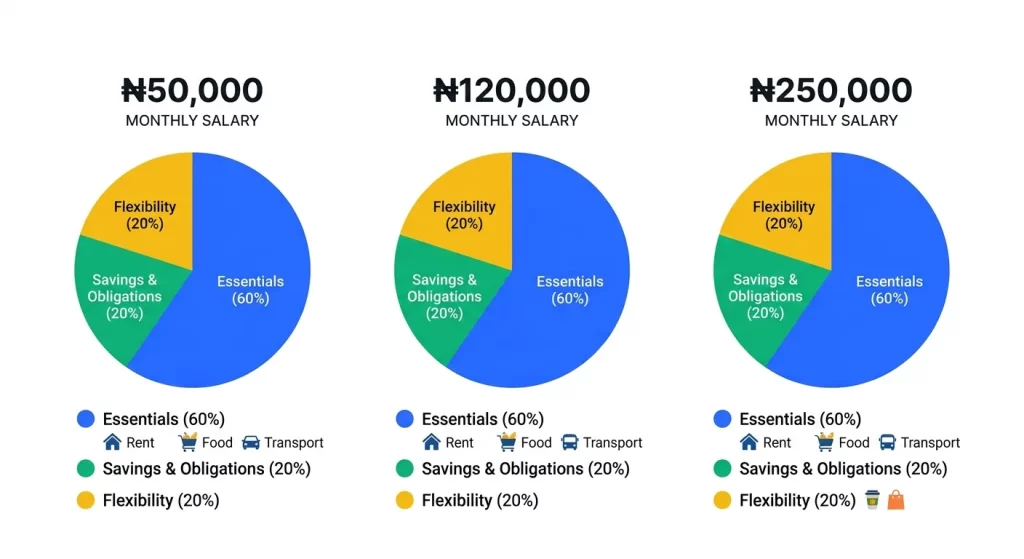
If you have ever Googled how to budget on a Nigerian salary and found advice that felt written for someone in California, you are not imagining things. The popular 50/30/20 rule — universally recommended by personal finance blogs — was built for dollar earners with functioning public infrastructure. Applied to a ₦80,000 Lagos salary without adjustment, it breaks by Day 5.
This guide does something different. It rebuilds the framework from the ground up for Nigerian realities, with real ₦ examples across three income brackets you can use before your next salary hits.
Day 20 and Your Account Is Already Screaming
It is the 20th. Salary landed on the 1st. You paid rent, sent money home, bought data, sorted school fees — and your banking app is giving you anxiety every time you open it.
You are not careless. You are navigating one of the most financially punishing environments in the world — 40%+ food inflation, unpredictable NEPA bills, transport costs that shift with every fuel price change, and family obligations that do not consult your account balance before arriving.
The problem is not discipline. The problem is that nobody taught you a system for how to budget on a Nigerian salary. That ends here.
Why “Just Spend Less” Is Useless Advice
Most Nigerians who run out of money before month-end are not buying unnecessary things. They are paying for:
- Transport costing ₦600–₦1,500 per day in Lagos, Abuja, or Port Harcourt
- Food prices that have risen over 40% in 24 months (per NBS data)
- Generator fuel because public electricity averages under 12 hours daily in most states
- Data because banking, work, and school all live online now
- Family remittances that are cultural obligations, not optional line items
When 70–80% of income goes to genuine necessities before a single luxury purchase, the problem is allocation — knowing exactly where every naira is going before it arrives. That is what salary budgeting in Nigeria actually solves.
The 50/30/20 Rule — What It Is and Where It Came From
The 50/30/20 rule was popularised by American Senator Elizabeth Warren in her 2005 book All Your Worth:
- 50% of after-tax income → Needs (rent, food, transport, bills)
- 30% of after-tax income → Wants (entertainment, dining out, subscriptions)
- 20% of after-tax income → Savings and debt repayment
Clean. Memorable. And for a median American earning $3,500–$5,000 per month in a country with rent assistance and functional public transport — reasonably workable.
For someone learning how to budget on a Nigerian salary in Lagos earning ₦80,000 monthly, it is almost mathematically impossible.
Why 50/30/20 Breaks Down for Nigerian Salaries
Let us run the numbers on a ₦80,000 monthly salary:
50% for needs = ₦40,000
A single room on Lagos mainland costs ₦250,000–₦400,000 per year — that is ₦20,000–₦33,000 monthly. Add transport (₦600 × 22 working days = ₦13,200), basic feeding, and electricity. You have already exceeded ₦40,000 before touching a single “want.”
In Nigeria, needs routinely consume 70–85% of income, especially at lower salary brackets and in urban areas. Applying this Western template without adjustment sets people up for failure — you try it, fail by Day 5, and conclude that budgeting does not work for people like you.
It does work. It just needs rebuilding for Nigerian realities.

The Nigerian-Adjusted Framework: 60/20/20
Here is a more honest starting point for how to budget on a Nigerian salary:
| Category | Percentage | What Goes Here |
|---|---|---|
| Essentials | 60% | Rent, food, transport, generator, data, school fees, medication |
| Obligations & Savings | 20% | Emergency savings, loan repayments, family remittances, cooperative contributions |
| Flexibility | 20% | Clothing, entertainment, church/mosque, personal care |
One critical rule is built in: savings and loan repayments sit in the obligations bucket, not at the end of the month. The most common money management mistake Nigerian salary earners make is putting savings last. Whatever remains after spending is almost always zero.
Real ₦ Examples Across Three Income Brackets
Example 1: ₦50,000 Salary (Corper, Domestic Worker, Junior Artisan)
| Category | Amount | Breakdown |
|---|---|---|
| Essentials (60%) | ₦30,000 | Room: ₦10,000 / Food: ₦12,000 / Transport: ₦8,000 |
| Obligations (20%) | ₦10,000 | Emergency savings: ₦5,000 / Family remittance: ₦5,000 |
| Flexibility (20%) | ₦10,000 | Data, personal care, social, small emergencies |
Reality check: At this income level, the flexibility category will regularly get raided. The goal is not perfection — it is ensuring savings are protected first, every single month.
Example 2: ₦120,000 Salary (Teacher, Nurse, Skilled Artisan, Mid-Level Staff)
| Category | Amount | Breakdown |
|---|---|---|
| Essentials (60%) | ₦72,000 | Rent: ₦30,000 / Food: ₦20,000 / Transport: ₦12,000 / NEPA+Generator: ₦5,000 / Data: ₦5,000 |
| Obligations (20%) | ₦24,000 | Emergency savings: ₦10,000 / Loan repayment: ₦8,000 / Cooperative+family: ₦6,000 |
| Flexibility (20%) | ₦24,000 | Clothing, social outings, entertainment, personal care |
Key insight: At this bracket, the 60/20/20 framework starts to breathe. A loan repayment fits inside the obligations bucket without cannibalising essentials — exactly how responsible personal finance Nigeria should work.
Example 3: ₦250,000 Salary (Bank Staff, Engineer, Civil Servant Grade 12+)
| Category | Amount | Breakdown |
|---|---|---|
| Essentials (55%) | ₦137,500 | Flat: ₦60,000 / Food: ₦40,000 / Transport: ₦25,000 / Utilities: ₦12,500 |
| Obligations (25%) | ₦62,500 | Emergency savings: ₦25,000 / Treasury bills/money market: ₦20,000 / Loan+cooperative: ₦17,500 |
| Flexibility (20%) | ₦50,000 | Lifestyle, dining, travel, entertainment |
The key risk: Lifestyle inflation. A ₦250,000 earner in Lagos can still be broke by Day 20 while spending like a ₦400,000 earner. At this income level, a 55/25/20 variant works — essentials drop slightly, freeing more room for savings and investment.
The 5 Budget Killers Draining Nigerian Salaries Silently
1. Unplanned family transfers. Your cousin calls with an emergency three times in one month — that is ₦45,000 unbudgeted. Fix: create a fixed “family obligation” line. When it is gone, it is gone.
2. Subscription creep. Netflix, Showmax, Spotify, cloud storage, three news sites you forgot you pay for. Audit your bank statement at month-end — the total will surprise you.
3. “Small-small” daily spending. Suya on the way home (₦800). A bottle of malt (₦500). Airtime top-up (₦200). Invisible individually, but easily ₦20,000–₦40,000 monthly on a ₦120,000 salary.
4. Overlapping Ajo/Esusu commitments. Informal cooperatives are useful tools — joining five simultaneously while already cash-constrained forces monthly borrowing to cover the obligations.
5. Reacting instead of planning. The person who knows how to budget on a Nigerian salary anticipates fuel price changes. The person without a budget pays panic prices and makes panic decisions.
How to Build Your First Monthly Budget in 30 Minutes
You do not need an app. You need paper, your last two bank statements, and 30 uninterrupted minutes.
Step 1: Write your exact monthly take-home salary — after tax, pension, and employer deductions. Net, not gross.
Step 2: List every fixed cost first — rent (monthly equivalent), loan repayments, school fees (monthly equivalent), cooperative commitments.
Step 3: Estimate variable essentials using last month’s actual bank statement. Do not estimate low — use real numbers.
Step 4: Add fixed + variable essentials. If this exceeds 70% of income, you have a structural income or housing problem — not a discipline problem.
Step 5: Split whatever remains — half to savings and obligations, half to flexibility. Even ₦2,000 in savings matters. Consistency beats amount.
Step 6: Review on the 15th of every month. Not month-end — too late by then. A mid-month check gives you two weeks to correct overspending before it becomes a crisis.
What to Do When the Budget Breaks Mid-Month
It will break — especially in the first three months. Here is the recovery protocol:
- Do not abandon the budget because it failed once. An imperfect budget still beats no budget.
- Identify which category broke. Was it essentials (largely uncontrollable) or flexibility (manageable)?
- Do not raid savings to cover flexibility shortfalls. Eat cheaper for a week. Skip one social event. Guard the savings line like a utility bill.
- If a genuine emergency hit, emergency savings exist exactly for this. Use them without shame, then rebuild them next month.
How Budgeting Reduces Your Need to Borrow — And When a Loan Still Makes Sense
A working monthly budget does three things that directly reduce loan dependency:
- Reveals spending leaks before they drain the account
- Builds a small buffer that handles ₦5,000–₦15,000 emergencies without borrowing
- Shows exactly what loan repayment amount is safe — preventing overborrowing that creates debt spirals
But understanding how to budget on a Nigerian salary does not eliminate every emergency. Medical bills arrive without warning. Equipment breaks the day before a major delivery. School fees deadlines are indifferent to savings balances.
When a genuine, time-sensitive emergency arises and savings cannot cover it, a short-term personal loan from a licensed, FCCPC-registered lender is a legitimate financial tool — not a moral failure.
The difference between a borrower who struggles and one who recovers quickly is almost always this: the one who recovers had a budget before the emergency, knew exactly what repayment they could handle, and borrowed accordingly.
LendSafe Nigeria is CBN-compliant and FCCPC-registered. Loan decisions in minutes. No hidden fees. Repayment terms visible before acceptance — built for Nigerian salary earners facing real financial pressure, not to trap them in cycles.