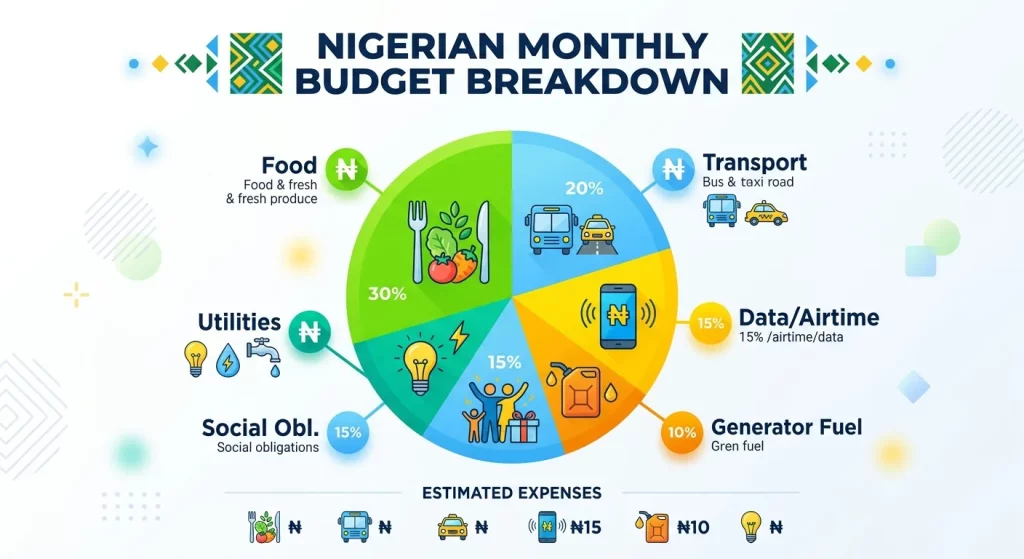
Knowing how to cut monthly expenses Nigeria-style is the difference between surviving until next payday and actually getting ahead. This guide skips the generic advice and shows you exactly where Nigerian salaries disappear — naira by naira — and what to do about it today.
Salary hits on the 25th. By the 10th of the following month, the account is near-empty. Not because anyone bought a car. Just… life happened. Airtime. Transport. Generator recharge. A small contribution for a colleague’s wedding. Food for the house. Data for the kids’ school app. Another ₦500 here, ₦2,000 there. Then the NEPA bill arrives. Or the landlord sends a WhatsApp message. And suddenly you’re searching for a loan app at 11pm.
This guide exists to stop that cycle — not by telling you to “spend less” (useless advice), but by showing you exactly where Nigerian salaries disappear and what to do about it.
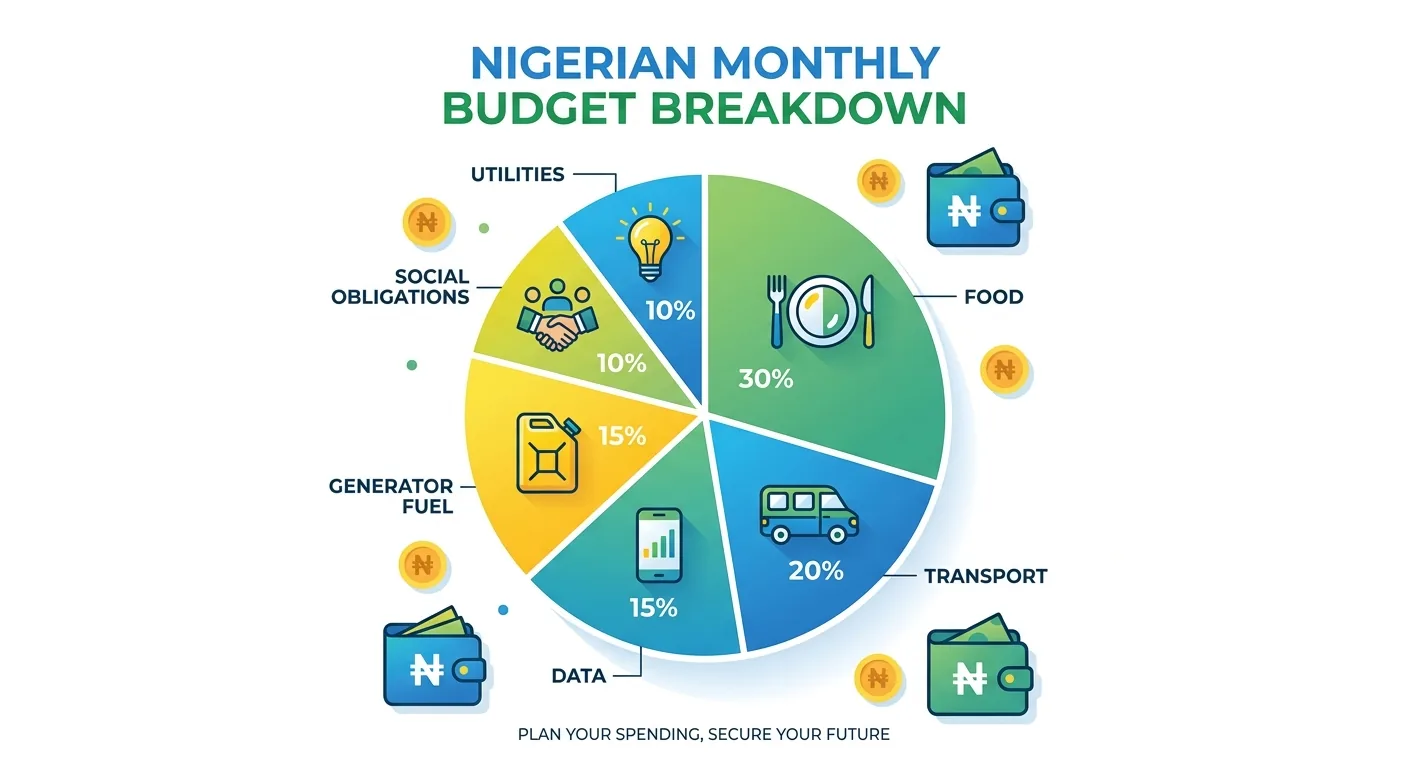
Why Cutting Expenses Feels Impossible on a Nigerian Salary (And Why That’s Not the Full Story)
Most personal finance advice is written for people earning in dollars or pounds. They say “cancel subscriptions” and “eat out less.” For someone earning ₦80,000 to ₦150,000 a month in Lagos, Abuja, or Port Harcourt, those tips land like a joke.
You’re not being extravagant. You’re surviving in one of the most inflation-hit economies in Africa. According to the National Bureau of Statistics (NBS), Nigeria’s headline inflation peaked above 33% in 2024 — meaning your ₦100,000 salary buys roughly what ₦67,000 bought two years ago.
But here is what is also true: most Nigerians are leaking between ₦70,000 every month on spending patterns they’ve normalized — not because they’re reckless, but because no one ever showed them the math in naira terms. That’s exactly what this guide does.
Step 1 — The 10-Minute Expense Audit
Before you cut anything, you need to see what you’re actually spending. Open your phone. Go to your bank’s SMS alerts or mobile banking app. Scroll back exactly 30 days. Write down every single debit — or screenshot them all.
Now group them into buckets:
| Category | Your Total |
|---|---|
| Food & market | ₦ ___ |
| Transport | ₦ ___ |
| Airtime & data | ₦ ___ |
| Utility bills (NEPA, water, gas) | ₦ ___ |
| Generator fuel | ₦ ___ |
| Rent (monthly portion) | ₦ ___ |
| Social (gifts, contributions, events) | ₦ ___ |
| Subscriptions & apps | ₦ ___ |
| Loan repayments | ₦ ___ |
| Everything else | ₦ ___ |
Add them up. Compare to your net income.
Most people who complete this exercise discover they are spending ₦8,000–₦25,000 more than they assumed — not on big purchases, but on small, repeated, invisible transactions. That gap is your target when figuring out how to cut monthly expenses Nigeria-wide.
Step 2 — The 5 Biggest Money Drains for Nigerian Households
These five categories silently consume the most naira every month.
1. Generator fuel (₦8,000–₦45,000/month)
A household generator doing moderate use burns ₦800–₦1,500 per day at current PMS prices. Over 30 days: ₦24,000–₦45,000 — often the second-biggest household expense after rent, yet rarely budgeted for precisely.
2. Data (₦4,000–₦12,000/month)
Between personal data, topping up for family members, and refilling bundles mid-month at the most expensive per-MB rates, many Nigerians are effectively buying their monthly allocation twice over.
3. Transport (₦3,000–₦16,000/month)
Someone doing a two-leg commute in Lagos pays ₦500–₦800 daily in fares — totalling ₦10,000–₦16,000 on working days only. Keke, Okada, and BRT fares have all increased significantly since 2023.
4. Unplanned social obligations (₦5,000–₦20,000/month)
Aso-ebi. Boss’s birthday collections. WhatsApp group contributions. These are real social pressures with real financial consequences — and they’re almost never budgeted for.
5. Small daily purchases (₦3,000–₦10,000/month)
Recharge for ₦200. Snack for ₦300. Extra data for ₦500. These feel like nothing individually. Multiply by 30 days and they frequently exceed your planned food budget.
Step 3 — Airtime and Data: You’re Probably Paying Double
Most Nigerians buy airtime in small chunks — ₦100, ₦200, ₦500 — when they’re low, rather than buying a monthly bundle upfront. This almost always costs more per unit of value.
The comparison:
– MTN 10GB data bundle (30 days): approximately ₦3,500–₦4,500
– Buying 500MB at a time to cover the same usage: easily ₦6,000–₦9,000
That is a ₦2,500–₦4,500 difference per month — purely from buying in panic mode instead of planning mode. Multiply by 12 months: ₦30,000–₦54,000 wasted annually on the exact same data volume.
Actionable fix: On payday, buy your full monthly data bundle before spending on anything discretionary. Treat it like a utility bill. Also audit whether you’re paying for Netflix or any streaming service you barely use — and whether splitting a plan with a family member could halve the cost.
Step 4 — Food and Transport: Where the Most Naira Quietly Vanishes
Food is non-negotiable. But how you buy food matters enormously — and this is one of the highest-impact areas to reduce spending in Nigeria without sacrificing nutrition.
Transport: Even two days of remote work per week — where your role allows — saves ₦1,200 weekly, or up to ₦4,800 monthly. That alone covers most people’s full data bundle.
Food — the bulk-buying math: A 50kg bag of rice purchased at Tejuosho, Mile 12, or Kasuwan Shanu market costs approximately 15–25% less per kilogram than buying in small cups from a corner shop. For a household consuming one bag monthly, that is a direct saving of ₦3,000–₦7,000 — if you can front the full amount on payday.
Canteen vs. home cooking: Counter-intuitively, for many single workers in Lagos, eating at a local buka (₦700–₦900 per meal) is cheaper than cooking with gas every day when you factor in gas refill costs, time, and food spoilage. Run your own numbers honestly before assuming home cooking is always the frugal choice.

Step 5 — The Social Obligations Trap (Aso-ebi, Contributions, “Abeg”)
This is the most sensitive topic in Nigerian personal finance — and arguably the most financially damaging one nobody discusses honestly.
Nigerians face enormous social financial pressure: weddings, funerals, church building funds, school levies, birthday collections, and supporting family in the village. None of these are inherently wrong. But without a system, they silently destroy monthly budgets.
The fix: Create a fixed “social obligations” budget — a set monthly amount you are willing and able to give. When that allocation is exhausted, it is exhausted.
A realistic social budget for someone earning ₦80,000–₦120,000: ₦5,000–₦10,000 per month. Set it. Protect it. This is not being stingy. This is being financially solvent enough to show up for people when it truly matters — and it is a cornerstone move for anyone serious about how to cut monthly expenses Nigeria-side.
Step 6 — Utility Hacks That Actually Work in Nigeria
Electricity: Buy prepaid meter units in one or two larger purchases per month rather than daily ₦500 top-ups. Some DISCOs — including Ikeja Electric and EKEDC — have periodically offered bonus units on larger purchases. Check your DISCO’s official app before your next top-up.
Generator sharing: Splitting generator running time with neighbors in a compound drops the cost-per-household significantly. A 50/50 fuel and maintenance split cuts this expense in half.
LED lighting: A one-time spend of ₦1,500–₦3,000 on LED bulbs reduces daily generator fuel consumption meaningfully. LEDs draw 5–9 watts versus 40–60 watts for older bulbs — a real difference across hours of daily generator use.
Cooking gas: A 12.5kg cylinder typically costs less per cubic meter than buying three separate 5kg cylinders for the same cooking volume. If you currently buy 3kg at a time, consider pooling funds with a neighbor to split a larger cylinder.
How Cutting ₦3,000–₦8,000 a Month Changes Your Loan Math
Here is why this matters beyond just “saving money” — and why anyone with an active loan should prioritize this immediately.
If you have a loan with monthly repayments of ₦12,000 and you cut ₦6,000 from your monthly expenses, the downstream effects are:
- You no longer need to borrow ₦6,000 at month-end to cover the gap
- Your loan repayment is made on time — protecting your credit bureau record with CRC Credit Bureau or FirstCentral
- Over three months, that is approximately ₦18,000 in emergency loan interest you don’t pay
- Over six months, your credit profile begins improving — making you eligible for lower-rate products if you need credit again
Small monthly savings compound. They reduce borrowing frequency, which reduces total interest paid, which reduces how much income you need just to stand still. Understanding how to cut monthly expenses Nigeria-wide is, at its core, a debt reduction strategy.
When Cutting Isn’t Enough — What to Do Next
Sometimes the gap between income and necessary expenses is structural, not behavioral. Cutting ₦5,000 a month when your rent just increased by ₦40,000 annually doesn’t fix the problem.
If the gap is too large for behavior changes alone, the next moves are:
1. A short-term bridge loan from a licensed lender
If you need emergency funds, use a CBN-regulated personal loan app like LendSafe — transparent fees, no hidden charges, fast decision. Borrow exactly what you need, no more.
2. Plan income growth actively
A budget that can never balance is an income problem, not a spending problem. A pay review conversation, a marketable skill upgrade, or one consistent side income stream changes the math permanently.
3. Deploy a debt repayment strategy
If multiple loan repayments are consuming your cash flow, use the debt avalanche method (highest interest rate first) or the debt snowball method (smallest balance first) to systematically eliminate obligations. LendSafe’s blog covers both strategies with Nigerian ₦ examples you can adapt directly.
The Real Goal: Borrow Less. Not Zero — Less.
The goal of this guide is not to shame anyone for borrowing. Loans exist because life is genuinely unpredictable. Hospital bills don’t schedule themselves. School fees don’t wait for payday.
The goal is to eliminate the unnecessary borrowing — the 11pm loan app searches that happen not because of an emergency, but because ₦3,000 went into data recharge and ₦4,000 went into a contributions envelope and now rent is short.
If you free up ₦5,000–₦10,000 monthly through these six steps, you will need fewer loans. The loans you do take will cover real emergencies. And you’ll repay them faster — because your monthly cash flow finally has breathing room. That is how to cut monthly expenses Nigeria-style: not with perfection, but with enough margin to stop the cycle for good.
Facing a genuine short-term emergency? LendSafe is a CBN-regulated personal loan app — apply in minutes, transparent fees, no surprises. Visit LendSafe today to check your eligibility.
Frequently Asked Questions
Q: How much can I realistically save by cutting monthly expenses in Nigeria on a ₦100,000 salary?
Most salary earners doing their first honest expense audit identify ₦8,000–₦20,000 in recoverable leakage — from data panic-buying, small daily purchases, unbudgeted social contributions, and generator fuel inefficiency. Recovering even half of that monthly adds up to ₦48,000–₦120,000 annually.
Q: Is it possible to reduce spending in Nigeria without affecting quality of life?
Yes — most of the gains come from how you buy, not what you buy. Switching from daily small data purchases to monthly bundles, buying food in bulk on payday, and setting a fixed social obligations budget all save money without cutting necessities.
Q: How does LendSafe help if I’m already in a debt cycle?
LendSafe offers short-term personal loans with clear, disclosed fees — no penalty traps or hidden charges. Used once for a genuine emergency and repaid on time, it breaks the cycle rather than extending it. Combine a single structured loan with the expense cuts in this guide and most people stabilize within 60–90 days.
Q: What is the first step to cut expenses on low income in Nigeria?
The 10-minute expense audit in Step 1 above. No budget plan works without first seeing your actual numbers — and most people are genuinely surprised by what they find.