Here is what most Nigerians do not know: within seconds of hitting submit, most loan apps quietly ran your name through one or both of Nigeria’s licensed credit bureaus — CRC Credit Bureau and FirstCentral Credit Bureau. Whatever those bureaus returned shaped the lender’s decision before any human reviewed your case.
The good news? You can check CRC credit report Nigeria data yourself — right now, before you apply anywhere else. This guide shows you exactly how, what it costs, and what to do with what you find.
What CRC and FirstCentral Actually Are
Nigeria has three CBN-licensed credit bureaus. Two dominate the lending market entirely.
CRC Credit Bureau (CRC CreditRegistry) launched in 2009 and is one of the oldest in Nigeria. Most commercial banks and many fintech loan apps query CRC when assessing a borrower’s creditworthiness. They hold records of every loan you have taken, your repayment behaviour, and any defaults — going back years.
FirstCentral Credit Bureau (FCB) is a strong competitor with deep ties to digital lenders. Many popular loan apps on your Play Store pull from FirstCentral. Some lenders query both bureaus simultaneously before making any decision.
Both operate under the Credit Reporting Act 2017, regulated by the CBN. Neither bureau creates your score from nothing — they only reflect what lenders have reported about you.
The critical point: What is in those files is not always accurate. Errors happen. Old loans show as unpaid. Repaid debts linger as defaults. If you never check your credit report in Nigeria, you keep getting rejected without ever understanding why.
Why You Should Check Before You Apply — Not After Rejection
Checking your own credit report is a soft inquiry — it does not affect your credit score. When a lender checks it during your application, that is a hard inquiry — too many in a short window can lower your score and signal desperation.
When you check CRC credit report Nigeria data first, you gain four concrete advantages:
- A clear picture of exactly what lenders will see when they run your name
- Evidence of any errors you can dispute before they block your approval
- Confidence to choose the right lender based on your actual profile
- A direct answer to why previous applications were declined
If you need cash before Friday, ten minutes spent pulling this report could be the difference between a fast approval and another silent rejection.
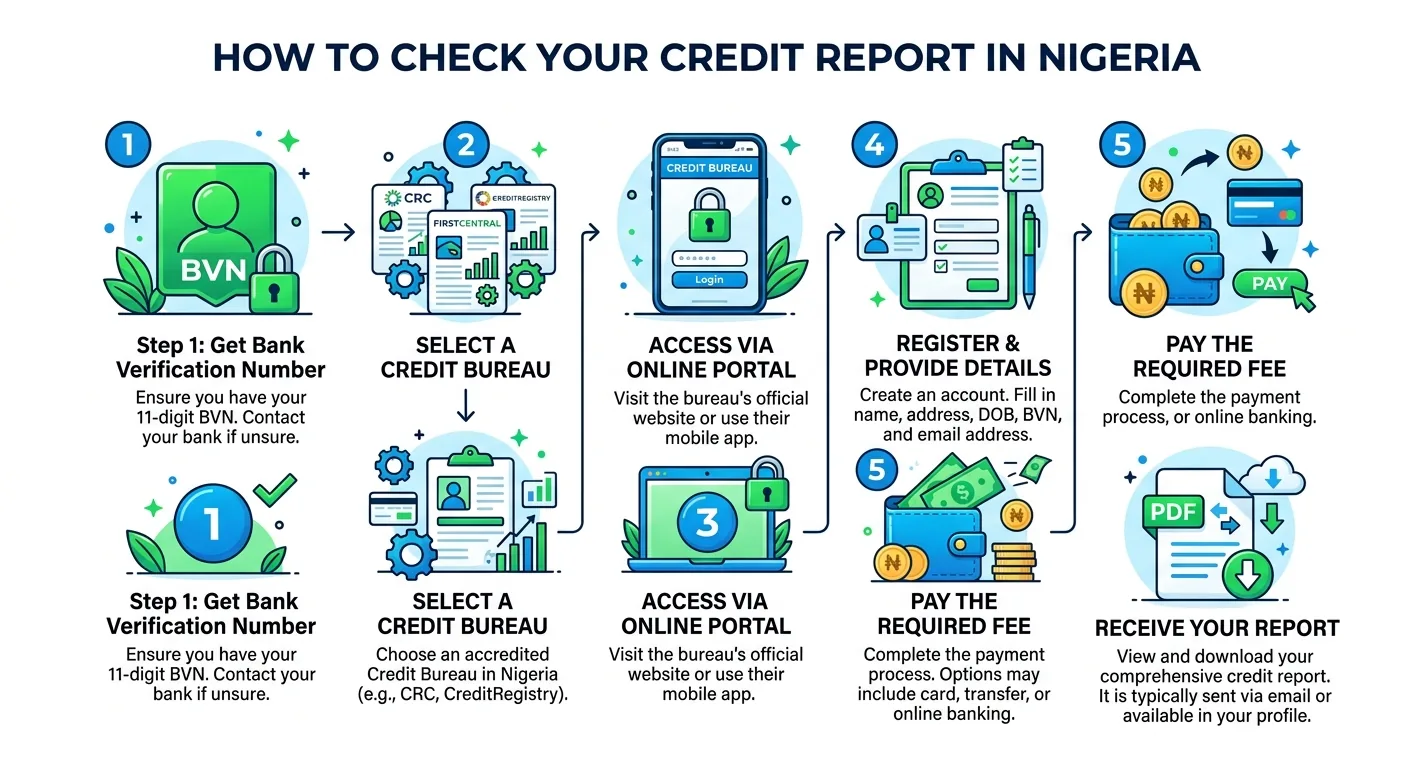
How to Check Your CRC Credit Report in Nigeria — Step by Step
Method 1: Online (Recommended)
- Visit www.crccreditbureau.com on your phone or desktop browser
- Click “Consumer Portal” or “Check Your Credit Report”
- Register with your full legal name, BVN, active phone number, and email address
- Complete identity verification — an OTP will be sent to your BVN-linked number
- Pay the access fee — currently ₦2,000 to ₦3,500 depending on report type
- Your report downloads as a PDF within minutes
Method 2: Physical Walk-in
CRC maintains offices in Lagos and Abuja. Bring a valid government-issued ID, your BVN, and proof of address. Walk-in reports typically cost slightly more and take 24–48 hours.
What you need ready:
- Your BVN (check via *565*0# on any network)
- Active phone number registered to that BVN
- Valid ID: NIN slip, national ID card, voter’s card, or international passport
- Stable data connection or WiFi
How to Check Your FirstCentral Credit Report — Step by Step
- Visit www.firstcentralcreditbureau.com
- Click “Get Your Credit Report”
- Create an account using your BVN and email address
- Complete identity verification via OTP
- Select your report type and pay the fee — currently ₦1,500 to ₦3,000
- Download your report immediately after payment confirms
FirstCentral’s portal is generally faster on mobile. If your connection is slow, try between 6am–8am when server traffic is lowest.
Important: Check both bureaus. A loan you repaid in full may appear correctly on one bureau and incorrectly as a default on the other. Checking only one gives you half a picture — and lenders see both.
What the Report Actually Shows — Decode It Simply
When you check your CRC credit report Nigeria file or your FirstCentral report, here is every major section and what it means:
| Section | What It Means |
|---|---|
| Personal Information | Name, BVN, address — verify these match your ID exactly |
| Account Summary | Total loans, active accounts, and closed accounts |
| Payment History | On-time, late, or defaulted payments across all lenders |
| Outstanding Balance | Total debt still owed across every reported lender |
| Enquiries | Which lenders checked your report and when |
| Adverse Information | Defaults, charge-offs, write-offs — the section that blocks approvals |
Green flag: Accounts marked “Closed — Paid as Agreed” or “Current”
Red flag: Accounts marked “Non-Performing,” “Written Off,” or “Default” — these are what lenders see the moment your BVN is queried.
If you see a default you do not recognise — a loan you never took, or a debt you cleared years ago still showing as unpaid — that is an error worth fighting before your next application.
What to Do If You Find an Error
Errors on Nigerian credit reports are more common than most borrowers expect. You have a legal right to dispute inaccurate entries. Here is the exact process:
Step 1: Screenshot or download the report page showing the incorrect entry.
Step 2: Gather proof — bank transfer receipts, repayment SMS confirmations, or a written acknowledgement from the original lender.
Step 3: File a formal dispute:
– CRC disputes: disputes@crccreditbureau.com
– FirstCentral disputes: Through their portal dispute section or info@firstcentralcreditbureau.com
Step 4: Under CBN regulations, the bureau has 21 working days to investigate and respond.
Step 5: If unresolved, escalate to the CBN Consumer Protection Department or the FCCPC.
Avoid submitting new loan applications while a dispute is live. Wait for the correction to reflect — then apply. This single step has turned rejections into approvals for thousands of Nigerian borrowers.
CRC vs FirstCentral — Which One Matters More for Your Loan Application?
| Lender Type | Likely Bureau Queried |
|---|---|
| Commercial banks (GTB, Zenith, Access) | CRC primary, sometimes both |
| Fintech loan apps (digital-first) | FirstCentral common, some query both |
| Salary advance products | Varies — bureau data plus proprietary scoring |
| Cooperative lenders | Rarely query either — rely on guarantors or payroll deduction |
Practical rule: Applying through a loan app tonight? Check FirstCentral first. Approaching a bank? Check CRC first. If you can spare ₦5,000 total, check both — because lenders who check CRC credit report Nigeria data often check FirstCentral too, and the complete picture is always more valuable than half the data.
You Now Know More Than Most Lenders Expect You To
Most Nigerians walk into loan applications completely blind. They do not know what the bureau says, cannot spot errors, and have no leverage when rejected.
You are now in a different position entirely. You know exactly how to check CRC credit report Nigeria information, how to read what it shows, and how to dispute anything that is wrong.
If you are ready to apply now: LendSafe runs a transparent credit check that surfaces your actual loan options — no hidden bureau pulls, no surprise rejections without context. Download the LendSafe app, complete your profile, and see your personalised offer in under three minutes.
If your report shows issues first: File your dispute, get it corrected, then return. LendSafe will still be here — and your approval chances will be significantly better.
Frequently Asked Questions
How much does it cost to check CRC credit report Nigeria data?
Currently ₦2,000 to ₦3,500 depending on report type. FirstCentral charges ₦1,500 to ₦3,000. Both fees are paid directly on the bureau’s official website.
Will checking my own report hurt my credit score?
No. Checking your own report is a soft inquiry with zero impact on your score. Only lender-initiated checks count as hard inquiries.
How often should I check my credit report in Nigeria?
At minimum, before any significant loan application. Once per quarter is ideal if you are actively managing your credit history or recovering from a default.
Can I get a free credit report in Nigeria?
No fully free option exists as of 2026. Both CRC and FirstCentral charge access fees. Check their websites directly for any current promotional offers.
What if the lender who reported the error no longer exists?
File the dispute directly with the bureau and provide all documentation you have. The bureau is obligated to investigate even if the original lender has closed or merged. Escalate to the CBN if they do not act within 21 working days.