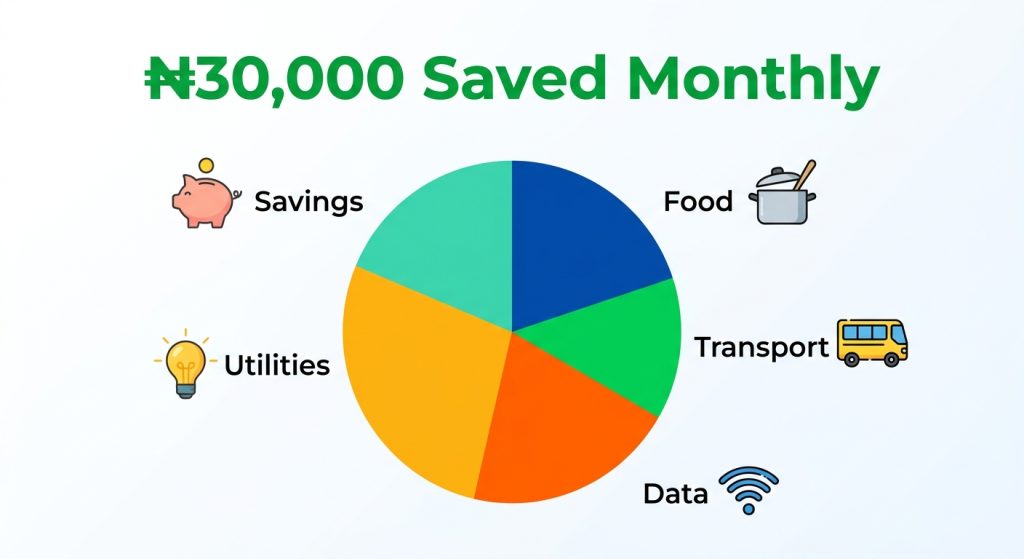
It is the 22nd of the month. Salary hit on the 1st. You have ₦3,200 left in your account, two weeks still to go, and your data subscription just expired.
You did not overspend on anything dramatic. No party. No new gadget. The money just… went. And now you are either borrowing from a colleague, skipping meals, or scrolling through loan apps at midnight.
This is not a discipline problem. It is a systems problem — and knowing how to cut monthly expenses in Nigeria is the fastest lever most working Nigerians have never properly pulled.
According to the National Bureau of Statistics (NBS), Nigeria’s headline inflation hit 33.2% in 2024. The same salary that covered your costs in 2022 now leaves a structural shortfall — even with zero lifestyle upgrade. The instinct most people follow is “earn more.” That is a long game. The faster game — the one that can free up ₦10,000 to ₦30,000 starting this month — is identifying and stopping what is already leaking out.
This guide on how to cut monthly expenses in Nigeria is built for salary earners, Keke and Okada riders, artisans, corpers, traders, and domestic workers. No abstract theory. Just specific cuts, with real naira numbers attached.
Why Cutting Expenses Beats Earning More Right Now
Here is the math nobody explains clearly enough:
If you earn ₦80,000 monthly and spend ₦85,000, you have a ₦5,000 shortfall. Two options:
- Option A: Find extra work or a side hustle to earn ₦5,000 more — time cost: high; energy cost: high; timeline: weeks to months
- Option B: Identify ₦5,000 in preventable spending and stop it today — time cost: one evening with your bank SMS history
Option B wins every time when you are already tired and already behind on loan repayments.
Understanding how to cut monthly expenses in Nigeria also directly reduces how much you need to borrow. If your monthly shortfall shrinks from ₦20,000 to ₦5,000, you borrow less, pay less interest, and exit the debt cycle significantly faster. At a typical Nigerian digital lender’s rate of 15–30% per month (which the CBN’s 2023 digital lending framework has been working to regulate), cutting ₦10,000 in borrowing need saves you ₦1,500–₦3,000 in interest charges every single month.
That compounding effect is the real prize here.
Step 1: The Nigerian Monthly Expense Audit
Before you cut monthly expenses in Nigeria, you need to see everything. Most Nigerians track nothing and then wonder where the money went. Your phone’s bank SMS alerts contain a complete three-month spending record — use it.
Take 20 minutes. Write down every expense from last month. Group them into these categories:
| Category | Example Items |
|---|---|
| Food & Cooking | Market runs, fast food, snacks, bottled water |
| Transport | Daily fares, fuel, bike repairs, ride-hailing |
| Data & Airtime | Daily bundles, subscriptions, calls |
| Utilities | NEPA prepaid, generator fuel, water |
| Rent (monthly share) | If paid annually, divide by 12 |
| Loan Repayments | Principal + interest combined |
| Streaming & Apps | Netflix, Showmax, betting apps |
| Social Obligations | Aso-ebi, gifts, group contributions |
| Miscellaneous | Everything you cannot immediately explain |
Look at the total. Now look at your income. The gap between those two numbers is your problem statement — and your savings opportunity.
Step 2: Food & Cooking Costs — The Biggest Drainer, Easiest to Cut
Food is where most low-to-middle-income Nigerians silently lose the most cash. Not because they eat lavishly, but because of how they buy and how often they cook.
The patterns that cost you most:
- Buying ingredients in tiny daily quantities — small-small buying is always more expensive per unit
- Buying cooked food every day because there is no time or gas to cook
- Drinking bottled or sachet water daily when a filter jug costs ₦3,500 once
- Eating at bukas and adding a soft drink — the drink alone doubles the effective meal cost
Real savings with actual naira numbers:
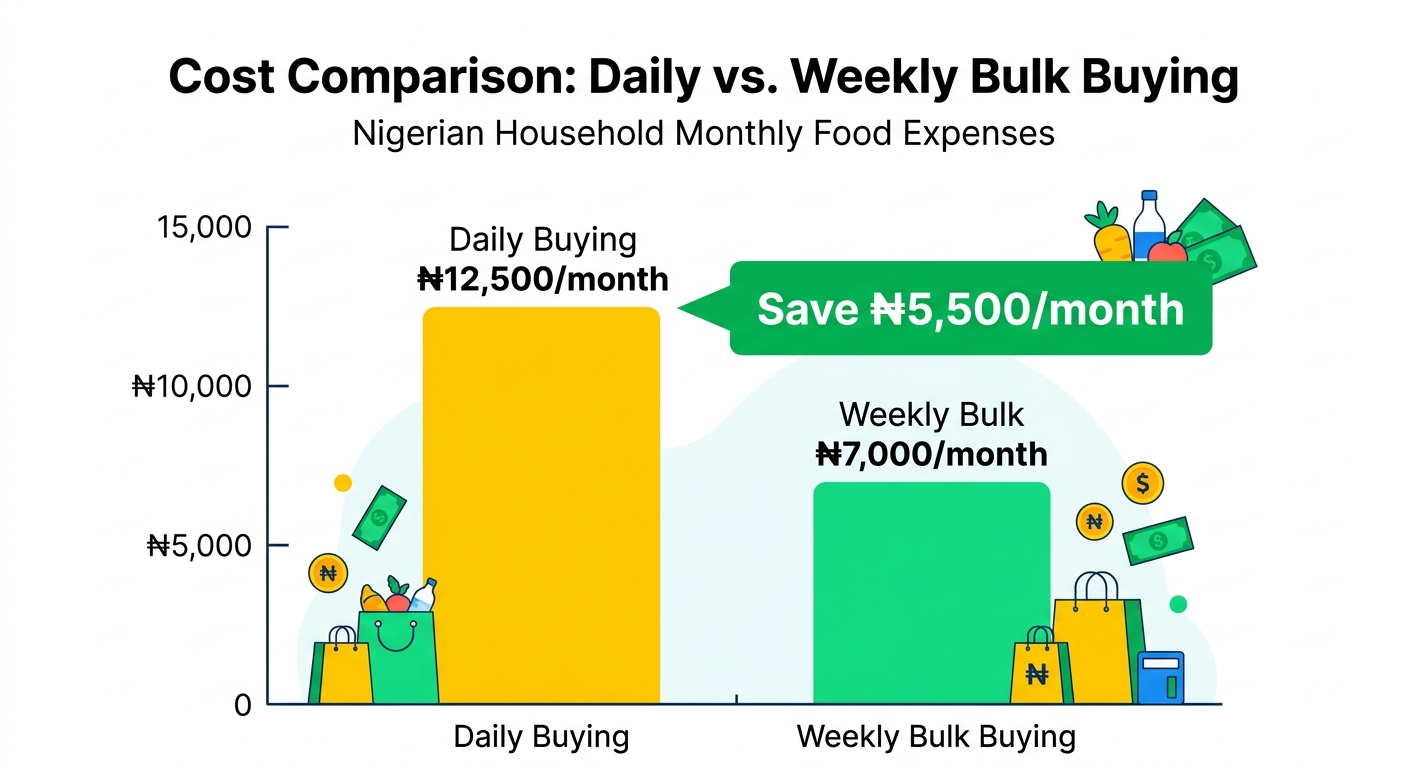
- Cook in bulk twice a week instead of daily: saves gas, saves time, eliminates the 6pm “I’ll just order out” decision. Estimated saving: ₦3,000–₦6,000/month
- Buy from the market once a week in larger quantities — tomatoes, peppers, and onions last 5–7 days when stored properly, and bulk market pricing is 20–35% cheaper per unit than roadside vendor pricing. Estimated saving: ₦1,500–₦3,000/month
- Carry home-cooked food to work three days a week. At ₦700–₦900 per outside meal vs ₦150–₦200 home-cooked equivalent: saving of ₦500–₦700 per day, ₦6,000–₦8,400 per month
- Cut takeaway and fast food to once a week maximum
Total potential monthly food savings: ₦5,000–₦12,000
This single category is often the fastest way to visibly cut monthly expenses in Nigeria with immediate, measurable results.
Step 3: Data, Airtime & Subscription Traps
This is the invisible money drain of 2026. Nigerians are paying for subscriptions they forgot they activated, data bundles that expire unused, and streaming platforms nobody watches anymore.
Common traps:
- Buying 1GB daily bundles at ₦300–₦350 instead of weekly or monthly plans. Daily bundles are the most expensive per megabyte across all four major Nigerian networks — MTN, Airtel, Glo, and 9mobile
- Paying for Netflix, Showmax, or Apple TV individually when shared household plans divide the cost
- Sports betting apps running background data 24 hours a day
- Multiple small airtime top-ups throughout the week that are never tracked
What to do:
- Switch to a monthly data plan. MTN’s ₦2,500/month plan delivers 12GB — far more per naira than ₦300/day bundles that total ₦9,000/month for comparable data
- Audit your recurring bank debits. Open your bank app and look at every automatic debit from the last 60 days. Cancel any subscription you have not used in 30 days
- Share one streaming subscription — split the cost with a sibling or roommate to halve the cost per person
Potential monthly savings: ₦2,000–₦7,000
Step 4: Transport — The Hidden Cost Eating Your Salary
Transport is non-negotiable — you must get to work and back. But the method of commuting can be optimized significantly without sacrificing reliability.
Where transport money leaks:
- Taking Bolt or Uber daily on routes served by BRT, danfo, or minibuses
- Bike-hailing for trips under 10 minutes of walking distance
- No consistent routing habit, meaning fares vary daily with no baseline for comparison
What to do:
- Map your cheapest reliable daily route once and commit to it. A Lagos worker commuting from Ikorodu to Lagos Island can pay ₦200–₦400 on BRT versus ₦1,500–₦2,500 on Bolt for the same trip. That difference is ₦1,100–₦2,100 per day, or ₦22,000–₦42,000 per month
- Reserve Bolt and Uber for late nights, rain, or genuine emergencies — not standard work commuting
- If you own a motorcycle or Keke for commercial work, track your daily fuel cost explicitly. Many riders discover they are spending 20–30% more on fuel than their route should require
Potential monthly savings: ₦4,000–₦15,000 (highest for daily ride-hailing users)
For more guidance on managing transport and household cash flow, visit SmartLoans Nigeria for financial tools designed for working Nigerians.
Step 5: Rent, Utilities & NEPA — Small Adjustments, Big Savings
You cannot cut rent mid-tenancy. But utilities are a completely controllable story when you know how to cut monthly expenses in Nigeria at the household level.
NEPA/prepaid electricity:
- Unplug chargers, fans, and televisions when not in use. Phantom load — electricity consumed by devices on standby — is measurable and real. The Nigerian Electricity Regulatory Commission (NERC) has acknowledged phantom load as a significant contributor to residential overbilling
- Switch to LED bulbs throughout your apartment. LED bulbs consume approximately 70–80% less electricity than incandescent alternatives
- Charge devices during early morning hours when grid supply is often steadier
Generator fuel:
- Coordinate generator run-hours with housemates. Running a 1.5KVA generator costs approximately ₦600–₦900 per hour in fuel at current prices — 4 hours daily costs ₦72,000–₦108,000 per month in fuel alone
- An inverter and battery setup (₦60,000–₦120,000 upfront) pays itself back in 4–8 months for households currently spending ₦15,000+ monthly on generator fuel
Water:
- Buying 75cl sachet water throughout the day costs ₦3,000–₦5,000/month. A ceramic filter jug (₦3,500–₦5,500, one-time purchase) or purification tablet solution (₦400–₦600/month) eliminates most of that recurring cost
Potential monthly savings: ₦2,000–₦8,000
Step 6: Lifestyle Leaks Nigerians Rarely Talk About
These are the expenses that feel individually small but collectively represent a serious monthly drain:
Social pressure spending:
– Aso-ebi contributions for weddings you were not planning to attend: ₦3,000–₦10,000 per event, often four to six times a year
– “I dey follow” spending — joining friends at a restaurant or bar when your budget genuinely cannot accommodate it that week
Impulse and invisible purchases:
– Unplanned buys at Shoprite or roadside vendors during routine outings
– Giving airtime to people who “will pay back” — they statistically do not
– ATM withdrawal fees: at ₦65–₦100 per interbank transaction, making five withdrawals per week from another bank’s ATM costs ₦1,300–₦2,000 monthly in pure fees for zero benefit
What to do:
– Implement the 24-hour rule: if you want something not on your list, wait one full day before buying. Most impulse urges disappear within hours
– Pay with your primary bank’s mobile app to eliminate interbank ATM charges entirely
– Allocate a fixed “free money” amount weekly — ₦2,000–₦3,000 — for social and unplanned spending. When it is gone, it is gone for that week
Potential monthly savings: ₦2,000–₦6,000
The 7-Day Cash Reset Plan (Step-by-Step)
If implementing all of this at once feels overwhelming, follow this sequenced reset:
Day 1: Pull three months of bank SMS alerts. Write every spending category on paper. Total them. Do not judge — just see.
Day 2: Identify your top three spending leaks by naira value. Focus only on those — not everything simultaneously.
Day 3: Cancel one subscription you have not used in the last 30 days. Switch from daily data bundles to a monthly plan today.
Day 4: Plan your food for the entire week. Go to the market once. Cook in bulk. Pack food for work at least three days.
Day 5: Map your cheapest reliable commute route. Test it and time it.
Day 6: Write your weekly transport and food budget on paper or in your phone notes. Visible goals are followed better than invisible ones — this is supported by behavioral psychology research.
Day 7: Review your week. Did you stay within budget even three of five weekdays? That is a win. Repeat next week with one additional adjustment.
The goal is not perfection in week one. The goal is plugging enough holes that ₦8,000–₦15,000 stays in your account by mid-month. This 7-day approach is how you sustainably cut monthly expenses in Nigeria without white-knuckling willpower.
For Nigerians actively managing loan repayments alongside this reset, SmartLoans Nigeria offers repayment structuring tools and transparent loan options without hidden charges.
How Cutting Expenses Protects You From Loan Dependency
Here is the structural reason why it matters to cut monthly expenses in Nigeria beyond just saving money:
Every ₦1,000 you stop wasting is ₦1,000 you do not need to borrow.
And when you borrow ₦1,000 less at a 20% monthly rate, you save ₦200 in pure interest charges — that month alone. Over twelve months, cutting a ₦10,000 monthly borrowing habit saves you ₦24,000 in interest that would have gone to a lender and produced nothing for you.
The CBN’s Consumer Protection Framework requires licensed lenders to disclose total repayment costs. Before you borrow, calculate the total amount repayable — not just the principal. Many Nigerians borrow ₦20,000 and repay ₦26,000–₦28,000 without doing this math first.
Loans are not the enemy. Emergency borrowing is sometimes necessary and entirely valid — a sudden hospital bill, a vehicle breakdown before a delivery job, a school fee deadline that cannot move. These are legitimate use cases for personal credit.
But borrowing to cover preventable spending — food that ran out because bulk shopping never happened, transport that drained your account because routing was never optimized — is one of the most expensive financial habits a working Nigerian can develop.
The framework is simple:
– Cut monthly expenses in Nigeria to protect your earned income
– Use loans only to protect against genuine, unexpected emergencies
– Apply the freed-up savings to build a ₦15,000–₦30,000 emergency buffer over three to four months
That combination — expense control plus strategic credit use — is how you stop the month-end shortfall cycle permanently.
Frequently Asked Questions
How quickly can I see results when I cut monthly expenses in Nigeria?
Most people who complete the 7-Day Cash Reset Plan see ₦5,000–₦10,000 freed up within the first two weeks, primarily from food buying habits and data plan switching. Larger transport and utility savings take 2–4 weeks to fully materialize as new habits form.
What if my salary is too low to save anything no matter what I cut?
If your income genuinely does not cover basic survival costs even after full optimization, the issue is structural income, not expenses. But for most Nigerians earning ₦60,000 and above, this guide surfaces real, actionable savings that are currently being lost every month.
Are these expense-cutting strategies different for Lagos vs other Nigerian cities?
The categories are the same, but the naira amounts differ. Transport costs are significantly higher in Lagos and Abuja. Food markets in smaller cities like Enugu, Owerri, or Kaduna often offer better value per unit. Adjust the ₦ figures in this guide by 20–30% depending on your city’s cost level.
How do I avoid falling back into old spending habits after the first month?
The single most effective tool is a weekly budget written down and reviewed every Sunday. According to research published by the American Psychological Association, behavior change requires consistent repetition over 60–90 days before it becomes automatic. The first month is the hardest — stay with it.
Where can I learn more about managing personal loans alongside a tight budget?
SmartLoans Nigeria publishes resources specifically for Nigerians balancing loan repayments with monthly cash flow, designed for the real income levels most working Nigerians deal with.
SmartLoans Nigeria provides fast, transparent personal loans with no hidden fees and no harassment. Approval in minutes for qualified applicants.
Sources Referenced:
– National Bureau of Statistics Nigeria — Inflation Report 2024
– CBN Consumer Protection Framework — Digital Lending Guidelines
– Nigerian Electricity Regulatory Commission — Residential Load Research