The Tap That Cost Emeka ₦15,000 Extra
Emeka is a dispatch rider in Lagos. His motorbike broke down on a Tuesday morning — no bike, no income, simple equation. He found a loan app, applied for ₦30,000, got approved in four minutes, and tapped “Accept Terms.”
He repaid ₦30,000 on the exact due date. Then he got a debit alert for ₦15,200 more — labelled “processing fee balance, late penalty, and platform charge.”
He had agreed to all of it. It was in the terms. He just never read them.
This story repeats itself thousands of times every month across Nigeria. Not because Nigerians are careless — because loan terms are deliberately written to be skipped. Long. Dense. Small font. Buried inside a scroll-to-accept screen on a five-inch phone at 11 PM when rent is due.
If you are moments away from signing a loan agreement, this guide will show you exactly how to read loan terms Nigeria lenders hand you — in under ten minutes — so you never pay a naira more than you agreed to.
Why Most Nigerians Skip Loan Terms (And Why That Is Dangerous)
Let us be honest about why people skip the terms and conditions.
You are already stressed. You need the money today. The approval screen feels like the finish line, and the terms page feels like the obstacle between you and relief. Many apps know this. Some deliberately exploit it.
According to the Federal Competition and Consumer Protection Commission (FCCPC), digital lending complaints have consistently ranked among the top consumer grievances in Nigeria since 2021 — with hidden charges and aggressive recovery practices dominating the reports.
Here is what skipping loan terms actually costs you:
- Surprise charges: Processing fees, insurance fees, and platform fees that were listed but never highlighted
- Penalty traps: Daily late fees that compound — some lenders charge 1% per day, meaning a ₦50,000 loan unpaid for 30 extra days accumulates ₦15,000 in penalties alone
- Contact harassment: Some apps include clauses permitting them to contact your phone contacts during default recovery — a practice the FCCPC formally banned in 2022 but some apps still attempt
- Auto-debit overreach: Some terms authorise lenders to debit your linked account repeatedly without additional consent
- Rollover traps: Some digital loan contracts auto-renew unpaid loans at higher rates without requiring your explicit approval
Reading the full terms takes four minutes. Dealing with the consequences of skipping them can take months.
Knowing how to read loan terms Nigeria lenders produce is not a legal skill — it is a financial survival skill every borrower needs before tapping Accept.
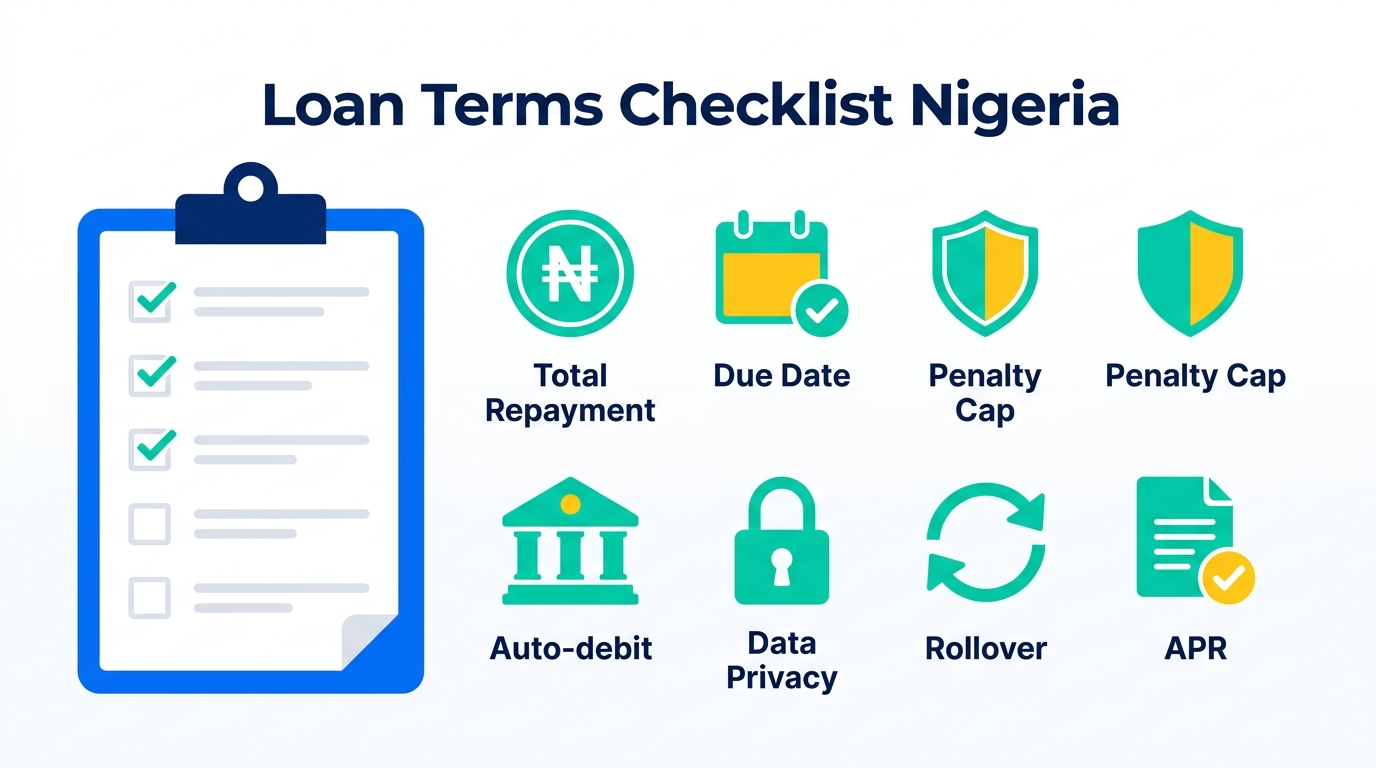
The 7 Loan Terms You Must Find Before You Sign
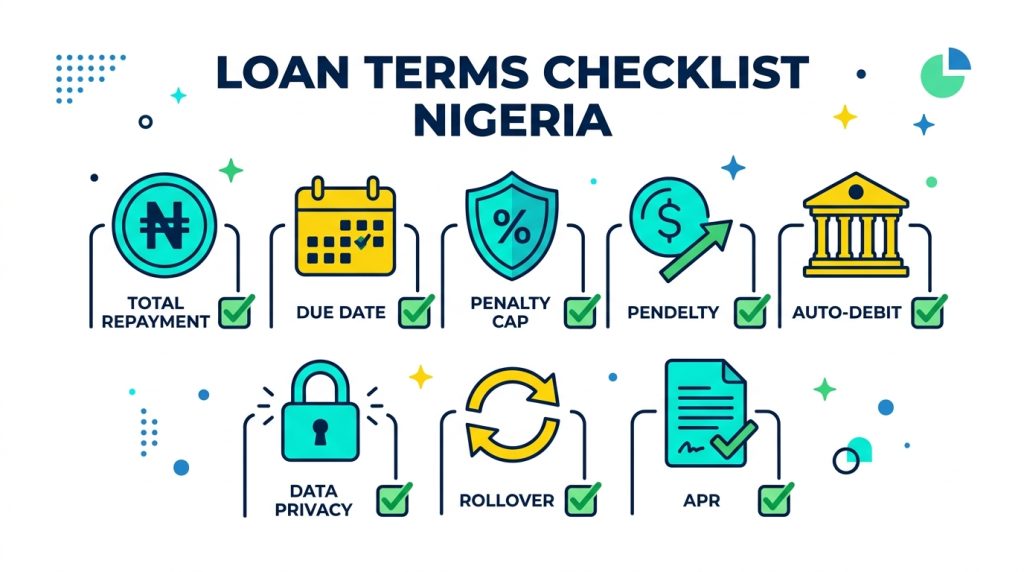
Open the terms document. If you are on a mobile app, use the text search function where available. These seven items determine your real cost far more than any advertised interest rate.
1. Total Repayment Amount — Not Just the Interest Rate
Never evaluate a loan by its interest rate alone. Find the line that says “Total amount repayable” or “Total cost of credit.”
A ₦50,000 loan marketed at “5% monthly interest” sounds manageable. Add a ₦3,000 processing fee, a ₦1,500 insurance charge, and a ₦500 platform fee, and your actual out-of-pocket cost jumps to ₦8,000 — more than three times what the headline rate suggests.
Nigerian regulations require lenders to disclose the Annual Percentage Rate (APR), which must incorporate all fees and charges. If APR is absent from the loan agreement Nigeria you are reviewing, calculate it yourself: subtract the principal from the total repayment figure. That difference is your true cost of borrowing.
What to look for: “Total repayment,” “total cost of credit,” or “effective APR”
2. Every Fee Listed as a Separate Line Item
Loan apps routinely break charges into multiple categories. Your job is to find every one of them:
| Fee Type | Typical Range in Nigeria |
|---|---|
| Processing fee | 1–5% of loan principal, deducted upfront |
| Management/service fee | ₦500–₦2,500 flat |
| Insurance premium | ₦500–₦2,000 flat |
| Platform/technology charge | ₦200–₦1,000 |
| VAT on all fees | 7.5% applied to each charge |
| Credit bureau check fee | ₦200–₦500 |
Add all of these to your interest. That total — not the rate percentage — is your real loan cost.
Red flag: If any fee is described as “variable” or “at our discretion” without a stated cap, that is an open-ended liability, not a transparent loan agreement.
3. The Exact Due Date and Whether Any Grace Period Exists
Find the exact due date. Then find whether a grace period is offered.
Some apps advertise a “30-day loan” but count from the moment of application approval, not from disbursement — which may arrive a day later. Some platforms execute their auto-debit at midnight on the due date, before your salary clears at 9 AM. This generates a technical “missed payment” and triggers penalties before you had any reasonable opportunity to repay.
The question to ask: Does any grace period exist? Even 24 hours can be the difference between a clean repayment record and a ₦3,000 penalty charge.
4. The Late Payment Penalty Structure — The Costliest Clause Most People Miss
This single clause is responsible for more financial damage than any other element of a loan contract in Nigeria. When you learn how to read loan terms Nigeria apps include, this section deserves the most attention.
Find the section labelled “default,” “late payment,” or “penalty charges.” Look for three things:
- Daily penalty rate — 1% per day is common. Annualised, that is 365%, far exceeding most headline interest rates
- Fixed penalty fee — some lenders charge ₦2,000–₦5,000 flat per missed payment
- Compounding rule — does the penalty apply only to the outstanding principal, or to the principal plus accumulated penalties?
Worked example:
– Loan: ₦20,000
– Penalty rate: 1% per day
– Days late: 21
Penalty = ₦20,000 × 1% × 21 = ₦4,200 in penalties alone
What is reasonable: A flat late fee with a clearly stated cap. Any daily penalty rate above 0.5% should concern you.
5. Auto-Debit Authority and Account Access Scope
Most digital loan platforms in Nigeria require BVN linkage or direct account access for automatic repayments. This is standard. The terms around it are not always standard.
Look specifically for:
- Number of debit attempts permitted per day — some apps attempt four to six debits in a single day when the first fails, each potentially triggering a bank charge on your account
- Whether auto-debit authority extends to fees and penalties, or is limited to scheduled principal and interest
- Whether the lender can debit before the due date to “reserve funds”
Red flag language: “We reserve the right to debit your account at any time for any amount outstanding.” This phrasing is too broad and gives the lender unlimited access without per-transaction consent.
6. Data Use and Contact Permission Language
The FCCPC’s 2022 Revised Assessment Criteria for digital lenders explicitly prohibits accessing borrowers’ phone contacts for loan recovery purposes. Despite the prohibition, some app terms still include contact-access language.
Search the document for:
– “contacts” or “phone book”
– “emergency contact notification”
– “third-party communication for recovery”
– “social network notification”
If any of these appear in the context of default recovery, that clause is non-compliant. You can report the lender to the FCCPC at consumer.gov.ng.
A responsible loan agreement in Nigeria will state clearly: “We will not access or contact your phone contacts for any recovery purpose.”
7. Loan Rollover and Auto-Renewal Conditions
Some loan contracts include an automatic rollover clause: if you cannot repay on the due date, the system automatically restructures your debt into a new loan — usually with an additional rollover fee of 2–5% of the outstanding balance.
This is the architecture of a debt spiral. One ₦30,000 loan that rolls over three times can generate ₦10,000–₦15,000 in additional rollover fees before you have cleared the original principal.
Search for: “rollover,” “loan extension,” “automatic renewal,” “restructuring,” or “rebooking fee.”
The standard you should demand: Any rollover must require your explicit, in-the-moment consent with full fee disclosure before execution.
Hidden Charges Buried in Plain Sight
Nigerian consumer protection law requires full fee disclosure. It does not require that those disclosures be easy to find. Here are the most commonly buried charges in digital loan agreements:
- Pre-disbursement deductions: Your account receives less than you borrowed. A ₦50,000 loan with a 4% processing fee disburses ₦48,000 — but you still owe interest on the full ₦50,000 principal
- Insurance levies: Loan insurance is sometimes mandatory and priced above market. It protects the lender, not you, in most standard structures
- Early repayment fees: Some lenders charge a fee if you repay before the due date — disclosed, but rarely in the summary section
- VAT on all fee categories: At 7.5%, VAT adds meaningfully to your total cost and is almost never included in the headline figures a lender advertises
Critical rule: Always calculate your effective borrowing cost based on the amount actually disbursed to your account, not the amount you applied for. If you receive ₦47,000 and repay ₦55,000, your cost is ₦8,000 on a ₦47,000 loan.
Penalty Clauses — What Happens If You Miss One Day
Here is a concrete scenario using common market rates:
- Loan principal: ₦50,000
- Agreed monthly interest: 10% (₦5,000)
- Total repayment due: ₦55,000
- Missed by: 14 days
- Penalty clause: 1% per day on outstanding balance
Daily penalty = ₦50,000 × 1% = ₦500 per day
14-day penalty = ₦7,000
You now owe ₦62,000 instead of ₦55,000. Your loan became 12.7% more expensive because of a two-week delay.
If you know your repayment date is at risk, contact the lender before the due date. Many responsible lenders will discuss options early. Almost none will reverse penalties after they have been applied.
Your Rights as a Borrower in Nigeria
Under the FCCPC’s 2022 digital lending framework and CBN consumer protection guidelines, you have the following enforceable rights:
- Full fee disclosure before you sign — including APR, all fees by name and naira amount
- Protection from contact-list harvesting for recovery purposes
- Fair collection practices — no threats, public shaming, or contact with employers or relatives
- Right to complain to the FCCPC and receive a response within 30 working days
- CBN escalation rights for CBN-licensed lenders through the Consumer Protection Department
Any clause in your loan agreement that conflicts with these protections may be legally unenforceable — but prevention by reading the terms before signing is always the better strategy.
Understanding how to read loan terms Nigeria lenders provide is the single most effective way to exercise these rights before a problem occurs rather than after.
Red Flag Language: Words That Should Stop You Cold
When reading any loan contract in Nigeria, stop and reconsider if you encounter any of the following:
- “Variable fees at our discretion” — no ceiling, unlimited liability
- “We may amend these terms at any time without prior notice” — the lender can change the deal after you have signed
- “By accepting, you authorise access to your contacts, SMS history, call logs, and gallery” — data access far beyond what lending requires
- “Interest and penalties will compound daily on all outstanding balances, including accumulated penalties” — penalties compounding on penalties is predatory
- “Loan is automatically renewed upon failure to repay by the due date” — rollover trap with no active consent required
- “You waive your right to pursue legal claims or regulatory complaints” — almost certainly unenforceable under Nigerian law, but its presence tells you everything about the lender’s operating philosophy
These are not standard clauses. They are deliberate choices. Their presence in a loan agreement is information about the lender — use it.
How to Compare Two Loan Offers Side-by-Side (60-Second Framework)
When evaluating two loan apps simultaneously, run this four-step framework:
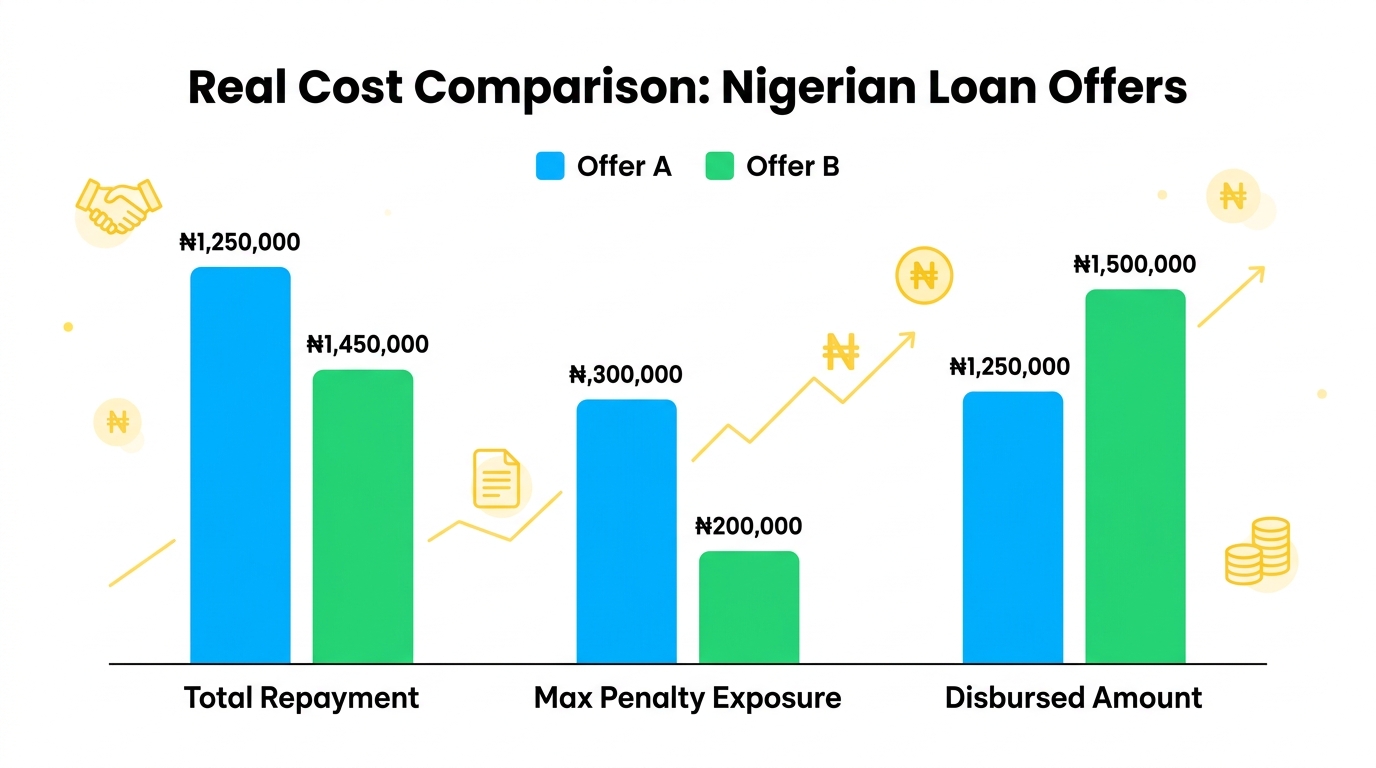
Step 1 — Total Repayment in Naira
Offer A: ₦55,000 total on a ₦50,000 loan
Offer B: ₦58,500 total on a ₦50,000 loan
Offer A appears cheaper. But do not stop here.
Step 2 — Penalty Structure
Offer A: ₦1,000 flat fee per late day, capped at 10 days (maximum penalty: ₦10,000)
Offer B: 1.5% per day, uncapped
At 14 days late on Offer B: ₦50,000 × 1.5% × 14 = ₦10,500 in penalties — already more than Offer A’s capped maximum.
Step 3 — Actual Disbursement Amount
Offer A: Disburses ₦47,500 (₦2,500 processing fee deducted upfront)
Offer B: Disburses ₦50,000 (fees built into total repayment)
Factor this into your real cost calculation.
Step 4 — Rollover Clause
Offer A: No auto-rollover; extension requires your explicit consent
Offer B: Automatically rolls over after 3 days of default, with a 3% rebooking fee
The verdict: Offer A costs ₦3,500 less upfront and offers dramatically better protection if life becomes complicated. Choose protection over a lower headline rate every time.
This side-by-side method is exactly what mastering how to read loan terms Nigeria apps provide makes possible — you stop comparing marketing and start comparing reality.
What Honest Loan Terms Look Like: The Transparent Lending Standard
Responsible digital lending in Nigeria — as defined by FCCPC standards and CBN consumer protection guidelines — should include every one of the following without you having to ask:
- ✅ Total repayment amount in naira displayed prominently before the acceptance screen
- ✅ All fees itemised by name and amount, not bundled into a single charge
- ✅ Penalty structure expressed as a fixed amount with a stated maximum cap
- ✅ Explicit statement that phone contacts will not be accessed for any recovery purpose
- ✅ Auto-debit terms specifying the exact time of debit execution and the maximum number of daily attempts
- ✅ Rollover terms requiring opt-in consent with full fee disclosure at the moment of extension
- ✅ FCCPC and CBN complaint channels stated in the agreement itself
If the loan agreement Nigeria you are reviewing cannot provide all of these — either because the information is genuinely absent or impossible to find in a reasonable reading — you are carrying more risk than the interest rate suggests.
Before You Tap “Accept” — A 60-Second Checklist
Screenshot this. Run through it before every loan acceptance.
□ 1. What is the total repayment amount in naira — not the rate, the actual number?
□ 2. What is the exact due date and the precise time the auto-debit will execute?
□ 3. What is the late penalty — flat fee, daily rate, or both — and is there a stated cap?
□ 4. What fees are deducted before disbursement? What amount actually hits my account?
□ 5. Does this app access my phone contacts for any purpose at all?
□ 6. Is there an auto-rollover clause? Can I affirmatively opt out?
□ 7. Is the APR (Annual Percentage Rate) stated anywhere in this document?
□ 8. Does this agreement mention where I can file a complaint if something goes wrong?
If you cannot answer all eight questions from the terms document in front of you, do not tap Accept yet. Ask the lender directly. A legitimate lender operating under CBN and FCCPC oversight will answer every question clearly. A lender who pressures you to accept quickly without answering is telling you something important about their intentions.
You are the one taking the financial risk. You have every right to four minutes of clarity before you do.