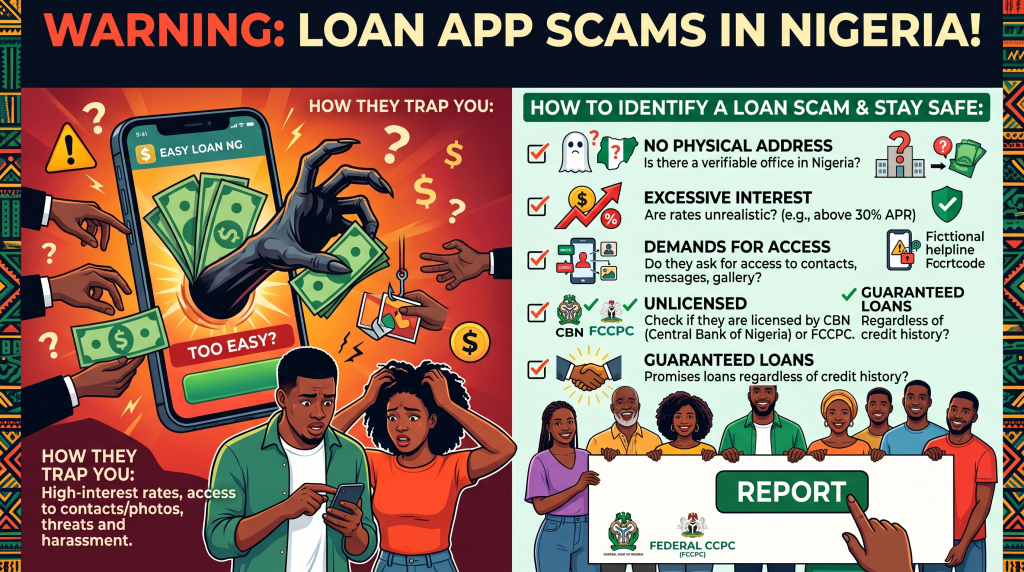
You open Google, type “fast loan Nigeria,” and within seconds you have 40 options — apps, WhatsApp numbers, Instagram pages. Some promise ₦100,000 in 5 minutes. Some say no BVN required. Some print “CBN approved” right in the name.
Here is what nobody tells you at that moment: a significant portion of those results are either unlicensed lenders, outright loan app scams in Nigeria, or apps engineered to harvest your data and extort you later.
The Federal Competition and Consumer Protection Commission (FCCPC) has been fighting this battle publicly since 2022. They have delisted apps, issued fines, and published enforcement warnings. But new fake loan apps in Nigeria appear faster than regulators can chase them.
This guide gives you the exact tools to tell the difference — before you hand over your BVN, your contact list, and your face.
Why Nigerians Are Easy Targets Right Now
Scammers do not choose random victims. They choose stressed people.
When you are three days from salary and ₦15,000 short on a bill that cannot wait, your brain is not running a full risk assessment — it is running a solution search. Fraudsters know this. They build their entire operation around that 90-second window when desperation beats caution.
The numbers reflect the scale. Between 2022 and 2024, the FCCPC received thousands of consumer complaints tied to digital lending — covering illegal contact-list access, defamatory SMS blasts to borrowers’ family members, and outright theft where applicants paid fees but received zero disbursement. The Commission’s 2022 Limited Interim Regulatory/Registration Framework was introduced specifically because loan app fraud in Nigeria had reached a level that required emergency regulatory action.
The same hustle instinct that makes Nigerians exceptional survivors — find a way, any way — is precisely what loan app scam operators exploit.
The 4 Main Types of Loan App Scams in Nigeria
Memorising a list of bad app names is useless because names change weekly. Understanding the category of scam protects you permanently.
Type 1: The Ghost App (Collect and Disappear)
You apply. You pay an “insurance fee,” “processing fee,” or “account activation charge” — typically between ₦1,500 and ₦10,000. The loan never arrives. The app goes dark. The WhatsApp number stops responding.
Red flag: Any upfront fee before loan disbursement is explicitly prohibited under FCCPC consumer lending guidelines. Legitimate lenders deduct applicable charges from the disbursed amount or bill on repayment — never before.
Type 2: The Data Harvest App
This app actually disburses a small loan — ₦3,000 to ₦10,000 — to establish credibility. But during installation, it demands access to your contacts, gallery, SMS inbox, and GPS location. It never needed those permissions to lend money. It needed them to build a blackmail file. When repayment is due — sometimes even before — your contact list receives messages calling you a thief, a fraudster, or worse. This is the loan app blackmail pattern that has destroyed reputations and driven people to crisis.
Red flag: A loan app that requests gallery or full contact access is a data predator, not a lender. Nigeria’s data protection framework under NDPC (the Nigeria Data Protection Commission) makes this type of access without explicit, informed consent a violation — but enforcement depends on people reporting it.
Type 3: The Impersonator App
This fake loan app copies the name, logo, colour scheme, and even the App Store screenshots of a real, FCCPC-listed lender — then operates entirely outside that company’s verified channels. Victims genuinely believe they are dealing with a known institution. The impersonator charges inflated rates, collects personal data, or simply vanishes after collecting fees.
Red flag: Always download from the official Google Play Store or Apple App Store, search the exact registered company name, and confirm the developer name listed beneath the app matches the lender’s registered business.
Type 4: The Rollover Trap
This variant is registered or semi-registered but profits from deliberately confusing repayment terms. They approve your ₦30,000 loan in minutes, then hit you with rollover fees, compounding daily penalties, and automatic renewal charges. In 30 days, your ₦30,000 debt can become ₦75,000 or more. Technically not a ghost scam — but functionally it destroys your finances.
Red flag: No Total Repayment Amount (TRA) clearly displayed before you accept. These practices were directly targeted in the FCCPC’s 2023 enforcement sweep against digital lenders operating above the regulated cost-of-credit threshold.
11 Warning Signs You Are Looking at a Fake or Dangerous Loan App
Run this checklist before submitting any personal information:
1. They ask for money before giving you money.
Processing fees, activation fees, insurance charges, “slot reservation” fees — all before disbursement. This is the single most reliable signal of a loan app scam in Nigeria. No legitimate lender operates this way.
2. The interest rate is missing or buried.
You cannot find a clear percentage anywhere before you sign up. Or it says “1% daily” without disclosing that equals approximately 365% per year on an annualised basis. FCCPC-registered lenders are required to display cost of credit transparently.
3. The app requests gallery, contacts, or SMS access.
A loan app needs your BVN, your bank account details, and identity verification. It does not need your photos, your WhatsApp conversations, or your full contact list. If it asks for those permissions, exit immediately.
4. Customer service is WhatsApp-only.
No registered business address. No email tied to a corporate domain. No traceable phone number. Just a mobile number that may disappear tomorrow. Real lenders — even small ones — have verifiable contact channels.
5. The Google Play developer name does not match the company name.
Open the app listing. Look at “Developer.” If the app presents itself as “FastCash Nigeria Limited” but the developer is listed as a personal name or unrelated entity, someone is deliberately hiding the trail.
6. Spelling errors, broken English, or cloned branding.
Fraudulent apps are often built quickly using stolen brand assets. Look for inconsistent logo proportions, awkward phrasing in the interface, or registered addresses that return nothing on Google Maps.
7. “CBN approved” or “FCCPC licensed” claims with no verifiable number.
Any developer can type those words in an app description. A genuine lender can provide their FCCPC registration reference, which you can cross-check directly at fccpc.gov.ng.
8. Countdown timers and artificial urgency.
“This offer expires in 8 minutes.” “Only 3 slots left.” Legitimate lenders do not operate flash-sale loan offers. Manufactured urgency is a psychological manipulation tactic designed to stop you from doing the 3-minute FCCPC check.
9. They contacted you first — unsolicited.
Real loan apps do not cold-message you on WhatsApp offering ₦50,000 from nowhere. The loan scam WhatsApp Nigeria pattern is one of the most reported entry points in FCCPC complaint data. Unsolicited loan offers should be treated as presumptively fraudulent.
10. No CAC-registered business name anywhere in the app or website.
Every legitimate digital lender in Nigeria has a business name registered with the Corporate Affairs Commission (CAC). If you cannot find a verifiable CAC registration number, there is a deliberate reason.
11. Reviews are either suspiciously perfect or entirely complaints — nothing in between.
Fraudulent apps seed identical short 5-star reviews at launch: “Very fast! Excellent service! Received money in minutes!” Real app review patterns show balanced, detailed feedback. Always scroll to the 1-star and 2-star sections and read them carefully.
The FCCPC Check: 3 Minutes That Could Save You From Months of Nightmare
The FCCPC maintains a published list of approved digital lenders under its Limited Interim Regulatory/Registration Framework. This is your primary verification tool against fake loan apps in Nigeria.
Step 1: Navigate to fccpc.gov.ng using a manual URL entry — not a Google ad result that may be a phishing page impersonating the regulator.
Step 2: Find the “Digital Lending” or “FCCPC Consumer Protection Nigeria” section. The approved lender list is published here and updated periodically since the 2022 framework came into effect.
Step 3: Search the exact legal company name of the lender you are considering — not the app’s marketing name, but the registered entity. If it is absent from the list, you are dealing with an unregistered operator. Full stop.
Step 4: For lenders claiming CBN licensing (microfinance banks, finance companies, mortgage lenders), cross-verify at cbn.gov.ng under “Licensed Institutions.” A legitimate CBN-licensed institution will appear in the directory.
This entire process takes under three minutes. Three minutes against months of harassment, data exposure, and financial loss.
For further guidance on recognising predatory practices before you apply anywhere, the SmartLoans.ng guide to responsible digital borrowing in Nigeria provides a practical foundation worth reading first.
What to Do If You Have Already Been Targeted by a Loan App Scam
If money has already left your account, or your data has already been accessed, act immediately across all four channels:
Report to the FCCPC: File a formal complaint at fccpc.gov.ng/complaints or call their consumer protection helpline. Document the app name, transaction reference, date, amount paid, and any communications received. Collective complaints are what trigger enforcement actions against loan app fraud in Nigeria.
Report to the EFCC: The Economic and Financial Crimes Commission handles digital fraud cases. File at efcc.gov.ng or visit your nearest zonal office in person. Bring screenshots, bank debit alerts, and all app details.
Flag the app on Google Play: If the scam app is still live, open the listing and select “Flag as inappropriate.” This feeds directly into Google’s review queue and can accelerate removal — protecting others from the same loan app scam in Nigeria.
Alert your contacts proactively: If the app accessed your phone and distributed defamatory messages to your contact list, send a calm, clear explanation before confusion spreads. The shame and silence these scammers count on is their most powerful weapon. Removing it removes their leverage.
Do not pay a second time. Scammers who threaten to release photos or contact your employer are running a secondary extortion play. Paying once signals the threat works. It will escalate, not stop.
How to Tell a Real Loan App From a Fake One in 90 Seconds
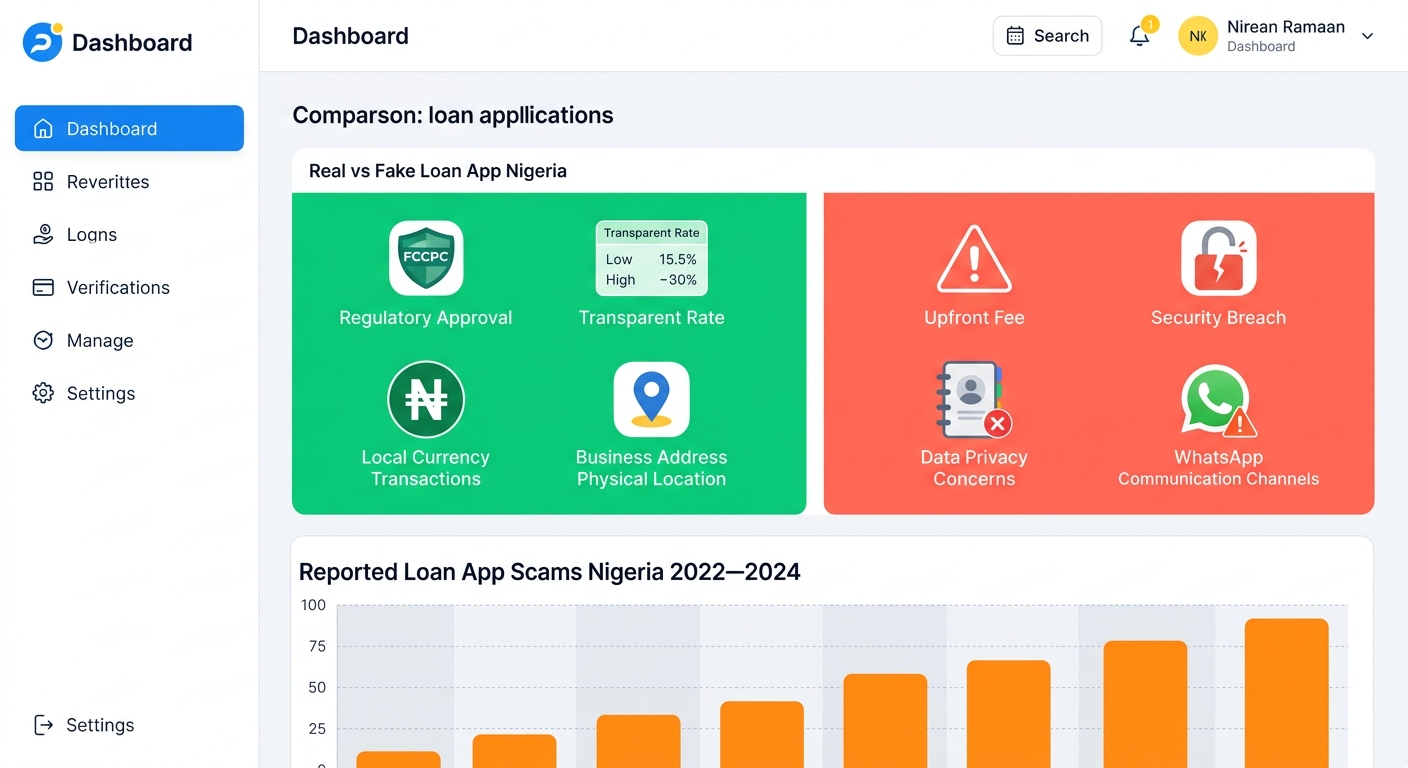
| Signal | Legitimate App | Loan App Scam |
|---|---|---|
| Upfront fee required? | Never | Almost always |
| FCCPC registration number shown? | Yes, verifiable | Absent or fabricated |
| Contact or gallery access requested? | No | Typically yes |
| Physical business address listed? | Yes, traceable | Missing or fake |
| App developer matches company name? | Consistent | Often a mismatch |
| Total repayment shown before acceptance? | Yes, clearly | Hidden or vague |
| Customer service reachable via multiple channels? | Yes | WhatsApp number only |
Two or more red-column answers: close the app and move on. Your time and your data are worth more than a fast ₦20,000 that carries ₦200,000 in consequences.
What Compliant Loan Apps in Nigeria Actually Look Like
Understanding what legitimate looks like makes identifying a loan app scam in Nigeria significantly easier. Compliant digital lenders registered under the FCCPC framework share these non-negotiable characteristics:
- Zero upfront fees. If processing charges apply, they are deducted post-disbursement or built into the repayment schedule — disclosed in writing before acceptance.
- Permissions limited to lending essentials. BVN verification, bank statement analysis, and identity documents. No contact list access. No gallery access. No SMS scraping.
- Clear cost of credit disclosure. You see the principal, the total repayment amount, the fee or interest figure, and the repayment date — all before you click “Accept.”
- A registered company name and address. Traceable on CAC, reachable via a working email and phone line.
SmartLoans.ng maintains a comparison of verified digital lenders operating in Nigeria — a useful reference when you need to validate a lender before applying.
Why Loan App Fraud in Nigeria Continues to Grow
The FCCPC’s 2022 intervention delisted dozens of predatory apps from Nigerian app stores and resulted in regulatory action against multiple operators. But enforcement faces a structural challenge: the barrier to launching a new fraudulent app is lower than the barrier to detecting and removing it.
According to FCCPC statements, over 150 digital lending entities had applied for registration under the framework by mid-2023 — but a much larger number were operating without any registration attempt. The Commission’s own communications acknowledge the gap between regulated entities and the actual volume of lending apps available to Nigerian consumers.
This is not a problem regulators can solve alone. Every consumer who runs a 3-minute FCCPC check before downloading, reports a suspicious loan app scam in Nigeria, and shares verified information with their network directly reduces the operational window available to fraudsters.
The Bottom Line: Protect Yourself Before the Emergency Hits
When you are stressed and short of cash, decisions accelerate. Scammers architect their entire business model around that compressed decision window.
The practical defence against a loan app scam in Nigeria comes down to three tools working together: the FCCPC verification check at fccpc.gov.ng, the 11-signal warning list above, and the 90-second comparison table. Used together, they work faster than the stress does.
Bookmark this page. Share it with someone who borrows regularly. Send it to the group chat before the next financial emergency hits.
The person who sidesteps one loan app scam in Nigeria protects more than money — they protect their contact list, their reputation, and months of peace of mind they will never have to rebuild from a blackmail campaign.
Before you download anything: three minutes at fccpc.gov.ng. That is the whole lesson.
For transparent, FCCPC-compliant personal loans with no hidden fees and no contact-list access, visit LendSafe to explore verified lending options available to Nigerians today.