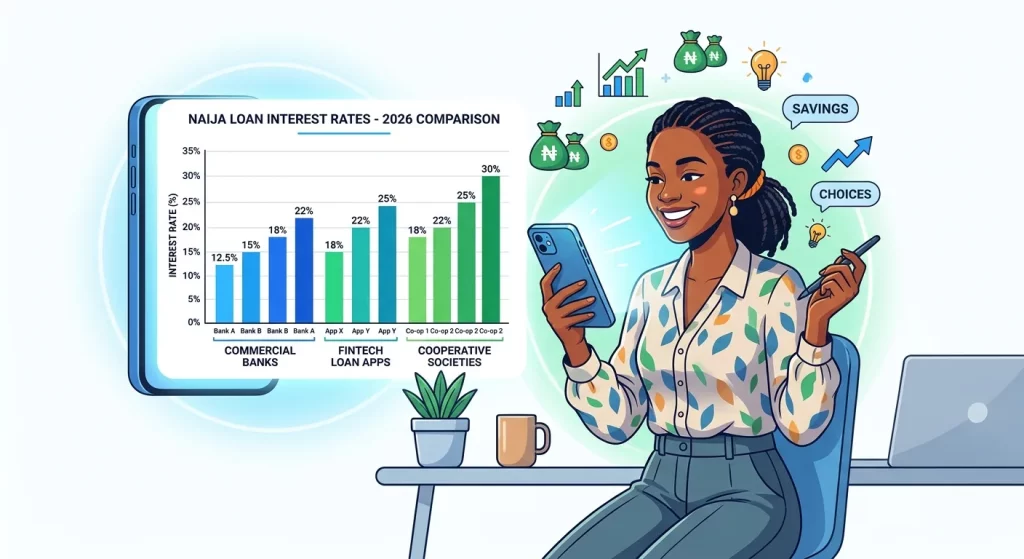
That ₦50,000 Loan That Quietly Became ₦80,000!
Chidi needed ₦50,000 urgently. His landlord had given him a final warning — three days or pack out. He found a loan app, saw “low interest, fast approval,” tapped apply, and got the money in four minutes.
What he did not read carefully: the app charged 3% per month on a flat basis, added a 5% processing fee, and included a “service charge” buried in the terms. By the time his 90-day repayment was complete, he had paid back over ₦78,000.
He was not scammed. The terms were there. He just did not know how to read the numbers.
This guide fixes that. Before you borrow a single naira, you will know exactly what loan interest rates Nigeria 2026 look like across every lender type, how to calculate your real cost, and what a fair deal versus an expensive trap looks like in plain numbers.
Why Loan Interest Rates in Nigeria Feel So High Right Now
You are not imagining it. Borrowing money in Nigeria is genuinely expensive in 2026, and the reasons are structural.
The CBN Monetary Policy Rate (MPR) — the benchmark rate governing what banks pay to borrow from the Central Bank — has remained elevated following the aggressive tightening cycles of 2024–2025. When the CBN MPR is high, every downstream lender raises their own rates to protect margins.
Inflation erodes the real value of money returned to lenders. If inflation runs above 25%, a lender charging 15% per year is actually losing purchasing power — so lenders price above inflation. What feels punishing to you is, from their side, barely breaking even.
Nigeria’s credit bureau penetration also remains relatively low, meaning many borrowers are still considered “unknown risk.” Unknown risk equals higher interest charged to cover potential defaults.
The result: loan interest rates Nigeria 2026 range from 2% to 30% per month depending on lender type, credit profile, loan size, and tenure. That spread is enormous — and navigating it intelligently saves you real money.
Flat Rate vs Reducing Balance: The Calculation That Changes Everything
Before comparing loan interest rates Nigeria 2026 across lenders, you must understand how interest is calculated — because two loans both advertised at “3% monthly” can cost very different amounts.
Flat Rate Method
Interest is calculated on the original loan amount for every month, even as you repay principal.
You borrow ₦50,000 at 3% flat for 3 months.
Monthly interest = 3% × ₦50,000 = ₦1,500
Total interest over 3 months = ₦4,500
Total repayment = ₦54,500
Reducing Balance Method
Interest is calculated on the outstanding balance each month. As you repay principal, interest drops.
Same ₦50,000 at 3% reducing for 3 months.
Month 1: 3% × ₦50,000 = ₦1,500
Month 2: 3% × ~₦33,333 = ~₦1,000
Month 3: 3% × ~₦16,667 = ~₦500
Total interest ≈ ₦3,000 — you save ₦1,500
Most Nigerian loan apps use the flat rate method. It is simpler to explain but significantly more expensive for you. Always ask which method applies before you sign. If a lender cannot answer that question, that itself is a red flag.
CBN Benchmark Rate 2026 — What It Means for Your Pocket
The CBN Monetary Policy Rate functions as the floor beneath all formal lending in Nigeria. Commercial banks typically lend at MPR plus a spread of 5–15 percentage points.
What this means practically:
– Formal bank personal loans: 24%–32% per annum (roughly 2%–2.7% per month)
– Microfinance banks: 3%–6% per month
– FCCPC-registered loan apps: 2%–15% per month
– Unregulated informal lenders: 10%–30% per month and above
The CBN rate provides critical context. If a lender charges you 30% per month, they are not adjusting for market conditions — they are exploiting urgency and lack of alternatives. That is predatory pricing, not legitimate market-driven lending.
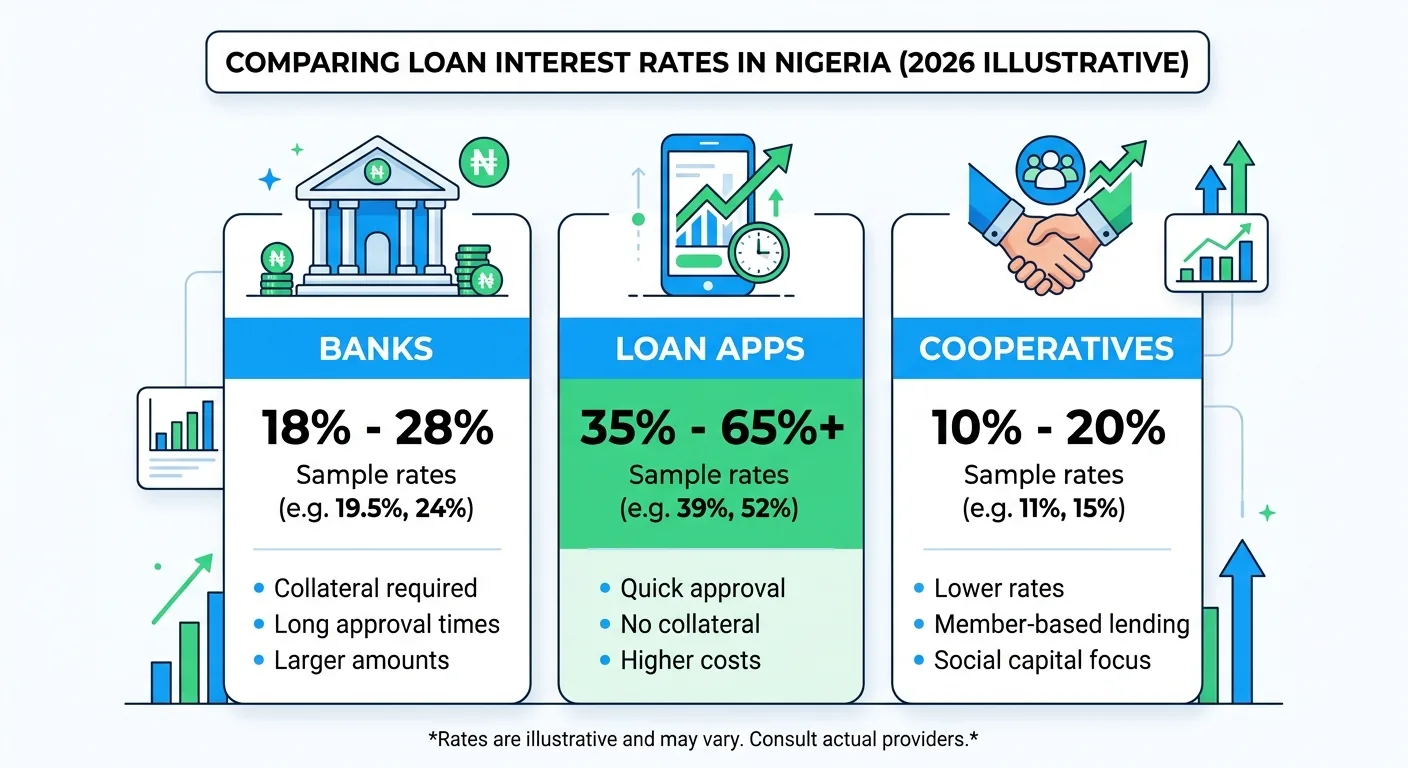
Interest Rate Ranges: Banks vs Loan Apps vs Cooperatives
| Lender Type | Typical Monthly Rate | Regulated By | Approval Speed |
|---|---|---|---|
| Commercial banks (salary loans) | 2%–2.7% per month | CBN | 1–5 business days |
| Microfinance banks | 3%–6% per month | CBN | Same day–2 days |
| FCCPC-registered loan apps | 2%–15% per month | FCCPC | Minutes |
| Cooperative societies | 1%–3% per month | Partially regulated | 1–7 days |
| Unregistered lenders | 10%–30%+ | None | Immediate |
Cooperatives offer the cheapest rates but require existing membership and move slowly. Banks are structured but frequently reject informal-sector workers. Registered loan apps occupy a practical middle ground for urgent needs — provided you choose a verified one. Unregistered lenders are the danger zone: fast money with terms designed to keep you borrowing indefinitely.
The Hidden Costs That Make Your Real Rate Much Higher
The advertised rate is rarely the full picture of what a loan costs in Nigeria. These charges inflate your actual finance charge:
1. Processing / Origination Fee — Charged upfront, typically 2%–5% of the loan. You receive less than you applied for but repay the full amount plus interest.
2. Insurance Fee — Some lenders bundle “loan protection insurance” — sometimes legitimate, sometimes a thinly disguised revenue line.
3. Late Payment Penalties — A 1%–2% daily penalty on overdue balance can escalate a small payment delay into a significant debt spiral within two weeks.
4. Rollover Fees — Extending your loan tenure triggers a rollover fee on top of continuing interest.
5. Platform / SMS / System Charges — Individually small (₦100–₦500), these stack across a loan tenure invisibly.
How to find your true annual percentage rate in Nigeria: Ask for the total repayment figure, then calculate: (Total Repayment − Loan Amount) ÷ Loan Amount. If you borrow ₦50,000 and repay ₦68,000, your cost is ₦18,000 — regardless of what the stated monthly rate claims.
Real ₦ Examples: What Your Loan Actually Costs in 2026
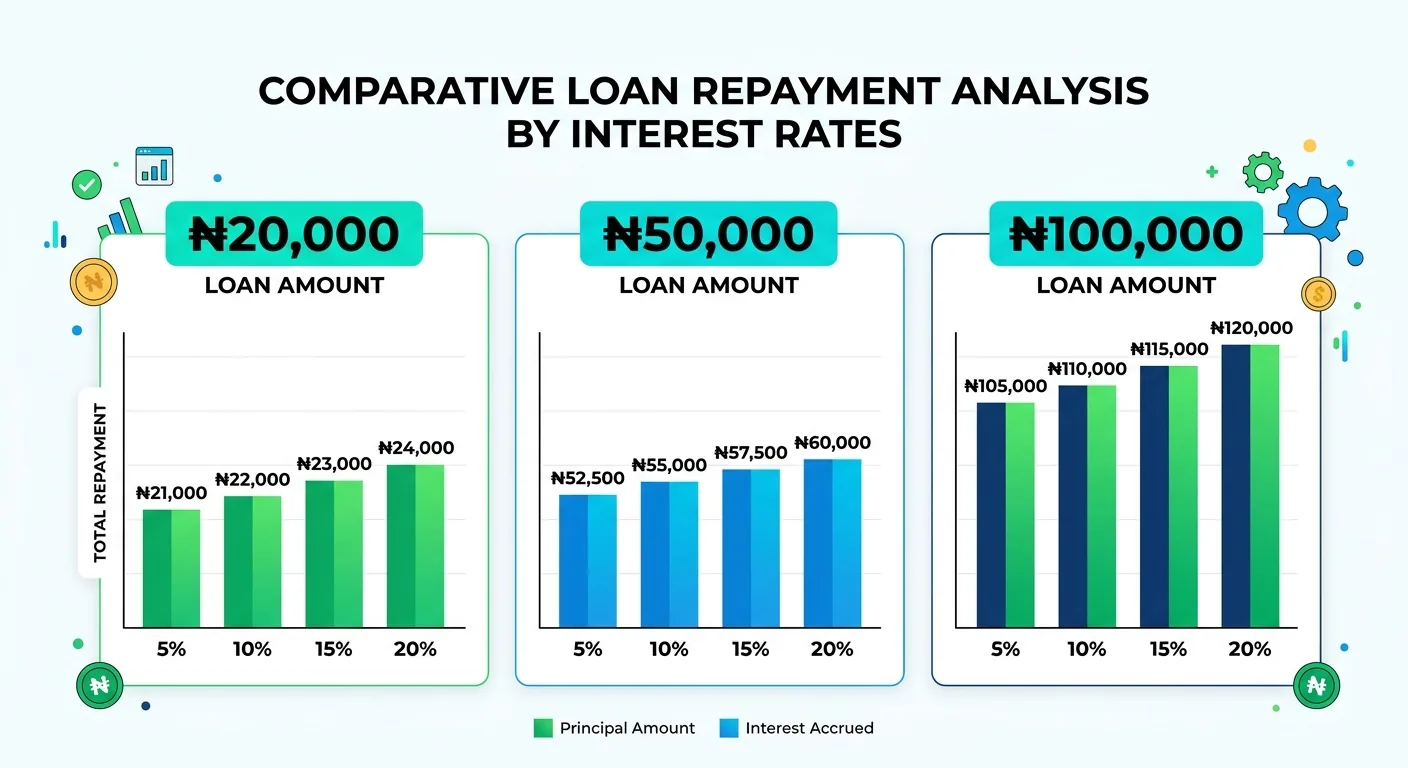
₦20,000 — 30-Day Loan (Flat Rate)
| Monthly Rate | Total Repayment | Interest Paid |
|---|---|---|
| 5% flat | ₦21,000 | ₦1,000 |
| 10% flat | ₦22,000 | ₦2,000 |
| 20% flat | ₦24,000 | ₦4,000 |
₦50,000 — 60-Day Loan (Flat Rate)
| Monthly Rate | Total Repayment | Interest Paid |
|---|---|---|
| 5% flat per month | ₦55,000 | ₦5,000 |
| 10% flat per month | ₦60,000 | ₦10,000 |
| 15% flat per month | ₦65,000 | ₦15,000 |
₦100,000 — 90-Day Loan (Flat Rate)
| Monthly Rate | Total Repayment | Interest Paid |
|---|---|---|
| 3% flat per month | ₦109,000 | ₦9,000 |
| 7% flat per month | ₦121,000 | ₦21,000 |
| 15% flat per month | ₦145,000 | ₦45,000 |
That ₦45,000 interest on a ₦100,000 loan is not a typo. It is exactly why understanding loan interest rates Nigeria 2026 before you apply is non-negotiable. Use these figures as your benchmark before accepting any offer.
How to Spot a Fair Rate vs a Trap Rate Before You Sign
You do not need a finance degree. You need five questions answered before you tap “Accept Offer.”
✅ Question 1: What is my total repayment amount in naira?
Not the rate — the total naira figure. Any legitimate lender shows this upfront.
✅ Question 2: Is the lender registered with the FCCPC or CBN?
Check the FCCPC Consumer Credit portal or the CBN licensed institutions list. Five minutes of verification protects your money and your data.
✅ Question 3: Is the rate flat or reducing balance?
Flat rates are more expensive. Know which applies before you commit.
✅ Question 4: Are there fees beyond the stated interest?
Processing fees, insurance, platform charges — demand a complete breakdown, not just a headline rate.
✅ Question 5: What is the daily penalty for a missed repayment?
A lender charging 5% per day on overdue balances can transform a ₦20,000 loan into a debt emergency within two weeks.
Clear answers to all five: you are dealing with a legitimate lender. Vague, deflected, or buried answers: walk away.
What LendSafe Charges — and Why Transparency Matters
LendSafe publishes your total repayment amount in naira before you confirm your loan. Not “you’ll see the breakdown after disbursement” — the exact figure is visible at the acceptance stage.
Rates on LendSafe reflect your credit profile, loan amount, and chosen tenure. Borrowers with consistent on-time repayments access lower rates over time — the platform is designed to reward responsible borrowing, not to keep users trapped in high-cost debt cycles.
LendSafe operates within the consumer protection framework governing Nigerian digital lenders and can be verified independently. If you are comparing loan interest rates Nigeria 2026 across providers, start with a lender that shows you the full naira cost before you agree to anything.
Quick Checklist Before You Borrow
Screenshot this and use it every time.
- [ ] I know the total naira amount I will repay — not just the stated rate
- [ ] I know whether the rate is flat or reducing balance
- [ ] I have confirmed the lender is FCCPC or CBN registered
- [ ] I have asked about all fees beyond the stated interest
- [ ] I know the daily penalty for late or missed payments
- [ ] The repayment fits within my actual monthly income without requiring another loan
- [ ] I have compared at least two lenders before accepting any offer
Frequently Asked Questions
What is a reasonable monthly interest rate for a loan in Nigeria in 2026?
For a registered lender, 3%–8% per month is within the normal market range depending on loan size and credit history. Anything above 15% per month warrants full cost calculation and serious scrutiny before acceptance.
Does the CBN regulate loan app interest rates?
The CBN regulates banks and microfinance institutions directly. Digital loan apps fall under FCCPC oversight for consumer protection. Neither body sets a fixed rate cap currently, but both require registered lenders to disclose total costs clearly.
How do I calculate my actual loan cost in Nigeria?
Multiply the loan amount by the monthly rate, then multiply by the number of months. Add any processing fees. That total is your interest. Add it to the principal for your total repayment figure. If the lender’s quoted total does not match — ask for an explanation before signing.
Are cooperative loans genuinely cheaper than loan apps?
Yes. Cooperative monthly interest rates in Nigeria typically run 1%–3%, making them the most affordable formal borrowing option. The trade-off is membership requirements, slower approval, and limited loan amounts for new members.
Bottom Line
Loan interest rates Nigeria 2026 range from manageable to genuinely dangerous depending on who you borrow from and whether you read the full terms before signing. The CBN rate environment makes cheap credit structurally difficult — but that does not mean every high-rate lender is charging fairly. Many are exploiting urgency. Some are not.
The difference between a loan that helps you and a loan that traps you is almost always visible before you sign — if you know what to look for. Now you do.
Ready to see what a transparent loan offer actually looks like? Check your rate on LendSafe — no commitment, no hidden figures, total repayment shown before you confirm.