If you have been turned down by a loan app in Nigeria and suspect your credit score is the reason, this guide is for you. A loan with bad credit score Nigeria borrowers can actually access does exist — but only once you understand what the system is really doing, and which myths are keeping you from the right options.
Not magic approvals. Not empty promises. Just the honest picture — who can still lend to you, what you can do right now, and what traps to avoid when desperation sets in and someone online is promising “instant approval, no checks.”
Let us go through it, myth by myth.
Myth 1: “Bad Credit in Nigeria Is the Same as Bad Credit Abroad”
First, breathe. A loan with bad credit score Nigeria situation is genuinely different from what the same phrase means in the UK or the United States, where a single score follows you everywhere for seven years with near-identical consequences across every lender.
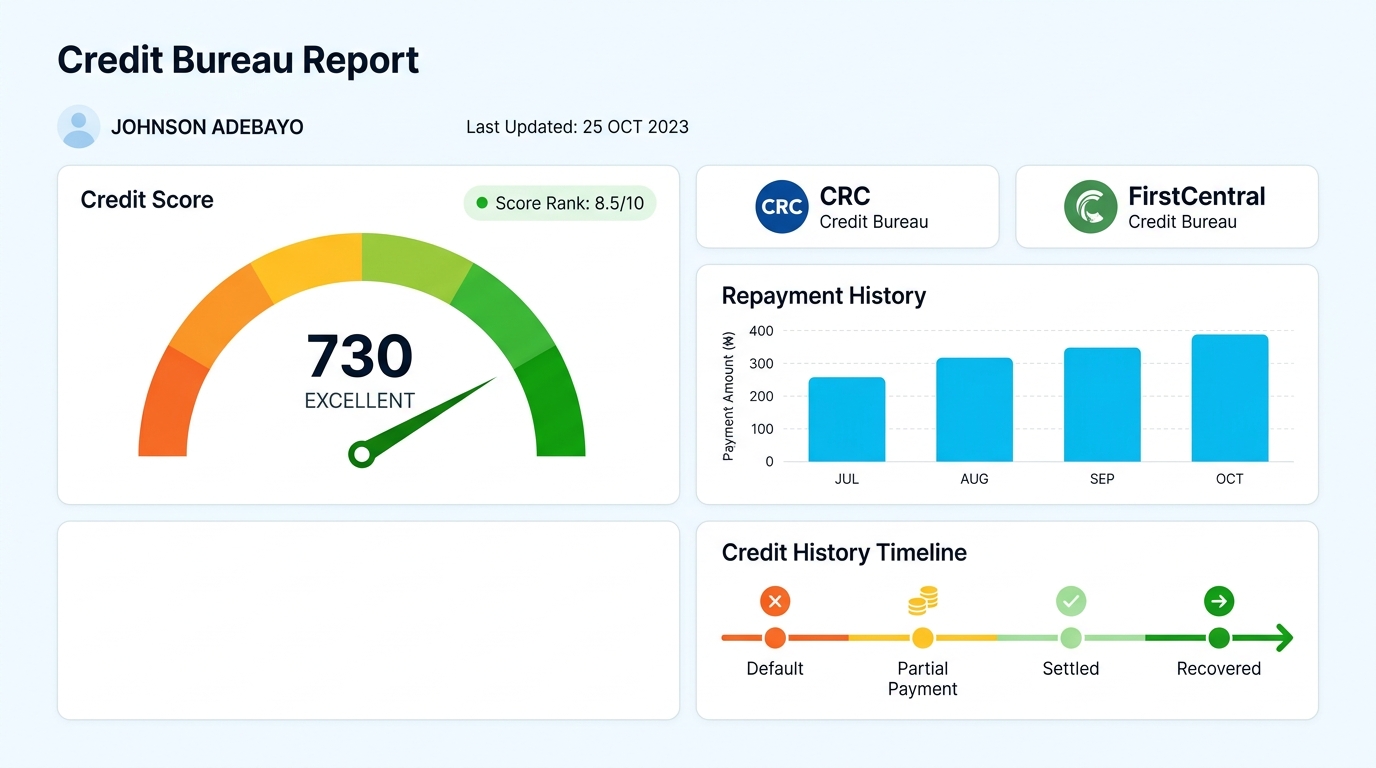
In Nigeria, your credit history lives across two main bureaus: CRC Credit Bureau and FirstCentral Credit Bureau. Your score on these platforms reflects how you have handled previous loans — whether you repaid on time, defaulted, or never borrowed at all.
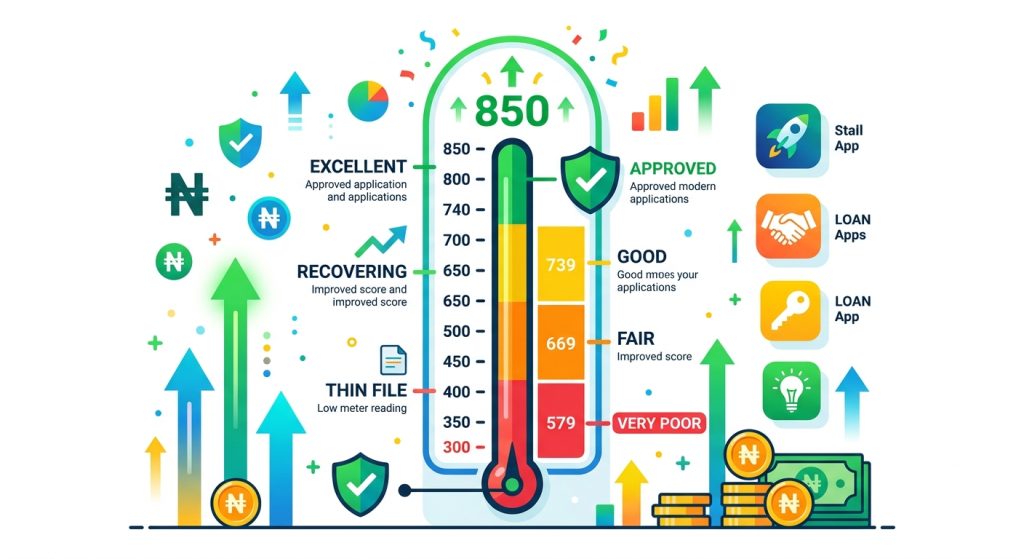
Scores typically fall between 300 and 850 on most bureau scales. A score below 580 is generally considered poor or high-risk by most Nigerian lenders in 2026.
Common reasons Nigerians carry bad credit scores:
– Defaulting on a previous loan app — even one missed repayment on FairMoney, Branch, or Palmpay is recorded
– Being reported by a lender even when you disputed the debt amount
– A guarantor relationship on a loan the primary borrower defaulted on
– Fraud flags triggered by identity mismatches between BVN, NIN, or bank records
– No credit history at all — millions of Nigerians are “credit invisible,” meaning bureaus have no data on them, which many lenders treat the same as bad credit
That last point is critical. If you have never taken a loan, you may be rejected not because you are risky, but because the algorithm has nothing to evaluate. The system does not know how to trust what it cannot measure.
Myth 2: “Lenders Only Look at One Number”
When you submit an application to a regulated Nigerian loan app, here is what actually happens in the background — usually within seconds:
- Your BVN triggers a CRC and/or FirstCentral bureau pull, showing your full repayment history across connected lenders
- Your phone — if you granted data access — may be scanned for SMS patterns, airtime recharge frequency, bank credit alerts, and financial app usage
- Some lenders run bank statement analysis via Open Banking integrations like Mono or Okra
- Your NIN linkage is verified to confirm identity match and detect fraud flags
- Your device metadata (phone model, OS version, app install date) may factor into the risk model
The bureau check is the hardest gate. According to the Credit Bureau Association of Nigeria (CBAN), lenders connected to CRC and FirstCentral can access repayment data going back several years. If a lender reported you as a defaulter two years ago — even if you later settled — that record may still be active and visible to every subsequent lender who runs your BVN.
Understanding this pipeline is the first step to knowing exactly where you can intervene.
Myth 3: “If One App Rejects You, They All Will”
This is the myth that keeps the most people stuck. Anyone searching for a loan with bad credit score Nigeria lenders will realistically approve needs to understand that scoring models vary enormously across platforms.
Here is the honest breakdown by credit situation:
| Your Credit Situation | Realistic Outcome |
|---|---|
| One missed repayment, since repaid | Low to medium approval chance — some apps will still approve |
| Multiple defaults, active | Hard. Most regulated apps will decline automatically |
| No credit history at all | Moderate chance — some apps treat new borrowers better than defaulters |
| Blacklisted on CRC/FirstCentral | Very hard. Clearing the record is the necessary first step |
| Fraud flag on BVN | Near impossible until resolved directly with the bureau or lender |
The difficult truth: if you are actively blacklisted with multiple defaults across several lenders, most responsible apps will decline you immediately. Anyone promising otherwise — especially with “no bureau check, no BVN, instant approval” — is running a scam or about to charge you predatory fees that make the situation far worse.
But if your situation falls in the middle rows of that table, you have real options.
More flexible with bad credit or thin credit files:
– Carbon (Paylater) — builds its own internal behavioral score from phone data, which can override a weak bureau result
– FairMoney — uses transactional and behavioral data; sometimes approves where others decline
– Palmcredit — known for approving smaller amounts to first-time borrowers regardless of bureau history
– Branch — relies heavily on phone-based alternative scoring; bureau is one input among many
– Umba — focuses on bank transaction patterns more than bureau scores
– LendSafe — evaluates applications using income signals and repayment capacity alongside bureau data, rather than bureau score alone
More strict (bureau-heavy lenders):
– Commercial bank personal loans (GTBank, Zenith, Access Quick Credit)
– LAPO and most formal microfinance banks
– Salary advance products from employer-linked fintechs
Important: Even flexible lenders will start you at low limits — ₦2,000 to ₦20,000 — when your bureau score is thin or damaged. Do not reject a small offer out of frustration. Accept it, repay early, and your limit grows on the next cycle.
Myth 4: “Your Bureau Score Is the Only Thing That Matters”
If your bureau score is weak, many lenders shift their evaluation to alternative data signals. Knowing these signals helps you optimize your profile before applying.
Key alternative signals Nigerian lenders use in 2026:
- Bank SMS patterns — regular salary credits, utility payments, and airtime purchases signal income stability
- Airtime recharge consistency — consistent top-ups indicate a regular income flow, even for informal earners
- App engagement history — how long you have had the lender’s app installed and whether you engaged with it previously
- Repayment of any prior loan on that specific platform — a ₦3,000 loan repaid on time on Branch makes you more creditworthy on Branch specifically
- Phone type and device value — some lenders use device value as a proxy for income level, affecting risk tier
- Bank transaction regularity — lenders using Mono or Okra integrations look for consistent inflows, even from informal business income
According to a 2023 EFInA Access to Financial Services in Nigeria survey, over 38% of Nigerian adults remain financially excluded, partly because of thin credit files rather than actual financial irresponsibility. Alternative data scoring is the mechanism designed to serve this population — use it to your advantage.
Myth 5: “There Is Nothing You Can Do Before Applying”
You need cash urgently. You cannot wait months to rebuild. But there are actionable steps you can take within 24–72 hours before your next application for a loan with bad credit score Nigeria lenders will consider:
Step 1: Check your own credit report
Visit CRC Credit Bureau or FirstCentral and pull your report. You are entitled to a free annual check. Look for errors — lenders sometimes report incorrectly, and a successful dispute can clear your file faster than any other single action.
Step 2: Clear any balance you can, then confirm in writing
Even a partial payment on an old loan debt — followed by a message to the lender requesting written confirmation — can shift your status from “active default” to “partially settled.” Bureaus update within 60 days of the lender submitting revised data.
Step 3: Apply to lenders who use alternative scoring first
Do not keep reapplying to the same strict lender repeatedly. Each logged decline can compound your risk profile. Target apps known for alternative scoring models — see the list in Myth 3 above.
Step 4: Start with the smallest loan amount available
Accept the minimum offer. Repay within the first week, even if you have a 30-day term. Early repayment signals reliability and typically triggers a limit increase on your next application cycle.
Step 5: Maintain identity consistency
Use the same phone number, BVN, and bank account across all applications. Switching numbers or accounts between attempts creates identity inconsistencies that flag automated risk systems immediately.
If you are ready to apply right now, LendSafe processes loan with bad credit score Nigeria applications based on income and repayment capacity signals — not bureau score alone.
Myth 6: “All Lenders Willing to Help Bad Credit Borrowers Are Legitimate”
This is the most dangerous myth. When legitimate apps have rejected you, certain actors will find you — through WhatsApp groups, Instagram DMs, Facebook marketplace listings, and Telegram channels.
Reject any offer that includes these red flags:
- “No BVN required, no credit check, ₦50,000 in 10 minutes” — this does not exist legitimately in Nigeria’s regulated lending space
- Upfront fee before disbursement — any lender asking you to pay ₦1,500 or ₦3,000 to “unlock” your loan is a scammer. No CBN-regulated lender charges upfront fees
- A “loan agent” on social media not linked to a verified app on Google Play or the iOS App Store
- Interest rates quoted as “₦500 per day” or vague percentages with no written loan agreement
- Pressure to decide in under one hour — legitimate lenders give you time to read terms before signing
The FCCPC (Federal Competition and Consumer Protection Commission) maintains an approved digital lenders list. Before accepting any loan, confirm the company appears on that list and holds a valid CAC registration number.
Bad credit makes you a target precisely because scammers know you have already been rejected and are more likely to accept terms without reading them carefully.
Myth 7: “If Every App Rejects You, You Are Out of Options”
If you have applied to multiple apps and every one has declined, stop applying for 30 days. Multiple logged applications against your BVN within a short window compound your risk classification and make the next round even harder.
Alternative paths while you pause app applications:
- Cooperative society — if your employer, trade association, market, or church has a cooperative, this is often the most flexible and cheapest credit source for Nigerians with poor bureau scores. Underwriting is community-based and human, not algorithmic
- Employer salary advance — go directly to HR or payroll. Formal employer advances do not require bureau checks in most organizations, and repayment is deducted at source
- Trusted personal network — a ₦10,000 soft loan from a family member repaid on time is infinitely better than a 30% monthly interest app loan that damages your score further
- Asset liquidation — Jiji listings for phone accessories, electronics, or clothing can generate immediate liquidity without creating new debt
- LAPO Microfinance Bank — physical branch presence, community underwriting, and more human judgment than app-based automated scoring
For SME owners, LendSafe also provides small business financing options that assess revenue history rather than relying purely on personal credit bureau scores.
Your Score Is Not a Life Sentence
A bad credit score in Nigeria is painful — it limits options at the worst possible moments. But it is not permanent. The Nigerian credit system is younger and more recoverable than most borrowers realize.
Here is what the data and lender behavior shows:
- Most loan apps update internal scores within 30–90 days of repayment improvement
- CRC and FirstCentral update bureau records within 60 days of a lender submitting new repayment data
- Borrowers who take two small loans and repay both on time typically move from high-risk to medium-risk classification on most platforms within six months
The person who takes a ₦5,000 loan this month and repays it in seven days has better standing by Q3 than someone who borrowed nothing and stayed “clean.” Every loan with bad credit score Nigeria borrowers successfully repay — even a tiny one — is evidence the algorithm learns from.
The Nigerian credit system rewards demonstrated behavior, not just passive history.
Quick Reference: Bad Credit Loan Action Plan
| Step | Action | Timeline |
|---|---|---|
| 1 | Pull your CRC or FirstCentral credit report | Today |
| 2 | Dispute any errors found in the report | 3–7 days |
| 3 | Apply to alternative-scoring apps (Branch, Carbon, LendSafe) | Today |
| 4 | Accept the smallest approved loan amount offered | Immediately |
| 5 | Repay early — before the stated due date | Within 7–14 days |
| 6 | Reapply at a higher amount on the same platform | 30 days later |
| 7 | Repeat the cycle until your score recovers | 3–6 months total |
Frequently Asked Questions
Q: Can I get a loan with bad credit score in Nigeria without a BVN?
No legitimate lender in Nigeria processes loans without BVN verification. Any offer claiming otherwise is a scam. Your BVN is the identity anchor the entire lending system uses — for your protection as much as the lender’s.
Q: How long does a default stay on my CRC record in Nigeria?
Nigerian bureaus typically retain negative data for five years from the date of default. However, lenders who settle or restructure a debt can update the record to “settled” — which significantly improves your profile even before the five years elapse.
Q: Does applying to many loan apps at once hurt my credit score?
Multiple applications within a short period can signal desperation to risk algorithms and may be flagged negatively. Spread applications across different sessions and focus on apps with alternative scoring models rather than bureau-heavy lenders.
Q: What is the fastest way to improve a bad credit score in Nigeria?
Dispute any errors on your bureau report, settle any outstanding defaults you can afford to clear, then take and repay a small loan on a flexible platform. Two on-time repayments within 90 days create measurable positive signals in the system.
Q: Is LendSafe available to borrowers seeking a loan with bad credit score in Nigeria?
LendSafe uses income signals and repayment capacity as primary evaluation criteria. While bureau data is considered, a thin or imperfect bureau file does not automatically disqualify your application.