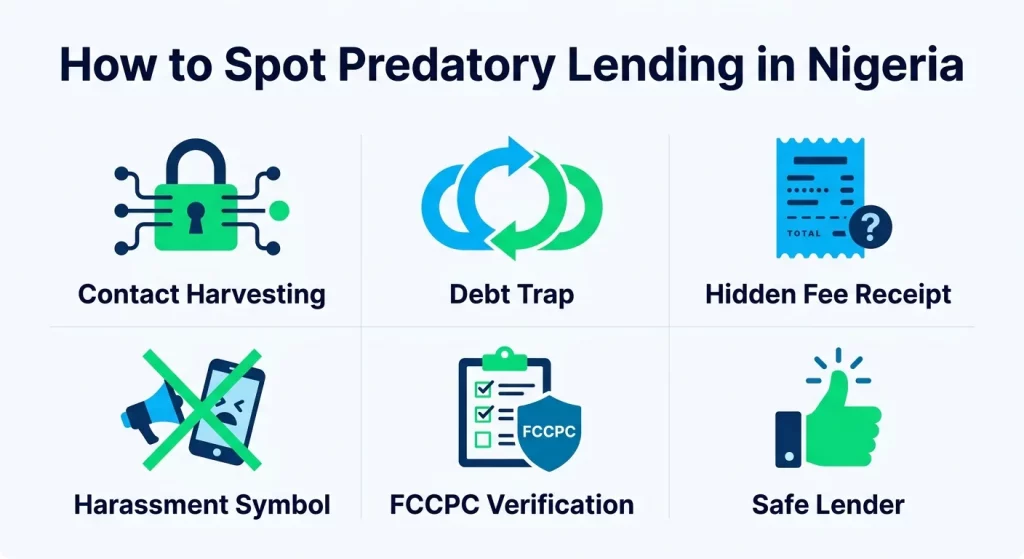
This guide breaks down exactly how predatory lending in Nigeria operates, how to identify dangerous lenders before you borrow, what your legal rights are if you are already caught, and how to find a lender you can actually trust in 2026.
What Predatory Lending Actually Means in Nigeria
Predatory lending Nigeria is not simply about high interest rates. It is a deliberate system engineered to trap borrowers inside a cycle of debt they cannot escape — using hidden fees, manipulative loan terms, and aggressive collection tactics that violate Nigerian consumer protection law.
In Nigeria, predatory lending has two dominant forms:
Face 1: Illegal loan apps. These are applications downloaded from third-party sources or — increasingly — even from the Google Play Store, operating without a valid Central Bank of Nigeria (CBN) licence or Federal Competition and Consumer Protection Commission (FCCPC) registration. They offer fast cash, harvest your entire phone contacts list at sign-up, and then weaponise that list the moment you miss a single repayment.
Face 2: Informal loan sharks. Operating in markets, motor parks, and densely populated urban neighbourhoods, these lenders offer cash with no documentation, charge compounding daily interest that outpaces any salary, and use physical intimidation as a primary collection strategy.
Both categories represent predatory lending in Nigeria. Both are illegal under the FCCPC Digital Lending Framework. And both are thriving because millions of borrowers do not yet know how to identify them before signing up.
The 6 Most Common Predatory Tactics Used on Nigerians Right Now
Understanding the specific tactics is your first and most effective line of defence against predatory lending in Nigeria.
Tactic 1: Contact Harvesting Disguised as “Loan Security”
The app requests full access to your phone contacts as a condition of loan approval. This is not a security measure — it is a hostage mechanism. Licensed lenders registered under the CBN or FCCPC do not require your contacts list to verify your identity or assess your creditworthiness. Any lender demanding this is building their collection toolkit before you even borrow a kobo.
Tactic 2: The Rollover Trap
You borrow ₦15,000 for 14 days. On day 14, you cannot pay in full. The app offers a “rollover” — another 14-day extension — but charges a fresh origination fee plus continued daily interest. What began as a ₦15,000 obligation becomes ₦28,000 by day 28. Borrowers who roll over four or five times have ended up repaying five times the original principal. This is one of the most documented debt trap Nigeria mechanisms.
Tactic 3: Undisclosed Fees Deducted at Disbursement
You apply for ₦30,000. The app approves ₦30,000. But after “processing fees,” “insurance charges,” and “platform levies” are quietly deducted, only ₦21,000 reaches your account — while you repay the full ₦30,000 plus interest. These charges are either buried deep in a terms document written in dense legal language or simply never disclosed at all. This is a direct violation of FCCPC transparency requirements.
Tactic 4: Falsified or Missing Repayment Records
Some predatory lenders record your repayment incorrectly or claim payments were never received, enabling them to continue charging penalties on amounts you have already settled. Without a documented transaction trail — a bank receipt, a payment confirmation email, an in-app acknowledgement — you have no evidence to dispute the claim.
Tactic 5: Shame-Based Harassment via Contact Broadcasting
Messages are sent to your saved contacts — family, colleagues, church members, former classmates — characterising you as a fraudster, criminal, or deliberate defaulter, even when you are merely one or two days late. In Nigeria’s tightly connected communities, this causes severe social and professional harm. It is calculated humiliation, not debt collection. The FCCPC received over 1,500 documented harassment complaints against illegal loan apps between 2022 and 2024 alone.
Tactic 6: Hidden Balloon Payments Inside Short Loan Terms
Your repayment schedule shows small weekly amounts that look affordable. But buried in the fine print is a large lump-sum balloon payment due at the final week. Most borrowers miss this until the final day, at which point default penalties begin compounding immediately. This is one of the most structurally deceptive features of high interest loans in Nigeria.
How to Spot a Predatory Loan App Before You Download
Before you enter your BVN or bank details anywhere, scan for these warning signals of predatory lending in Nigeria:
- No CBN or FCCPC licence number listed in the app, on the website, or in the Play Store description
- Demands access to your contacts, SMS, or photo gallery as a condition of approval
- No physical business address and no functional customer support line
- Monthly interest above 30% with no clear total repayment figure shown
- Instant approval with zero identity verification — skipping BVN checks means they have nothing to lose if you default; you bear all the risk
- App is not available on the official Google Play Store or Apple App Store
- No written loan agreement provided before disbursement
- Requires an upfront fee — any “insurance deposit,” “activation charge,” or “processing advance” before funds are released is a classic fake loan app Nigeria scam structure
If three or more of these apply to a lender you are considering, stop. The loan is not worth what follows.
The FCCPC and CBN Test: How to Verify Any Lender in 2 Minutes
Nigeria has two regulatory bodies covering consumer lending. Use both before you commit to any loan — especially when evaluating whether a lender is part of the predatory lending Nigeria ecosystem.
The Central Bank of Nigeria (CBN) licences microfinance banks and financial institutions authorised to offer loans. You can verify a lender’s status at www.cbn.gov.ng under the “Financial Institutions” section.
The Federal Competition and Consumer Protection Commission (FCCPC) maintains a public register of approved digital lenders under its Limited Interim Regulatory/Registration Framework, first published in 2022 and updated through 2024. This is the definitive FCCPC licensed lenders list for Nigeria. You can access it at fccpc.gov.ng.
The 2-Minute Verification Process:
1. Go to fccpc.gov.ng
2. Navigate to “Digital Lending” or search “approved lenders”
3. Download the most current approved list PDF
4. Search the document for the lender or app name
If the lender does not appear on that list, they are operating illegally under Nigerian law — regardless of how professional their app looks or how fast their approval process is. A polished user interface is not a licence.
Real Cost Comparison: Predatory Lender vs Licensed Lender
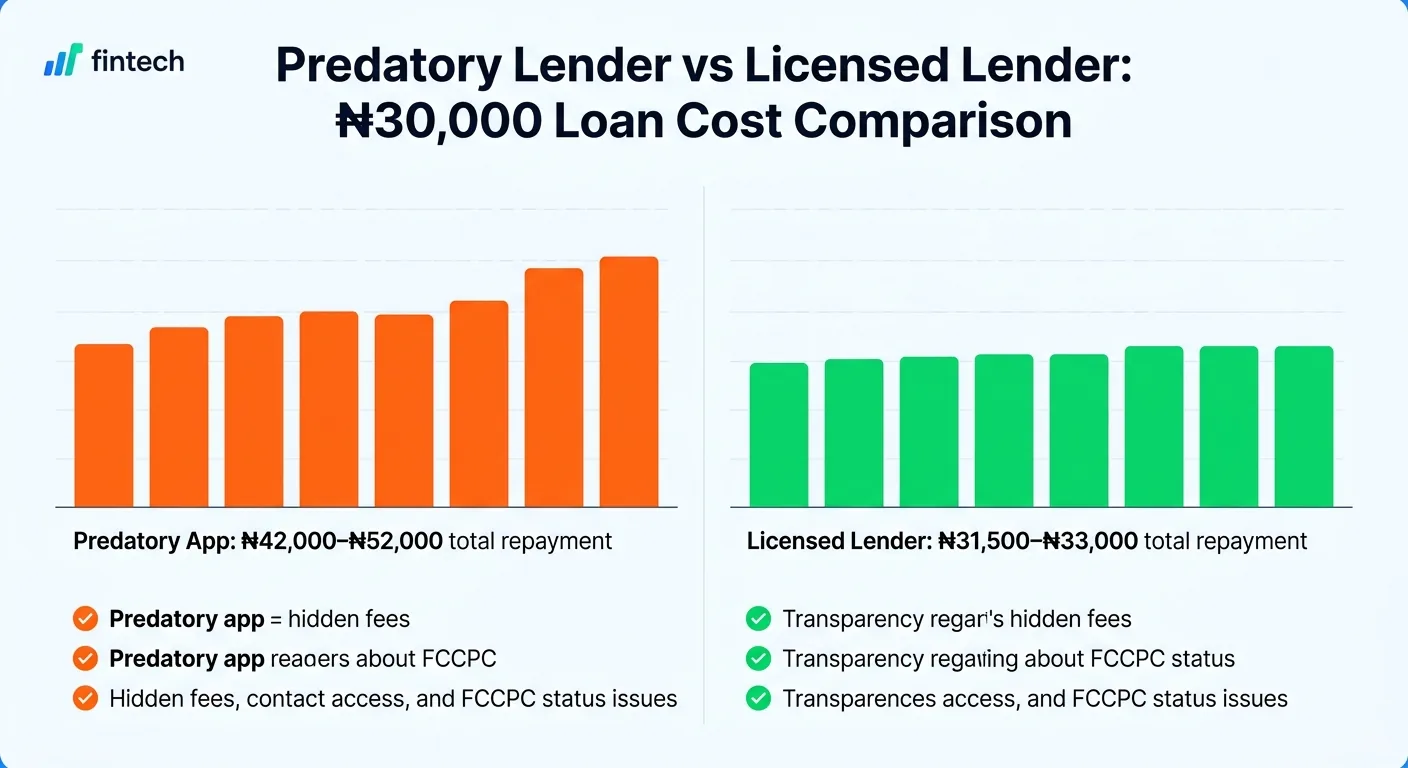
Here is what borrowing ₦30,000 for 30 days genuinely costs — depending on who you borrow from:
| Factor | Predatory Loan App | Licensed Lender |
|---|---|---|
| Amount Applied For | ₦30,000 | ₦30,000 |
| Amount Actually Received | ₦21,000 (fees deducted silently) | ₦28,500 (fees disclosed upfront) |
| Monthly Interest Rate | 25–40% | 4–10% |
| Total Repayment Amount | ₦42,000–₦52,000 | ₦31,500–₦33,000 |
| Hidden Fees | Yes — undisclosed at application | No — all itemised before acceptance |
| Harassment on Late Payment | Yes — contacts targeted from day 1 | No — regulated escalation process |
| Written Loan Agreement | Rarely provided | Always provided before disbursement |
| FCCPC Registration | No | Yes |
The predatory lender appears faster, simpler, and more accessible. That is the entire design. The true cost is two to three times higher, and any payment disruption — even one day late — triggers a cascade that makes repayment exponentially harder. This is the loan trap Nigeria borrowers fall into most often.
What Happens After You Borrow From a Predatory Lender
This is the timeline documented from thousands of verified borrower complaints filed with the FCCPC between 2022 and 2024:
Days 1–7: Disbursement happens quickly. You feel relief. The app experience feels normal.
Days 8–14: Repayment day approaches. If funds are not ready, calls start — sometimes five to ten per day from rotating numbers.
Days 15–21: Contact broadcasting begins. Your mother, employer, church group, or former schoolmates receive WhatsApp messages or SMS texts describing you as a fraudster or criminal. The language is deliberately humiliating and designed to generate social pressure faster than legal action ever could. This is loan harassment Nigeria borrowers fear most — and it is entirely illegal.
Days 22–30: The debt has now grown by 40–80% through rollover fees, daily penalty charges, and “extension processing” costs. The original ₦30,000 is now ₦48,000 to ₦54,000 — on a loan you may have already partially repaid.
Day 31 Onwards: Some illegal lenders report borrowers to credit bureaus — including CRC Credit Bureau and FirstCentral Credit Bureau — damaging credit scores for future legitimate borrowing. Others maintain harassment campaigns for months, affecting employment stability and family relationships.
This is not a worst-case scenario. It is the documented standard operating procedure of predatory lending in Nigeria.
How to Borrow Safely: What to Look For in a Legitimate Loan App
Emergency financial need is real. Access to legitimate credit should not require accepting abuse. Here is what a genuinely trustworthy lender looks like in 2026 — the opposite of predatory lending in Nigeria:
✅ Appears on the FCCPC approved digital lenders register
✅ Operates under a CBN licence or under a CBN-licensed microfinance bank
✅ Does not request access to your phone contacts under any condition
✅ Sends a full loan agreement — itemised fees, interest rate, and repayment schedule — before releasing funds
✅ Displays the total repayment amount clearly before you accept the offer
✅ Has a verified customer support channel — a working phone number, email address, or live chat
✅ Repayment schedule is fixed and transparent with no undisclosed balloon payment
✅ Requires no upfront payment before disbursement — any request for an advance “insurance fee” or “processing deposit” is definitionally fraudulent
A licensed lender generates revenue when you repay successfully. Their business model depends on your financial health, not your financial desperation. That structural difference matters enormously.
For Nigerians who want to verify safe borrowing options and understand standard market interest rates, the LendSafe Nigeria resource hub provides detailed comparisons of licensed lenders operating in Nigeria. You can also review current borrower guides and eligibility tools at LendSafe before committing to any loan application.
Borrow Smart, Not Desperate
Predatory lending Nigeria survives on a single condition: that borrowers are too financially stressed, too ashamed, or too rushed to check credentials. Every element of the predatory loan experience — the instant approval, the minimal paperwork, the urgency framing — is engineered to bypass the moment of reflection where you would ask the basic questions.
The defence against predatory lending in Nigeria is not complicated. It is just four actions:
- Check the FCCPC approved lenders list before downloading any loan app
- Read the total repayment figure — not just the advertised weekly or monthly rate
- Confirm the app does not request your contacts
- Require the loan agreement in writing before accepting any disbursement
If a lender resists any of these four conditions, that resistance is your answer.
Legitimate emergency loans are available in Nigeria from lenders who are FCCPC-registered, CBN-compliant, and built for borrowers who need real financial support — not a debt trap that compounds every time you cannot pay.
No contact harvesting. No hidden fees. No shame-based collection.