
You Work. You Get Paid. By Week Three, the Money Is Gone.
Smart spending in Nigeria is not a luxury skill reserved for high earners — it is the single most practical financial habit any salary earner can build. Yet every month follows the same exhausting pattern for millions of Nigerians: salary enters, bills hit, life happens, and by the 20th you are either borrowing from someone or rationing data and transport money.
You are not lazy. You are not careless. You are probably not even earning too little — at least not entirely.
Most Nigerians stuck in this cycle are not victims of one catastrophic financial mistake. They are victims of small, invisible traps that drain money quietly and consistently — in ways that feel completely normal because everyone around them is doing the same thing. The Central Bank of Nigeria’s 2023 Financial Stability Report noted that household debt servicing pressure remains one of the key risks to consumer financial resilience, driven as much by behavioral habits as by macroeconomic conditions.
This article names those traps plainly. No jargon. No lectures. Just the patterns, the real ₦ numbers, and what to do — starting this month.
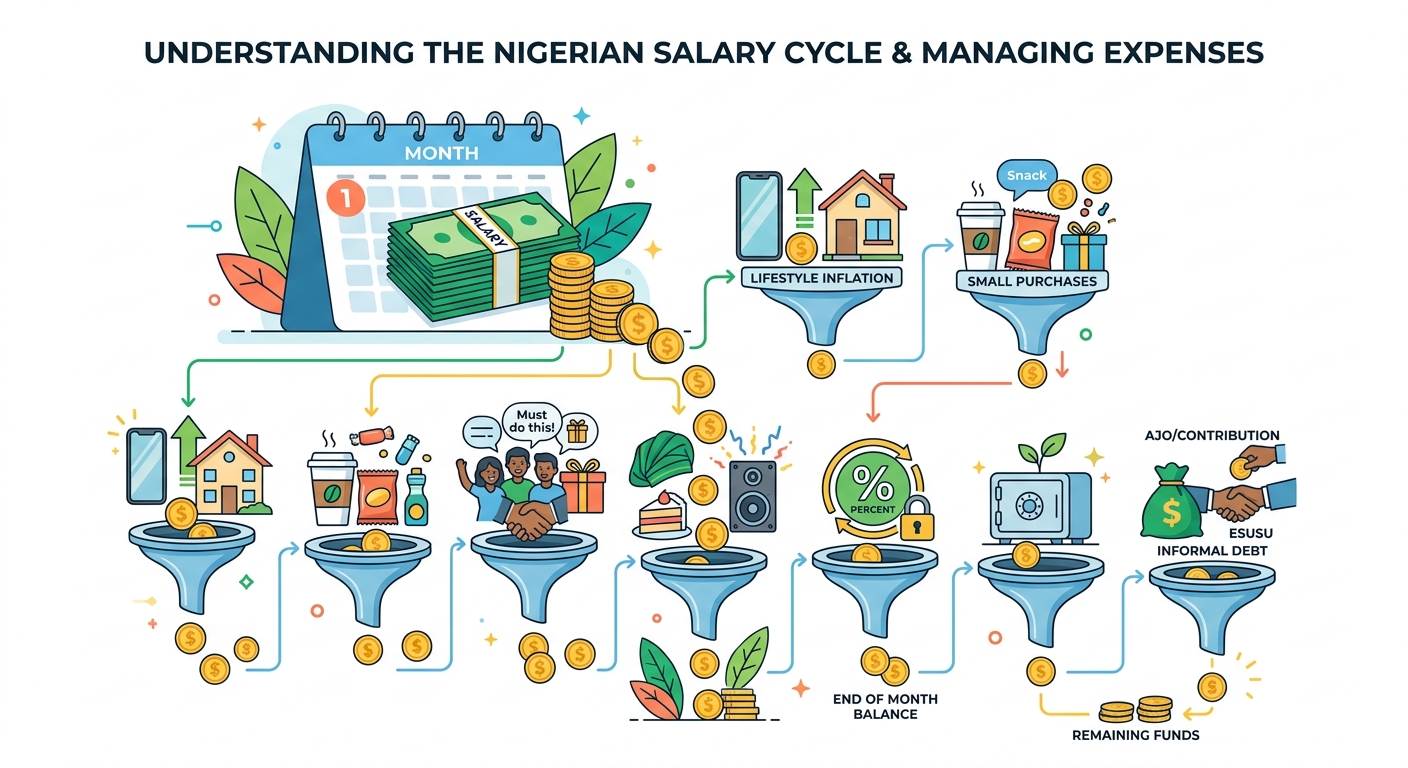
Trap #1: Lifestyle Inflation — You Earn More, You Spend More, You Save Nothing
You got a raise. Or you switched jobs. Or a side income picked up. What happened next?
If you are like most Nigerians, your spending rose to match — or exceed — your new income within 30 to 60 days. New phone. Better estate. More data. Chicken every night instead of every Friday.
This is lifestyle inflation, and it is why people earning ₦200,000 a month are just as financially stressed as people earning ₦80,000. Your brain adjusts its baseline. What was a luxury at ₦80,000 becomes a necessity at ₦200,000. So your needs grow every time your income grows. Your savings stay at zero.
The ₦ reality: A salary earner who jumps from ₦100,000 to ₦160,000 and immediately upgrades their rent from ₦400,000/year to ₦600,000/year has committed an extra ₦16,667/month before spending a single naira on anything else. Add a new data plan, a better restaurant habit, and upgraded transport, and that income increase has completely vanished.
What to do: Before you spend a single naira of any income increase, lock 20–30% of it into savings automatically — within 48 hours. Apps like PiggyVest or a basic savings account work. The key is speed. If you do not touch it in the first two days, your lifestyle will not miss it.
This is the foundation of smart spending in Nigeria: controlling the baseline before it controls you.
Trap #2: The “Small Small” Leak — ₦500 Here, ₦1,000 There, Gone by Month-End
This is the most invisible money trap in Nigerian personal finance.
₦600 late-night suya. ₦400 betting ticket. ₦1,500 hair retouch. ₦800 extra data top-up. ₦300 park food because you left the house without eating. None of these feel significant. Each one feels earned, deserved, or necessary in the moment.
But the math is devastating. If you spend ₦1,500 per day on purchases that feel small — snacks, impulse buys, convenience food, random top-ups — that is ₦45,000 a month leaving your account without a single major purchase attached to it. For someone earning ₦120,000, that is 37.5% of their salary disappearing silently.
This is one of the most common financial mistakes in Nigeria — not overspending on big items, but undercounting the small ones.
What to do: Track spending for just one week — not one month, just seven days. Use your bank’s statement download or a plain notes app. Category totals will surprise you. Even cutting discretionary micro-spending by half frees up ₦15,000 to ₦22,000 monthly. That is loan repayment capital. That is emergency fund seed money.
Trap #3: Social Pressure Spending — “I Don’t Want Them to Think I’m Suffering”
This trap is cultural, emotional, and deeply expensive.
Splitting a bill you cannot afford. Buying a round of drinks because you did not want to look broke at the table. Sending ₦5,000 to a cousin’s birthday fundraiser because you feared the WhatsApp group reaction. Buying a new outfit for an outing you did not even want to attend.
Nigerian social culture is warm and community-oriented — and that same culture can silently drain your account in the name of face-saving.
The annual cost of keeping up with others in Nigeria: A Nigerian who spends ₦8,000 a month managing social perception — drinks, unsolicited gifts, contributions to events they do not care about — spends ₦96,000 a year on appearances alone. That is three months of loan repayments. That is a fully funded emergency buffer. That is the definition of impulse buying driven by social anxiety, not actual need.
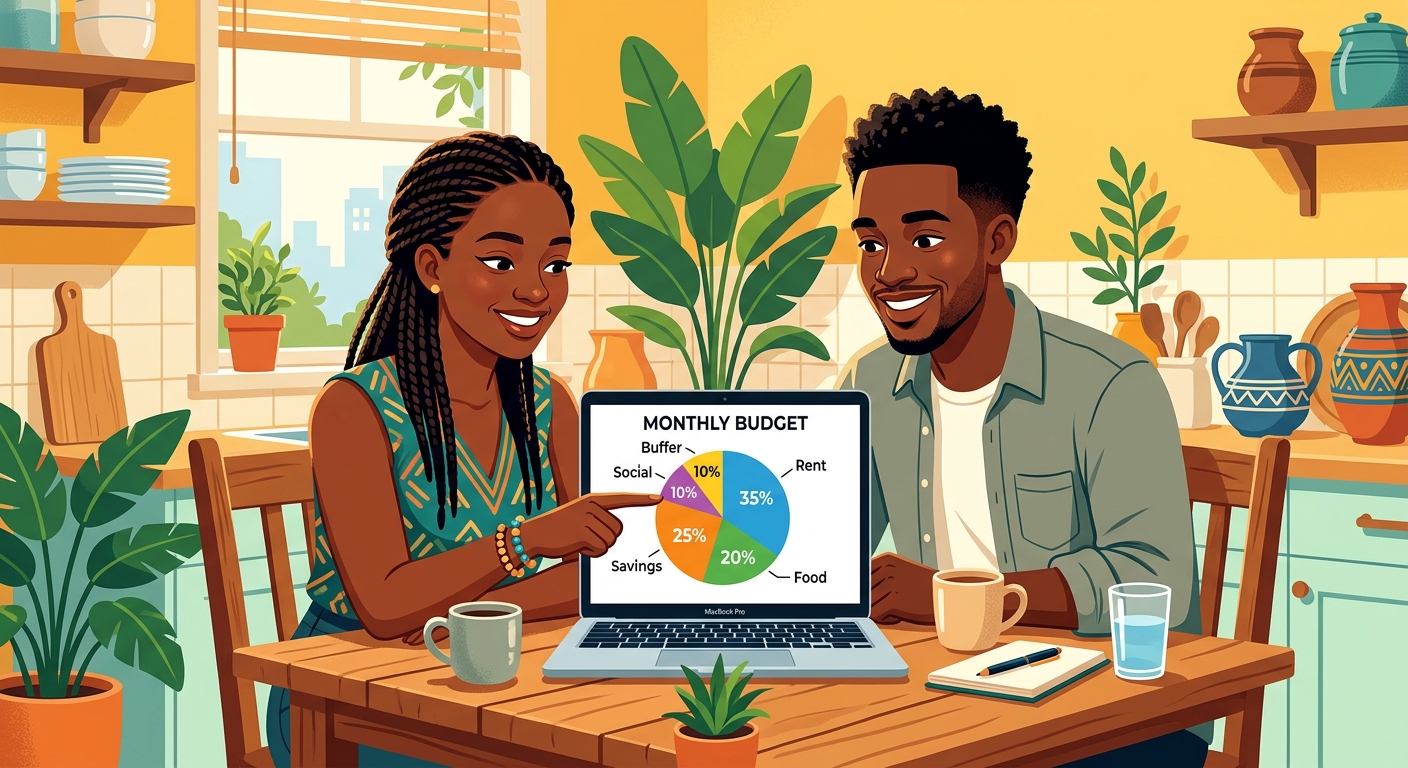
What to do: Create a fixed “social budget” — a hard naira amount per month for contributions, outings, and gifts. When it is exhausted, it is exhausted. You do not announce it. You simply stop. Real friends will not notice the limit. The ones who judge you for having financial boundaries were never allies to your financial health.
Trap #4: Borrowing to Celebrate — Owambe, Aso-Ebi, and Event Debt
This deserves its own section because it is genuinely epidemic in Nigerian households.
Nigerians borrow to fund parties. To buy aso-ebi fabric they did not request. To travel to weddings in states they cannot afford to visit. To fund birthday celebrations for children in order to match what they saw at someone else’s event.
There is nothing wrong with celebration. Debt-funded celebration, however, is a trap that punishes you for months after the music stops and the photos are archived.
The true cost: A ₦50,000 loan taken in January for a December event, at a typical licensed digital lender rate of 5–8% monthly, costs between ₦65,000 and ₦78,000 to repay by March. You are paying for something you ate and wore four months ago. This is one of the clearest examples of the loan cycle in Nigeria feeding on celebration culture rather than genuine need.
What to do: Build a “celebration fund” — a separate savings pocket at even ₦2,000 per week. If the fund cannot cover the event, scale the event down. A smaller asoebi. A different fabric. Nobody’s marriage failed because you did not purchase the ₦18,000 lace fabric. Practicing smart spending in Nigeria means protecting future-you from present-you’s social impulses.
Trap #5: Ignoring the Interest You Are Already Paying
Many Nigerians borrowing from loan apps are not doing the full calculation — and lenders are not always volunteering it prominently.
A real ₦ breakdown: You take ₦20,000 from a loan app. You repay ₦26,000 in 30 days. That is ₦6,000 paid for access to your own income for one month — a 30% monthly cost. If you do this six times a year, you have paid ₦36,000 in interest on loans that never exceeded ₦20,000 at a time. Annualized, that rate exceeds 300%.
The Central Bank of Nigeria’s Consumer Protection Framework mandates that licensed lenders disclose effective interest rates — but borrowers must actively read those disclosures, not just the headline loan amount.
Rolling loans — repaying one and immediately taking another — means interest compounds your financial stress every single cycle. This is the loan cycle in Nigeria in its most recognizable form, and breaking it requires the kind of smart spending decisions that cut the need for repeated borrowing in the first place.
What to do: Before your next loan, calculate total repayment minus principal. That remainder is what the loan costs you in real money. Ask honestly: is the reason behind this loan worth that cost? For a medical emergency or a rent crisis, the answer is often yes. For lifestyle maintenance, it usually is not.
Trap #6: Zero Buffer — No Emergency Fund Means Every Surprise Becomes a Debt
This is the structural trap underneath all the others.
When you have ₦0 saved for surprises, every unexpected expense becomes a borrowing event. The NEPA bill spikes. Your phone screen cracks on the way to a job interview. A child’s school fee arrives three weeks early. Any one of these events converts immediately into a loan — with interest attached.
The NBS 2023 Household Survey found that a significant proportion of Nigerian households reported borrowing within the past 12 months for what they described as “unexpected expenses” — the exact shocks that a modest buffer fund would absorb without any interest cost.
A person with even a ₦20,000 buffer saves significantly compared to a person who borrows at 25–30% monthly rates for every small emergency. Over 12 months, the difference in total cost can exceed ₦30,000 on nothing but avoided interest.
What to do: Start with a micro-goal: ₦5,000 untouchable. Put it somewhere you cannot access with one tap — a separate savings pocket, a second account, or a short-term fixed deposit. Grow it to ₦10,000, then ₦30,000. This fund is exclusively for genuine surprises. Building it requires discipline for two to three months. After that, it saves you real money every single month.
This single habit is the fastest path to financial discipline in 2026 for the average Nigerian salary earner — and the clearest expression of smart spending Nigeria can actually practice right now.
Trap #7: Informal Debt You Are Not Counting — “I’ll Pay Amaka When I Can”
Borrowed ₦3,000 from a colleague in March? Still outstanding? That is a debt. Owe your landlord one month from a negotiated extension? That is a debt. Running negative on a shared family airtime plan? That is a debt.
Nigerians routinely undercount what they owe because informal debts carry no repayment reminders, no penalty clauses, and no digital tracking. But they carry relationship damage, social awkwardness, and — when the person finally asks — a request that arrives at the worst possible financial moment.
What to do: Write every debt down, formal and informal, with amounts and realistic due dates. Total the number. Most people are surprised to find their real liability is 30–60% higher than they thought once informal obligations are included. Prioritize informal debts — not because they cost more in interest, but because those relationships are worth more than any interest rate. Seeing the full picture is itself a smart spending discipline.
What To Do Starting This Month — Without Waiting for a Perfect Moment
You do not need to fix all seven traps simultaneously. Pick two this week:
- Track one week of spending — reveals the “small small” leak immediately and creates the awareness that makes every other change possible
- Start a ₦5,000 untouchable buffer — breaks the loan-for-every-emergency cycle at its root
These two moves measurably shift your financial position within 60 days. Not perfectly. But enough to feel the difference and build momentum.
Smart spending in Nigeria does not require a financial degree or a high income. It requires seeing the patterns clearly and changing one or two of them at a time — consistently, not perfectly.
When a Loan Is the Right Call — And When It Is Not
Part of smart spending in Nigeria is knowing when borrowing is the rational decision, not just the emotional one. Use this framework before your next application:
| Situation | Loan: Yes or No? |
|---|---|
| Medical bill, no insurance, no accessible family support | ✅ Yes — act immediately |
| Rent due, salary genuinely delayed with evidence | ✅ Yes — with a concrete repayment plan |
| Income-generating tool broke, needed to work tomorrow | ✅ Yes — loan pays for itself |
| Aso-ebi fabric, owambe travel expense | ❌ No — scale the event down |
| End-of-month food and transport shortfall | ⚠️ Review spending first; borrow only if gap is structural |
| Item you saw advertised on Instagram | ❌ Hard no — sleep on it for 72 hours minimum |
The difference between smart borrowing and trapped borrowing is straightforward: smart borrowers borrow for emergencies while actively fixing the habits that created the shortfall. Trapped borrowers borrow to maintain a lifestyle they have not yet financially earned — and pay compound interest for the privilege.
If you are borrowing smart — for real emergencies, not lifestyle maintenance — SmartLoans.ng connects Nigerians to fast, transparent, and regulated lending options so you borrow safely when it genuinely matters.
You now know which traps you are in. That awareness alone puts you ahead of most people running the same monthly cycle. The next step is one small action this week — not a complete financial overhaul, just one habit changed. Smart spending Nigeria starts exactly there.
Related Reading: How to Budget on a Nigerian Salary: The 50/30/20 Rule With Real ₦ Numbers
Disclaimer: This article is for financial education purposes only. Loan eligibility, terms, and applicable rates depend on individual assessment by licensed lenders. Always read and understand the full loan agreement before signing. For CBN-regulated lending information, visit cbn.gov.ng.