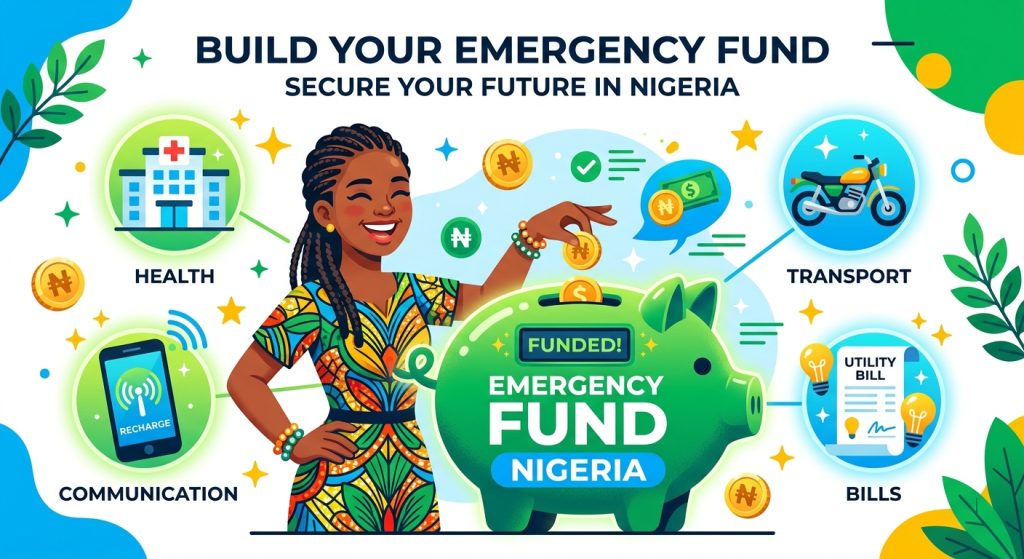
You did not take that last loan because you were irresponsible. You took it because life moved before your salary did — and there was nothing between you and the gap.
That gap is exactly what an emergency fund Nigeria closes. Not an investment. Not a savings target for a new phone. A dedicated pile of cash whose only job is to stand between you and a lender every time NEPA disconnects, a Keke engine knocks, or a school fees deadline arrives three days early.
This guide is written for Nigerian salary earners, Okada and Keke riders, artisans, domestic workers, corps members, and market traders who want to stop borrowing for the same reasons every single month. You do not need to be rich to build this. You need a plan that works on what you actually earn right now.
What an Emergency Fund Actually Is (and What It Is Not)
Let us be specific, because confusion here is where most people fail.
An emergency fund is NOT:
– Your savings for a new phone, a wig, or a generator
– Money you plan to invest or lock away in PiggyVest for six months
– Your “next month rent” money sitting idle in your main bank account
– Any amount you are still planning to “put aside when things improve”
An emergency fund IS:
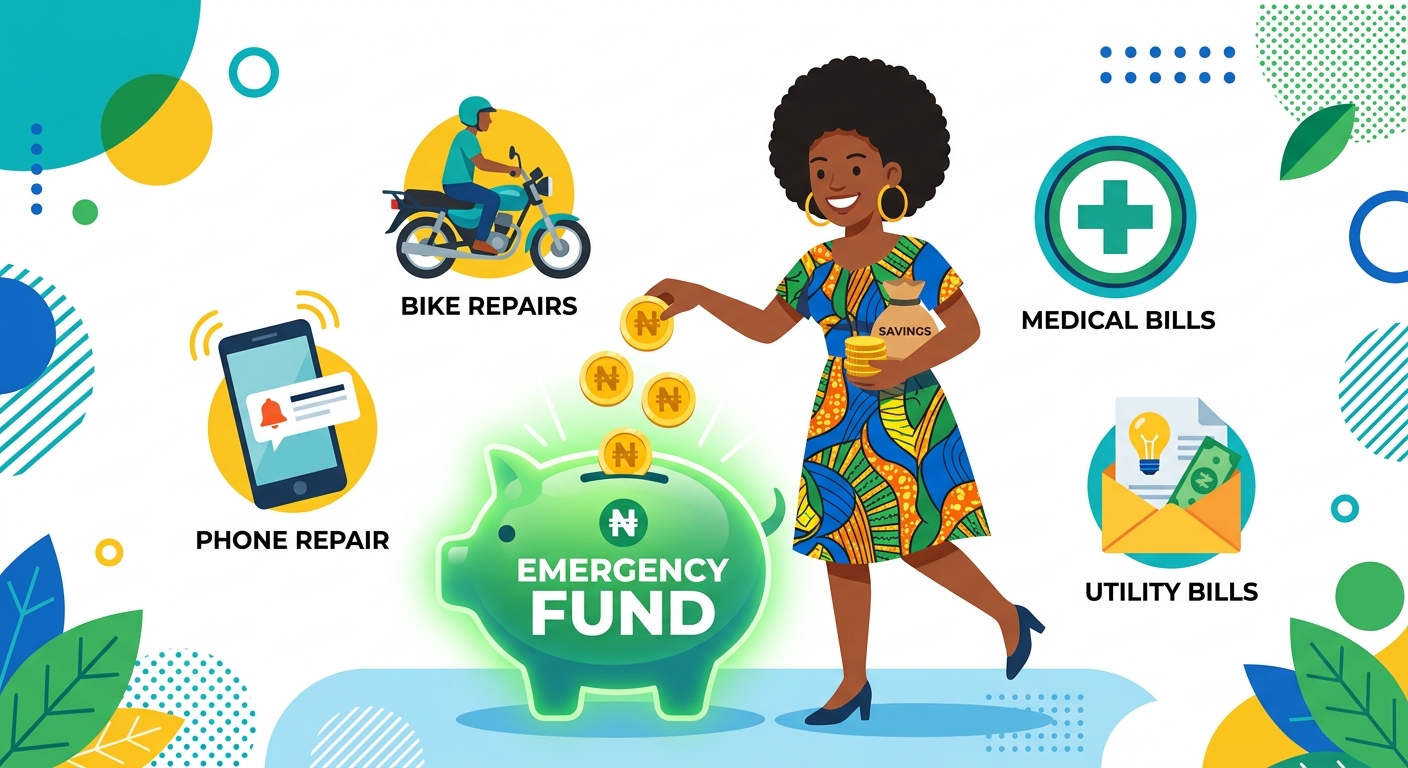
– Cash reserved only for genuine emergencies: medical bills, broken income-generating equipment, urgent family crises, utility disconnection threatening your work or home
– Accessible within 24 hours — via a separate savings wallet, USSD-accessible bank account, or even a physical envelope where necessary
– Non-negotiable — you do not touch it for non-emergencies, full stop
The moment you use your emergency savings Nigeria to buy data bundles or pay for aso-ebi, it stops functioning as a financial safety net and becomes another spending account. The label must match the behaviour.
The Real Cost of Not Having One (In ₦ Numbers)
Here is what happens every time you take a short-term loan instead of pulling from your own savings:
A ₦20,000 loan on a typical Nigerian loan app with a 30-day tenure at a 15% interest and fee structure costs approximately ₦23,000 to repay. That is ₦3,000 gone — not to your bill, not to your household, not to your family. Paid purely for the privilege of borrowing.
According to the Central Bank of Nigeria (CBN) Consumer Protection Framework, many informal digital lenders charge effective annual rates that exceed 100% when fees are factored in — meaning short-term convenience becomes long-term financial damage for repeat borrowers.
Multiply that ₦3,000 loss by just 8 emergency borrowing events per year — conservative for most Nigerians managing irregular expenses — and you have paid ₦24,000 extra in a single year. For someone earning ₦80,000 monthly, that is nearly one-third of a month’s salary handed over to lenders for problems that a small rainy day fund would have solved for free.
A properly built emergency fund Nigeria with ₦20,000 sitting in it eliminates that cost entirely. The maths is not complicated. The behaviour is the challenge.
How Much Do You Actually Need?
The global personal finance rule says three to six months of expenses. In Nigeria, that advice is borderline useless for someone earning ₦80,000 per month. Three months of expenses equals ₦240,000 — a number so overwhelming that most people never start.
Here is a more honest, Nigeria-specific emergency savings framework:
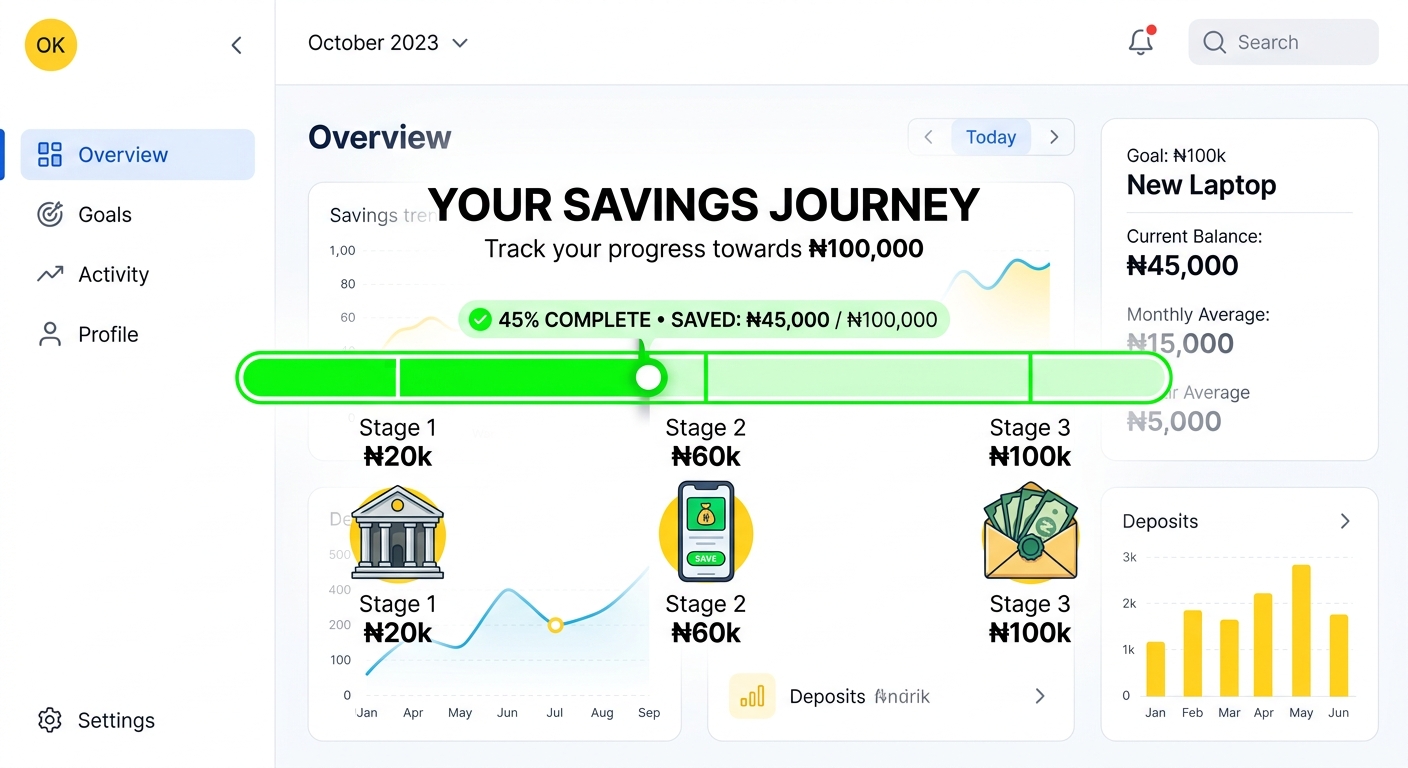
Stage 1 — Micro Buffer (start here): ₦10,000 to ₦20,000
This is your “stop the bleeding” fund. Enough to cover one utility bill, one medical consultation, one emergency transport, or two days of lost income. Build this first. It is achievable in 4–8 weeks on almost any regular income.
Stage 2 — Short-Gap Fund: ₦30,000 to ₦60,000
This covers a larger emergency — a school fees gap, a broken phone or motorbike repair, a week of medical care. Depending on your income, this takes 3–6 months to build.
Stage 3 — Full Buffer: One month of your total expenses
For someone spending ₦100,000 per month, this means ₦100,000 set aside and permanently untouched. This is the long-term target — not the starting point.
The Nigeria Bureau of Statistics (NBS) 2023 Household Survey showed that over 60% of Nigerian households report experiencing at least one unexpected financial shock per quarter. Building even a Stage 1 emergency fund Nigeria directly addresses that reality.
Most Nigerians who reach Stage 1 and genuinely protect it report borrowing less within 60 days. That is the cycle break that matters most.
Where to Keep Your Emergency Fund in Nigeria
Your emergency fund Nigeria must be accessible but not too accessible. The goal is friction — enough that you do not spend it impulsively, but not so much that you cannot reach it in a genuine crisis.
Option 1 — Separate bank account (different bank from your salary account)
Opening a free account at a different bank creates natural friction. You will not accidentally spend it. You can still transfer via USSD within minutes when an emergency strikes. This works particularly well for salary earners with stable monthly inflows.
Option 2 — Digital savings wallet with instant withdrawal
Apps like Cowrywise Flex Naira or PiggyVest’s Flex Dollar with instant withdrawal enabled work well. The operative phrase is instant withdrawal — if it takes 72 hours to access your money, it is not serving as an emergency cash reserve.
Option 3 — Physical cash (last resort, but valid)
For informal workers — Okada riders, market traders, domestic workers — who distrust digital platforms or have irregular phone access, a sealed envelope of physical cash at home is still better than nothing. The psychological barrier of breaking a seal reduces impulse spending meaningfully.
Do not use: Fixed deposits, locked savings products like PiggyVest Safelock with withdrawal penalties, or any investment product. An emergency fund Nigeria must not carry withdrawal delays, lock-in periods, or penalties of any kind.
How to Build an Emergency Fund on a Small Income — Step by Step
Week 1: Identify your number
Calculate what one genuine emergency actually cost you in the last 12 months. Write that figure down. That number becomes your Stage 1 target. Do not estimate — review your loan history or bank statements.
Week 2: Open a separate account or wallet
Do not wait until you have the money. Open the account now with zero balance. The infrastructure must exist before the habit can form.
Week 3: Calculate your daily or weekly contribution
If your Stage 1 target is ₦15,000 and you want to reach it in 8 weeks:
₦15,000 ÷ 8 weeks = ₦1,875 per week ≈ ₦268 per day
That is the cost of two sachets of water and a small snack. The problem has almost never been the amount. It has been the absence of a consistent system.
Weeks 4–8: Transfer before you spend anything else
Every salary day or market day, move your emergency fund contribution first — before data, before food money, before any discretionary expense. This is the “pay yourself first” principle, and it is the single behaviour that separates Nigerians who actually build savings from those who permanently intend to.
Month 3 onwards: Defend what you built
When Stage 1 is complete, the real test begins. Something will present itself that feels like an emergency but is not — a new party, a trending item, a friend who needs to borrow. Your emergency fund Nigeria does not cover these. Protect it as though it is borrowed money you owe back to yourself.
The Mindset Shift That Makes It Stick
Most Nigerians who attempt to save and fail do so because they treat savings as what remains after spending. Nothing ever remains. Life always fills the space money leaves.
The shift required is simple but transformative: your emergency fund contribution is a bill. It gets paid the same way rent gets paid — before anything else, without negotiation, with a clear consequence for skipping it.
The consequence for not building your emergency fund Nigeria is already familiar to you. It is that 2am panic with three days to go until salary and zero cash. It is the embarrassment of approaching a colleague for money again. It is the ₦3,000 in loan interest you paid last month instead of eating properly.
Your financial buffer is not a luxury. It is the floor that makes every other financial goal possible.
What Changes Once You Have It
The psychological effect of a funded emergency fund Nigeria is something most Nigerians who build one describe in almost identical terms: “I stopped panicking at the end of the month.”
That calm is not accidental. When you know ₦20,000 is sitting in a separate account that you cannot touch unless something genuinely breaks, your decision-making changes entirely. You do not rush into a predatory loan offer out of desperation. You do not accept punishing terms because you have no alternative. You negotiate. You wait. You choose.
That is the real value of building an emergency savings buffer — not only the cash, but the options the cash creates. Financial anxiety in Nigeria is often not about overall income level. It is about having zero margin when something goes wrong. A funded emergency fund creates that margin.
When You Should Still Use a Loan
A well-funded emergency fund Nigeria reduces borrowing — it does not eliminate every scenario where a loan makes sense. There will be emergencies that exceed your buffer: a major medical event, equipment replacement beyond your saved amount, a family crisis that costs more than you currently hold.
In those moments, a legitimate, CBN-registered loan with transparent terms and no abusive contact list practices is a valid tool. The critical difference is that you are now choosing to borrow — not being forced to by desperation. You borrow the specific gap, not an inflated panic amount. You repay on schedule because your emergency fund remains intact for the next smaller crisis.
That is responsible borrowing. It only becomes possible once you have the buffer that converts borrowing from a lifeline into a deliberate decision.
If you ever need to bridge a genuine gap that exceeds your savings, SmartLoans.ng offers transparent short-term loan options with clear terms — no hidden fees, no exploitative rates.
Start Today, Not Next Salary
Open the account now. Transfer ₦500 if that is all you have available today. Name the account “Emergency — Do Not Touch” inside your banking app. Tell no one about it so no one asks to borrow from it.
Then repeat next week.
In eight weeks, you will have a working financial buffer. In six months, you may experience something that has probably been rare in your adult financial life: a month where no unexpected event forced you to a loan app.
Building an emergency fund Nigeria is the single most impactful financial move available to low-to-middle income earners in 2026. Not the flashiest. Not the most discussed. But the one that breaks the loan cycle before it starts — ₦268 at a time.
Frequently Asked Questions
Q: What counts as a genuine emergency for my emergency fund?
A: Medical bills, broken income-generating tools such as a phone, motorbike, or machine, job loss bridge expenses, urgent travel for a family crisis, or utility disconnection affecting your ability to earn. A sale, a party, or a trending item is not an emergency.
Q: Can I start my emergency fund Nigeria with ₦500?
A: Yes. The opening transfer is not about the amount — it is about creating the account, the habit, and the psychological category. ₦500 today becomes ₦5,000 in ten weeks at that pace. Start now.
Q: What if I use my emergency fund — do I start over?
A: Using it for a genuine emergency means it worked exactly as designed. Rebuild immediately from your next income. The goal after an emergency is to restore the buffer as quickly as possible — treat it like a debt you owe yourself.
Q: How is an emergency fund different from a regular savings account?
A: A regular savings account often holds mixed purposes — holidays, electronics, future goals. An emergency fund Nigeria has one purpose only. The mental separation is as important as the physical separation.
If an emergency exceeds your savings today, explore SmartLoans.ng for CBN-compliant personal loan options with transparent fees and no hidden charges. Check your eligibility in under two minutes.