Emeka needed ₦50,000 in January. His rent was three weeks overdue. He downloaded a loan app, clicked through four screens, and the money landed in his account in eleven minutes. He was relieved.
Sixty days later, the app sent a final repayment notice: ₦85,000 due by end of week.
He borrowed ₦50,000. He was being asked to return ₦85,000 — a ₦35,000 interest charge on a two-month loan. That is 70% total cost, equivalent to over 400% per year. Nothing on the approval screen had told him that clearly.
Emeka is not alone. Understanding loan interest rates Nigeria— what is normal, what is robbery, and how to calculate the real cost before you click accept — is exactly what this guide is built for.
By the end of this page, you will know what rates are legal and reasonable in Nigeria right now, what banks charge versus what loan apps charge, how lenders hide the true cost using confusing language, and exactly how to compare any two loan offers side by side.
What “Interest Rate” Actually Means in Nigeria (Plain English)
An interest rate is the price you pay for borrowing money — expressed as a percentage of the amount borrowed.
If you borrow ₦10,000 at 10% interest for one month, you repay ₦11,000. The extra ₦1,000 is the cost of the loan.
Simple enough. But here is where it gets complicated in Nigeria: lenders do not all use the same measurement. Some quote monthly rates. Some quote annual rates. Some quote a “flat rate” that sounds low but is actually double what you think. Almost none of them volunteer the full picture upfront.
Understanding what loan interest rates Nigeria 2026 lenders quote — and what each format truly means — is not optional. It is the single most important number in any loan decision you will ever make.
CBN’s Benchmark Rate in 2026 — And Why It Matters to You
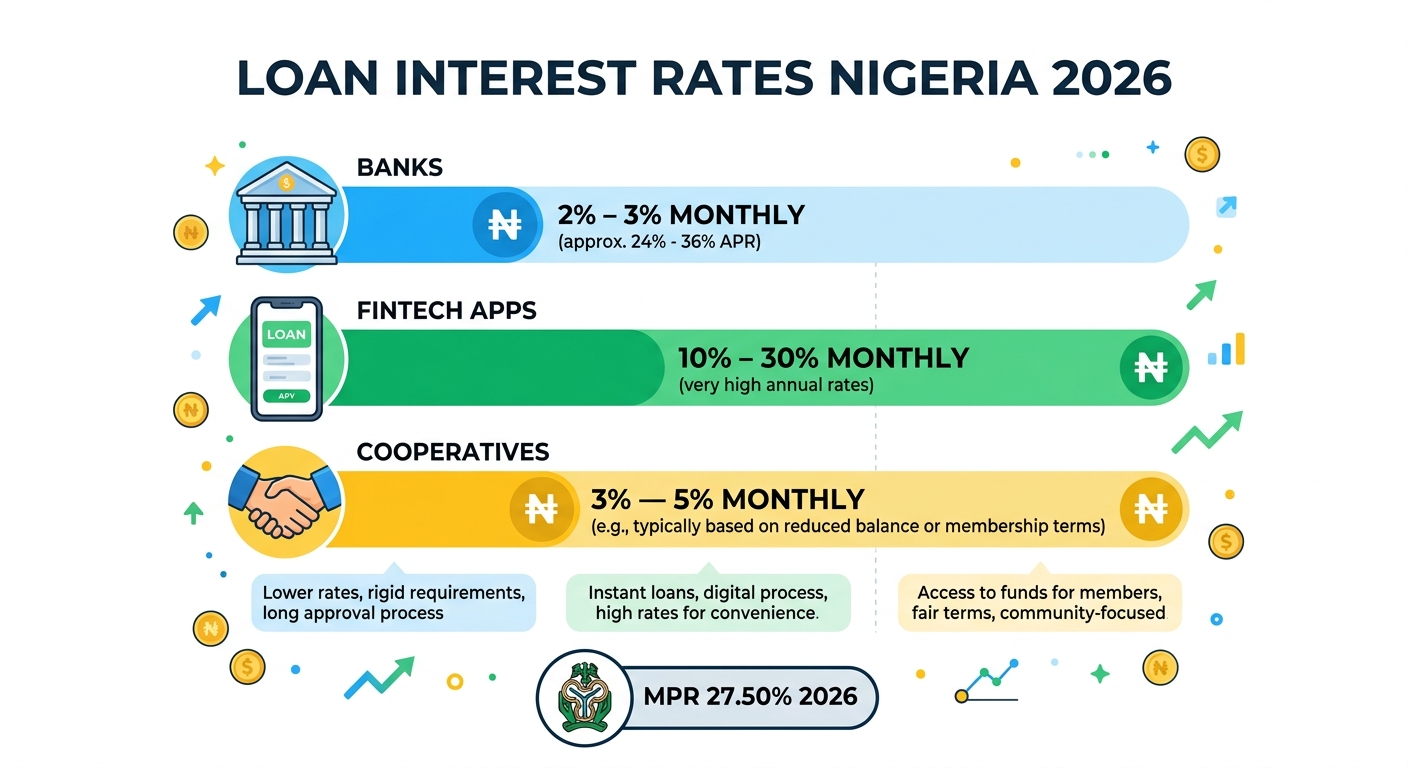
The Central Bank of Nigeria (CBN) sets what is called the Monetary Policy Rate (MPR). This is the baseline rate at which the CBN lends money to commercial banks. In 2026, Nigeria’s MPR stands at 27.50%, following a sustained tightening cycle that began in 2023 and extended through 2025 to suppress inflation, which peaked above 33% year-on-year during that period according to the National Bureau of Statistics (NBS).
Here is the direct consequence for personal borrowers:
When the CBN’s MPR is elevated, commercial banks borrow money at high cost. They pass that cost to you — the retail borrower — by pricing personal loans even higher. A 27.50% MPR environment makes cheap consumer credit structurally rare. You should expect to pay significantly more in loan interest rates Nigeria 2026 than you would have in 2020 or 2021 when the MPR sat at 11.50%.
The CBN does not universally cap personal loan interest rates for all lenders. It regulates commercial banks and licensed microfinance banks through published guidelines, including the CBN Microfinance Policy Framework. Loan apps operating outside direct CBN supervision — via money lender licences or unregulated fintech structures — face fewer rate restrictions, which is why their charges can feel extreme.
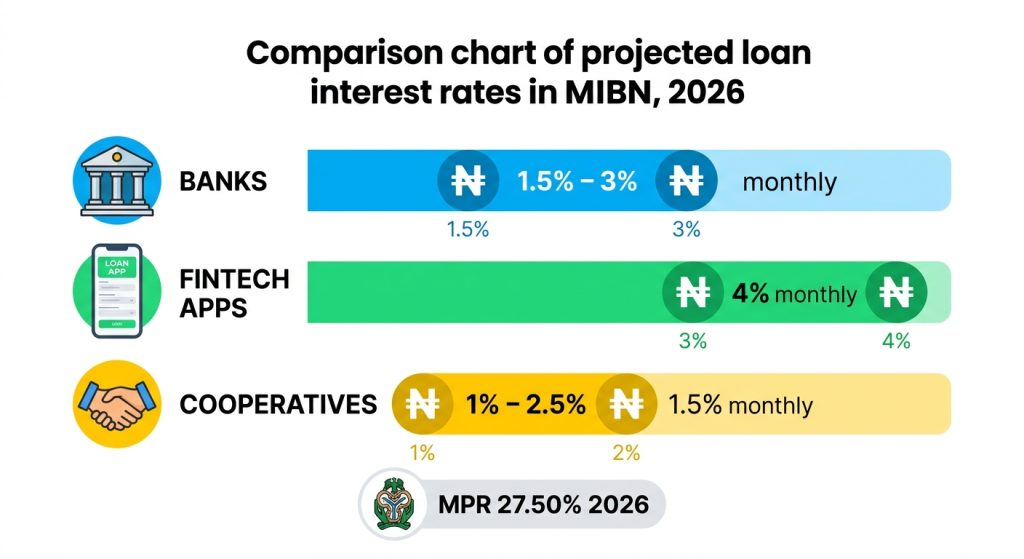
Key benchmark to remember: Any personal loan in Nigeria in 2026 priced below 25% per annum (roughly 2% per month) from a formal lender would be unusually cheap given the current rate environment. Anything above 200% per annum (roughly 16%+ per month) requires serious scrutiny before you proceed.
📌 You can verify the current CBN Monetary Policy Rate directly on the CBN official website before making any borrowing decision.
Bank Personal Loan Rates Nigeria 2026
Commercial banks — GTBank, Access Bank, Zenith Bank, First Bank, UBA, and others — offer personal loans primarily to salary account holders. Their rates in 2026 reflect the high MPR environment directly.
Typical range for bank personal loans in 2026:
| Lender Category | Monthly Rate | Annual Rate (Approximate) |
|---|---|---|
| Tier-1 commercial bank | 2.5% – 4% per month | 30% – 48% per annum |
| Microfinance bank | 3% – 6% per month | 36% – 72% per annum |
| Cooperative society | 2% – 3% per month | 24% – 36% per annum |
Banks also layer on fees that raise the true bank loan rate Nigeria 2026 above the headline: management fees (1–3% of the loan amount), credit life insurance charges, and facility fees. These additions can raise your effective cost by 2–5% before a single repayment instalment is made.
Who qualifies? Salary earners with an active domiciliation account at the lending bank. Most market traders, artisans, Okada riders, and self-employed individuals are structurally excluded. If you fall into this group, banks are largely unavailable to you regardless of the rate they advertise.
Loan App Interest Rates Nigeria 2026 (The Real Numbers)
Loan apps have filled the gap banks leave open. They lend to people banks decline. They approve in minutes. But they charge substantially more — and the range is wide enough to separate reasonable options from predatory ones.
Here is an honest breakdown of what lending apps in Nigeria were charging across the loan interest rates Nigeria 2026 landscape, based on publicly available rate disclosures and borrower-reported repayment data:
| Loan App Category | Typical Monthly Rate | Equivalent Annual Rate |
|---|---|---|
| Conservative fintech lenders | 3% – 5% per month | 36% – 60% per annum |
| Mid-tier loan apps | 5% – 10% per month | 60% – 120% per annum |
| Aggressive short-term apps | 10% – 30% per month | 120% – 360% per annum |
The loan size and tenure also drive the rate. Apps offering ₦5,000 to ₦20,000 for 7–14 days routinely carry the highest effective rates on a per-naira basis. The shorter and smaller the loan, the more expensive it typically is per naira borrowed.
Regulatory note: Nigeria’s Federal Competition and Consumer Protection Commission (FCCPC) has publicly sanctioned loan apps with abusive collection practices and opaque rate structures. The FCCPC maintains a list of approved digital lenders that borrowers can check before accepting any offer. Always verify that any loan app you use appears on this list.
Salary Lenders and Cooperatives — What They Actually Cost
Salary advance platforms — including employer-integrated apps and third-party payroll lenders — typically charge lower rates than open-market loan apps because repayment is deducted directly from your salary, reducing default risk significantly.
- Salary advance platforms: 2% – 5% flat per month, deducted at source
- Staff and trade cooperatives: 1% – 2.5% per month, sometimes structured as interest-free for longstanding members
If you have access to a cooperative through your employer, union, professional body, or religious organisation, this almost always represents the cheapest personal loan rate Nigeria available without collateral. The practical limitation is processing time — cooperative loans often take several days, ruling them out for same-day cash needs.
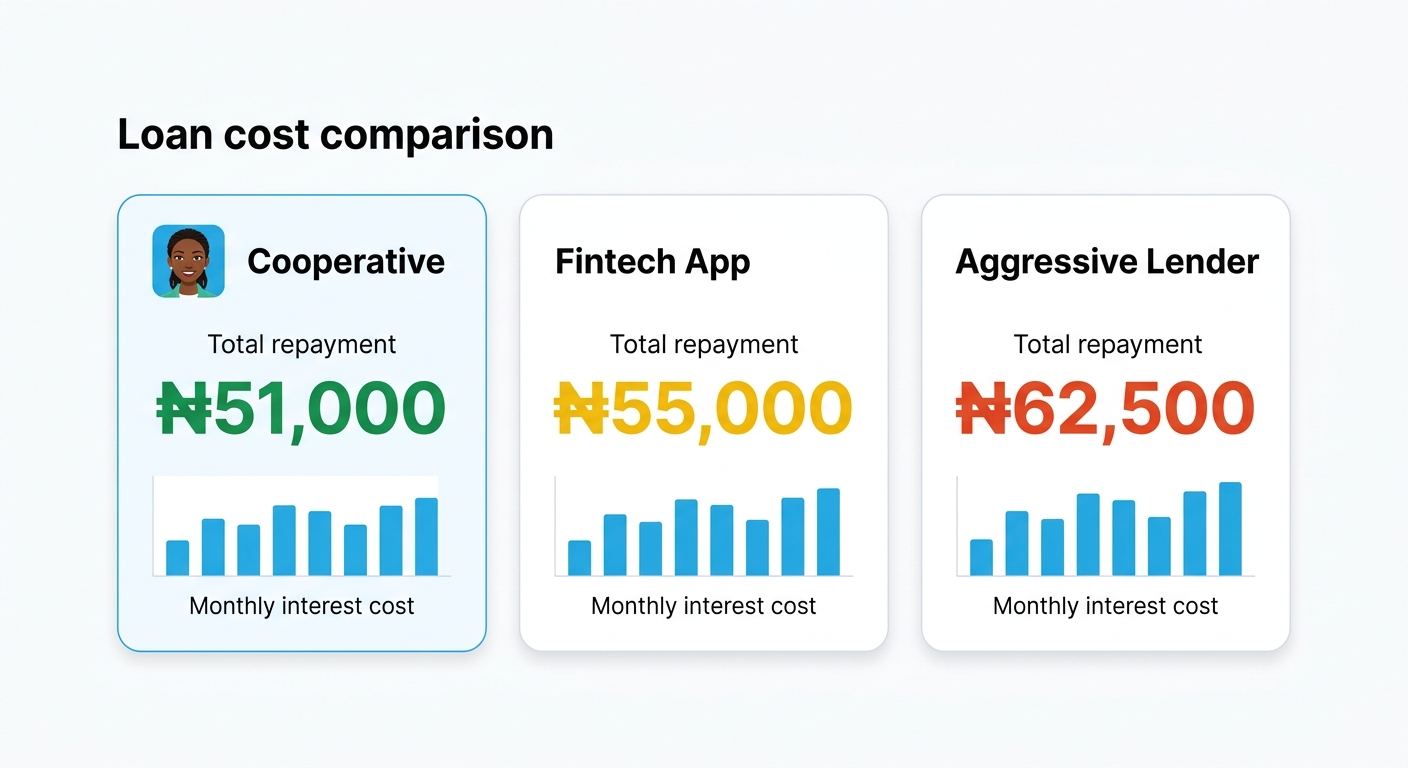
₦ Worked Example — Cooperative vs Loan App:
| Scenario | Borrow ₦50,000 for 30 days | Total Repayment |
|---|---|---|
| Staff cooperative at 2%/month | ₦50,000 + ₦1,000 | ₦51,000 |
| Mid-tier loan app at 10%/month | ₦50,000 + ₦5,000 | ₦55,000 |
| Aggressive app at 25%/month | ₦50,000 + ₦12,500 | ₦62,500 |
That difference — ₦1,000 versus ₦12,500 — is why your access to borrowing options matters as much as the loan amount itself.
APR vs Monthly Rate vs Flat Rate — The Trick That Hides the True Cost
This is the section most lenders hope you skip.
Monthly rate: Percentage charged each month on your outstanding or original balance.
Annual Percentage Rate (APR): The full annual cost including fees, expressed as a percentage — the most complete and honest picture.
Flat rate: Percentage charged on the original loan amount throughout the entire term, regardless of how much you have already repaid. This is the most misleading format used in Nigeria.
The flat rate trap — worked ₦ example:
You borrow ₦100,000 at a “5% flat rate per month” for 6 months.
– Monthly interest quoted = ₦5,000 (5% of ₦100,000, every month)
– Total interest paid = ₦30,000 over 6 months
– But your balance reduces each month as you repay principal
On a reducing-balance basis, you are actually paying closer to 9–10% per month effective rate — nearly double what the “5% flat” headline suggests. Many Nigerian lenders — particularly in the informal sector — use flat-rate quoting precisely because it obscures the true loan APR Nigeria borrowers are absorbing.
Always ask your lender one question before signing: “Is this rate calculated on the reducing balance or on the original loan amount?”
If they cannot answer that clearly and directly, walk away.
What a “Fair” Interest Rate Looks Like in Nigeria Right Now
Given the CBN’s 2026 MPR of 27.50% and Nigeria’s current inflation environment, here is a practical fairness benchmark for loan interest rates Nigeria 2026:
- 2% – 4% per month (24% – 48% per annum): Competitive and reasonable for personal loans in today’s environment. Tier-1 banks and strong fintech lenders operate here.
- 5% – 8% per month (60% – 96% per annum): Expensive but within acceptable range for unsecured digital loans issued without collateral to borrowers with no formal credit history.
- 10%+ per month (120%+ per annum): High-risk territory. Proceed only if you are completely certain about repayment within the agreed term, and only with a fully licensed, FCCPC-registered lender.
- 20%+ per month (240%+ per annum): This is predatory pricing by any measurable standard. Avoid entirely.
These thresholds represent the current consensus for fair borrowing conditions — they will shift if the CBN adjusts the MPR significantly in either direction.
If you want to explore loan options within the fair rate range, LendSafe compares verified lenders with transparent pricing across loan sizes.
5 Red Flags That Tell You the Rate Is Too High
Before you click approve on any loan offer in Nigeria in 2026, check for these warning signs:
1. The rate is only shown monthly — never annualised.
A lender who shows you “just 8% monthly” but refuses to display the annual equivalent (96%) knows the full number would alarm you. Transparency requires showing both figures.
2. Fees are buried in the terms, not shown upfront.
Processing fee, insurance, service charge, disbursement fee — if these do not appear on the summary screen before approval, your effective rate is higher than advertised. This is one of the most common methods lenders use to hide the true cost of a high interest loan Nigeria offer.
3. The loan tenure is very short with no flexibility.
Seven-day loans at high daily rates create a debt trap the moment you cannot repay in full. Rollover fees compound with devastating speed. A ₦20,000 loan at 5% per week becomes ₦26,000 after just two rollovers.
4. The app does not appear on the CBN or FCCPC approved lender directory.
Unregistered lenders face no rate ceiling and no accountability for abusive practices. Registration is the minimum filter — it does not guarantee fairness, but absence guarantees no protection.
5. The total repayment figure is not shown before you confirm.
You must see the exact naira amount — principal plus all interest and all fees — before clicking accept. If that figure is absent from the confirmation screen, the lender is structurally hiding the true cost.
How to Compare Loan Offers Side-by-Side (Simple Formula)
Do not compare cheap loan Nigeria claims by monthly rate alone. Compare by Total Repayment Amount for an identical loan size and tenure. This single step bypasses all fee-hiding language.
Three-step comparison method:
Step 1: Ask each lender: “If I borrow ₦30,000 for 30 days, what is the exact total I repay — all fees included?”
Step 2: Subtract ₦30,000 from that total. The remainder is your true cost of borrowing.
Step 3: Divide the cost by ₦30,000, then multiply by 100. That is your actual monthly rate.
Worked ₦ example:
| Lender | Total Repayment on ₦30,000 | Cost of Loan | True Monthly Rate |
|---|---|---|---|
| App A | ₦34,500 | ₦4,500 | 15% per month |
| App B | ₦36,000 | ₦6,000 | 20% per month |
| App C | ₦32,100 | ₦2,100 | 7% per month |
Choose App C — not because the name sounds better, but because the number is lowest. This formula works for any loan amount, any tenure, and cuts through all the marketing language that obscures how much a loan truly costs in Nigeria.
For a broader comparison of licensed loan providers offering transparent total repayment figures, visit LendSafe.