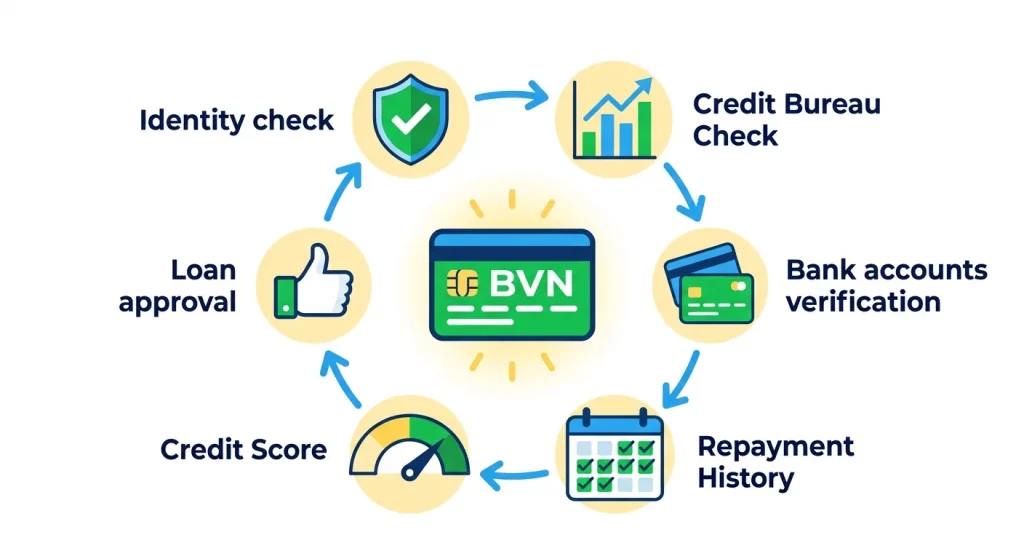
You type your BVN into a loan app, tap Submit, and wait. In most cases, the app replies in under two minutes — approved or declined.
But in those two minutes, something very detailed just happened. Lenders didn’t just confirm your identity. They ran a background check that touches your bank accounts, your repayment history, your outstanding debts, and in some cases even your spending patterns.
Most Nigerians don’t know this. They assume BVN is just a number to prove “I am who I say I am.” It is that — but BVN loan verification Nigeria processes unlock significantly more than your name and date of birth.
This article breaks down exactly what lenders see when they run a BVN loan verification Nigeria check, why some applicants get approved instantly while others get declined before talking to anyone, and what you can do right now if your BVN profile is working against you.
What BVN Is — And Why Every Lender in Nigeria Demands It
Your Bank Verification Number is an 11-digit biometric identity number issued by the Central Bank of Nigeria (CBN) through the Nigeria Inter-Bank Settlement System (NIBSS). It was introduced in February 2014 to solve a very specific problem: Nigerians were defaulting on loans and opening new bank accounts to escape lenders at other institutions.
BVN closed that loophole permanently. Once your fingerprints and facial photograph are enrolled against a single number across every bank you use, you cannot walk away from a debt and open a fresh account under a different name elsewhere. The BVN follows you — across every institution, every loan app, every credit decision made about you in Nigeria.
For lenders — whether a commercial bank like GTBank or Zenith, a microfinance institution, or a loan app on your Android phone — BVN loan verification Nigeria is the starting point for every credit decision they make.
Without it, they cannot verify your identity, cannot query your credit history, and cannot safely price the risk of lending to you. This is why legitimate lenders always require BVN upfront. Any lender explicitly advertising “no BVN needed” is either taking a reckless underwriting risk or operating outside CBN and FCCPC regulatory frameworks — both of which should concern you as a borrower.
The Exact Data Your BVN Unlocks for Lenders
When a lender submits your BVN through NIBSS or a licensed credit bureau, the following categories of information become accessible in real time:
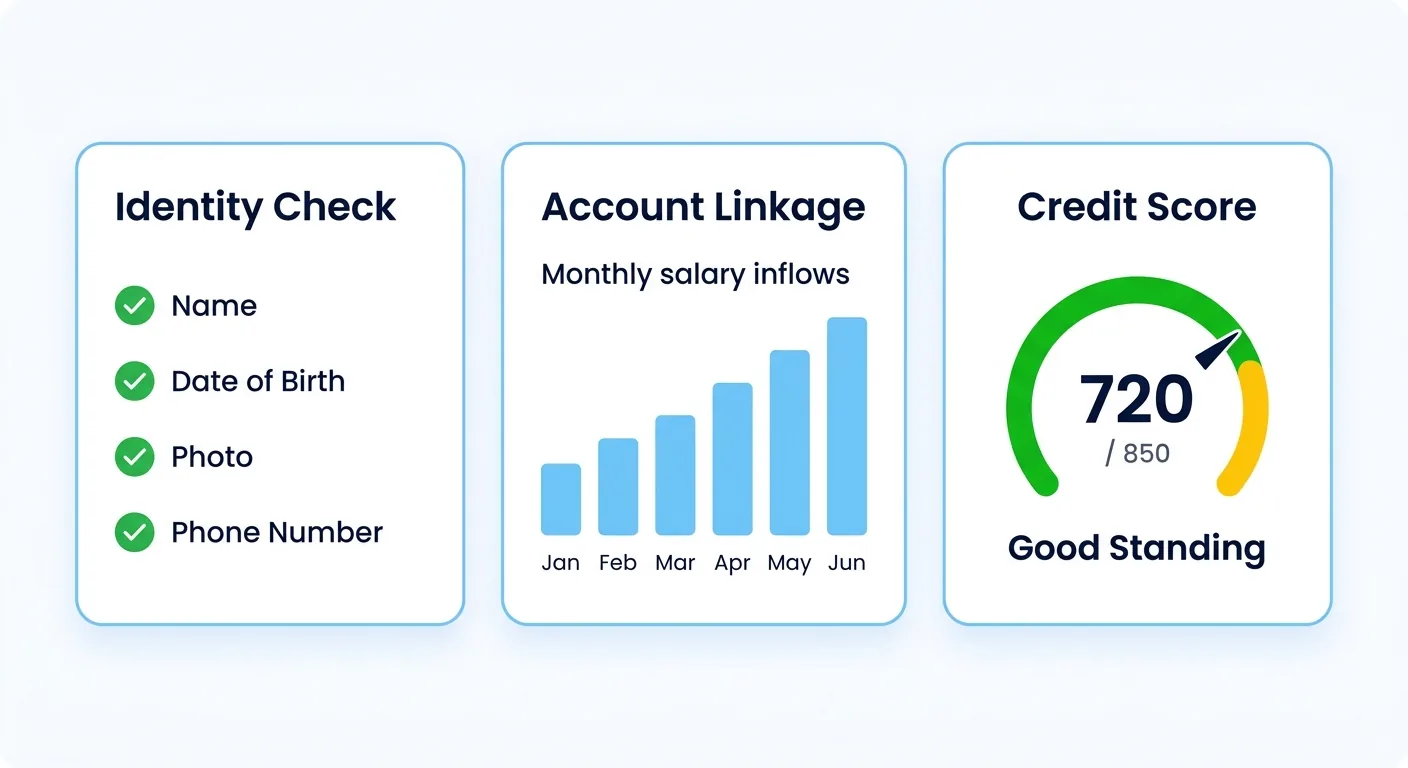
Identity data:
– Full legal name as registered at enrollment
– Date of birth
– Phone number registered at the time of BVN enrollment
– Facial photograph on file
– Enrollment bank and the date of registration
Bank account linkage:
– Every commercial bank account in Nigeria linked to that BVN
– Account status per institution: active, dormant, closed, or frozen
– Whether accounts reflect consistent income inflows or erratic activity patterns
Credit history (surfaced through credit bureaus):
– All formal loans taken using accounts connected to your BVN
– Repayment performance — on time, late, or defaulted
– Outstanding loan balances across multiple lenders simultaneously
– The number of recent credit inquiries — how many lenders have run a BVN loan verification Nigeria check on you in the past 30 to 90 days
The identity layer resolves in seconds. The credit bureau layer is where approvals and rejections are actually determined — and where most applicants are surprised by what lenders can see.
CRC and FirstCentral: The Credit Bureaus Your BVN Unlocks
Nigeria has three CBN-licensed credit bureaus: CRC Credit Bureau, FirstCentral Credit Bureau, and Credit Registry. CRC and FirstCentral are the two most widely integrated by loan apps and digital lenders operating at scale.
When a lender runs a BVN loan verification Nigeria query, they submit your BVN to one or both bureaus. The bureau returns your Credit Report, which contains:
- A complete list of every credit facility opened in your name across all lenders
- The outstanding balance on each facility
- Month-by-month repayment performance going back 24 to 36 months
- Your overall credit score — a numerical summary of your creditworthiness
- Any loan that went to a collections agency or was written off as an irrecoverable loss
Here is the critical detail most borrowers miss: these bureaus update continuously. According to CRC Credit Bureau, lenders are obligated to report both positive and negative credit events on an ongoing basis. A loan you defaulted on in 2023 is still active in your file in 2026 unless the original lender formally reported it as settled. Conversely, every on-time repayment you make today is being recorded and improving your score in real time.
Lenders running BVN loan verification Nigeria checks don’t just see your present financial situation. They see a rolling 24 to 36-month picture of your borrowing behaviour — and they use it to predict what you’ll do next.
What a Clean BVN Profile Looks Like (Approval Signals)
Each lender maintains a proprietary internal scorecard, but a strong BVN credit profile consistently produces these signals across the industry:
✅ Zero outstanding defaulted loans — no lender in the bureau system has reported you as a non-performing borrower
✅ Low credit utilisation — if you have a ₦200,000 credit limit across active facilities, you’re not drawing ₦190,000 of it simultaneously
✅ Consistent on-time repayment history — previous loans repaid on schedule or with minor delays that were quickly corrected
✅ Stable, matching phone number — the number on your BVN matches the number you’re applying with. Mismatches create identity friction that delays or blocks approval.
✅ Regular account inflows — salary credits, business revenue, or consistent transfers suggesting real, recurring income
✅ Low recent inquiry count — you haven’t applied to 15 different loan apps in the past 30 days
A borrower whose BVN profile reflects all six signals will typically clear automated BVN loan verification Nigeria checks within 60 to 90 seconds on any credible lending platform.
What a Red-Flag BVN Profile Looks Like (Rejection Signals)
These are the specific patterns that trigger instant automated decline or escalation to manual underwriting review:
🚩 Active loan default — you took a loan and stopped paying. Whether it was ₦8,000 from a mobile app or ₦800,000 from a microfinance bank, if the lender reported the default to CRC or FirstCentral, it is visible to every lender who queries your BVN loan verification Nigeria record.
🚩 Debt stacking — you already have three or four simultaneous active loans. A new application on top raises an immediate over-indebtedness flag. Some lenders hard-decline at two or more active facilities.
🚩 High inquiry velocity — fifteen loan app applications in two weeks signals financial distress to automated scoring engines. Each inquiry is logged. Frequency matters.
🚩 Phone number mismatch — the number on your application doesn’t match your BVN enrollment number. Some lenders decline immediately; others require a verification call or alternate documentation.
🚩 Frozen or encumbered accounts — EFCC-ordered freezes or court-mandated restrictions on any account linked to your BVN will surface in the NIBSS data layer during verification.
🚩 Thin credit file — this surprises many first-time borrowers. If you have never borrowed formally and have zero bureau record, some lenders decline you — not because you are a bad borrower, but because you are an unscored borrower. They cannot price the risk of someone they have no data on.
NIN vs BVN — Do Lenders Check Both in 2026?
This is one of the most common questions around BVN loan verification Nigeria processes, particularly following the CBN and Nigerian Communications Commission (NCC) mandates on NIN-SIM linkage.
Here is the current operational reality:
- BVN remains the primary credit identity instrument for lending. It is the identifier connected to credit bureau databases and NIBSS banking infrastructure.
- NIN (National Identity Number, issued by NIMC) is increasingly used as a secondary identity confirmation layer — particularly to cross-validate names and dates of birth for fraud prevention.
- Many fintechs and digital lenders now request both BVN and NIN during onboarding. This is not because NIN connects to credit bureaus — it does not — but because matching both documents significantly reduces synthetic identity fraud during the BVN loan verification Nigeria process.
Practical implication: If your NIN and BVN carry different name spellings or date of birth entries — which is common due to data entry errors at enrollment — you may face application delays or verification failures. Visit any NIMC office or your enrollment bank to reconcile discrepancies before applying. It is a fixable problem, but it takes time to process.
Can You Hide a Bad Loan History From BVN Checks?
No. And the attempt creates additional problems.
Common approaches people try:
- Using a different phone number on a new loan application
- Applying through a family member’s bank account
- Opening a brand-new bank account at a different institution specifically for the application
None of these circumvent BVN loan verification Nigeria systems. The reason is biometric: your BVN enrollment captured your fingerprints and photograph. Every bank account you have ever opened — or ever will open — at any CBN-licensed institution is linked to the same BVN. Your credit history, your defaults, your outstanding balances — they travel with that BVN everywhere it goes, permanently.
The only legitimate exit from a damaged BVN credit profile is systematic repair:
- Settle outstanding defaults with original lenders
- Get written confirmation of settlement and bureau update commitment
- Monitor your credit report through CRC or FirstCentral to confirm the update posts within 45 days
- Rebuild a positive repayment track record over 6 to 12 months
Anyone who approaches you with an offer to “wipe your BVN record” or “clear your credit bureau file” for a fee is running a scam. There is no technical mechanism that allows third parties to delete legitimate negative records from CBN-regulated bureau databases.
How LendSafe Uses BVN Verification — A Transparent Breakdown
At LendSafe, BVN loan verification Nigeria serves two distinct purposes within the loan application process:
1. Identity confirmation — verifying that the person submitting the application is the actual BVN holder, not someone using fraudulently obtained identity information. This protects both the lender and you as a legitimate borrower from identity theft exposure.
2. Credit assessment — querying bureau data to understand your repayment history and active debt obligations before making a lending decision tailored to your actual financial position.
LendSafe does not use your BVN to access or debit your bank account funds. BVN verification is a read-only data check. It reads your identity record and credit bureau profile. It does not grant any lender the technical ability to initiate fund transfers from your accounts.
Any SMS or notification claiming “your BVN was used to debit your account” is a phishing or social engineering scam. Do not engage — report it to the CBN Consumer Protection Department and your bank immediately.
LendSafe operates within FCCPC registration requirements and CBN consumer credit guidelines. BVN data is used exclusively for your loan application assessment and is not sold, shared with unrelated third parties, or retained beyond regulatory requirements.
What to Do Right Now If Your BVN Profile Has Problems
If You Have a Defaulted Loan on Record
- Contact the original lender directly. Negotiate a settlement — even a partial settlement on a written-off debt may prompt a bureau status update from “default” to “settled.”
- Get a written settlement letter confirming the lender will submit an updated record to CRC and/or FirstCentral.
- Follow up with the bureau directly after 30 to 45 days to confirm the update has posted.
- Pull your free annual credit report from crc.com.ng or FirstCentral’s consumer portal to review exactly what lenders currently see when they run a BVN loan verification Nigeria check on you.
Real example: A borrower with a ₦25,000 defaulted loan from a 2022 app lender settles for ₦18,000 with a written update agreement. Within 45 days, the bureau record changes from “non-performing” to “settled.” Their next loan application — for ₦50,000 — clears automated review in under two minutes. The ₦7,000 negotiated off the balance cost nothing relative to what it unlocked.
If You Have a Phone Number Mismatch
Visit your bank with a government-issued ID and your BVN details. Request a BVN-linked phone number update. Most commercial banks process this at the branch; some now permit it through authenticated mobile banking sessions. Allow 5 to 10 business days for the change to propagate across the NIBSS system before reapplying.
If You Have No Credit History At All
Start with a small, structured loan. A ₦10,000 loan repaid on schedule over 30 days creates a bureau footprint where none previously existed. That footprint becomes a credit score. That score — built across three to five successful repayment cycles — unlocks larger facilities at better rates. SmartLoans.ng’s entry-level product is specifically structured for borrowers building a BVN loan verification Nigeria profile from zero.
If You Were Declined and Don’t Know Why
You are legally entitled to request your credit report under CBN consumer credit regulations. Reviewing it yourself takes 15 minutes and shows you exactly what the lender’s algorithm saw during the BVN loan verification Nigeria process. It is the fastest diagnostic tool available to you — and the annual free report costs nothing.