You need ₦60,000 this week.
Maybe your refrigerator died in the middle of this heat. Maybe your child’s school fees deadline is Friday morning. Maybe your laptop — the one you depend on for your remote job — just gave up on you at the worst possible time.
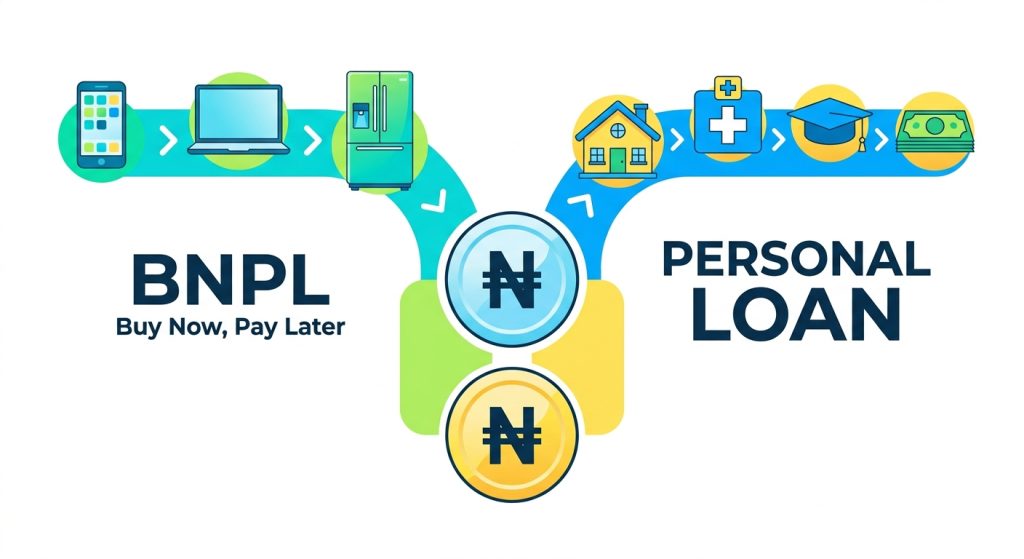
You search online. Two options keep appearing: BNPL (Buy Now, Pay Later) and a personal loan. Both promise fast money. Both say “no stress.” Both look attractive when you’re under pressure and short on cash.
But BNPL vs personal loan Nigeria is not just a comparison of names — it is a comparison of real costs, real constraints, and real consequences. On the exact same ₦60,000 need, one option can cost you nearly five times more than the other. One is perfectly designed for specific situations. The other will quietly trap you if you use it for the wrong problem.
This guide breaks it all down with actual naira numbers, named Nigerian providers, and a 60-second decision framework you can use right now.
Side-by-Side Comparison: BNPL vs Personal Loan Nigeria
| Factor | BNPL | Personal Loan |
|---|---|---|
| Speed | Instant to 24 hours | 5 minutes to 24 hours |
| Cash to you? | No — goes to merchant | Yes — directly to your account |
| Typical amount | ₦10,000 – ₦500,000 | ₦5,000 – ₦1,000,000+ |
| Repayment period | 1 – 12 months | 1 – 12 months |
| Interest rate | 0% – 30%+ depending on provider | 3% – 30% per month |
| Flexibility of use | Restricted to partner merchants | Completely unrestricted |
| Credit check required? | Sometimes light BVN check | Usually yes — BVN + credit bureau |
| Penalty for late payment | Fees + credit score damage | Fees + credit score damage |
| Best for | Specific product purchases | Any financial emergency |
True Cost Breakdown: Real ₦ Numbers on a ₦60,000 Need
This is the section most comparison articles skip. Let us use a specific scenario thousands of Nigerians face every month.
Situation: Your Android phone is broken. Replacement costs ₦60,000. You need it for work and cannot pay outright. You are weighing BNPL vs personal loan Nigeria side by side.
Option A: BNPL (Typical Nigerian Provider — Paid Plan)
You purchase the phone through a BNPL provider on a 3-month repayment plan.
- Phone price: ₦60,000
- BNPL interest rate: 5% per month (many providers advertise “0%” but apply processing fees — this uses a common paid plan structure)
- Processing fee: ₦1,500 upfront
- Monthly instalment: ₦21,000 × 3 months
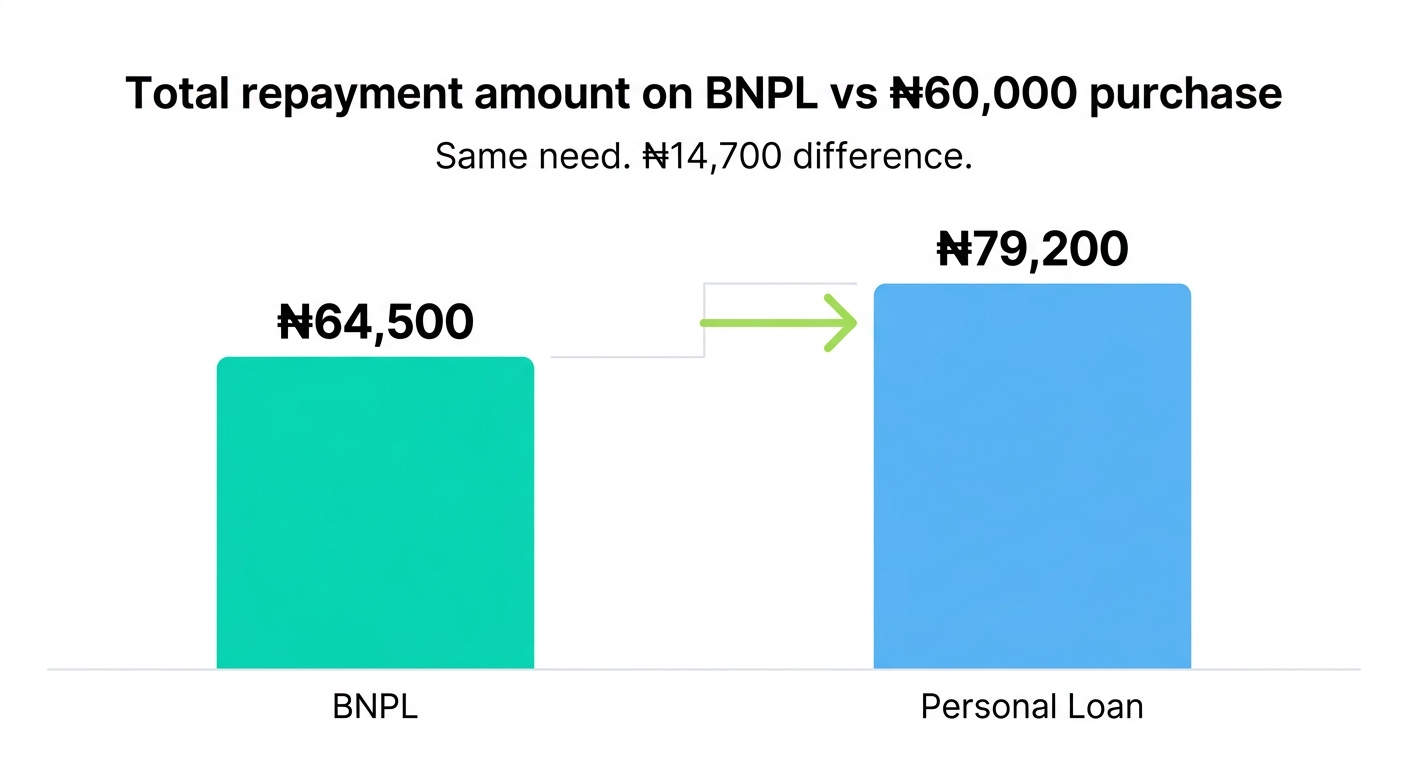
Total repayment: ₦63,000 + ₦1,500 = ₦64,500
Extra cost above phone price: ₦4,500
Note: Some BNPL providers offer genuine 0% interest on specific merchant partnerships for short terms. If you qualify for one of those deals, your extra cost drops to ₦0 — the cheapest money you will ever access in Nigeria.
Option B: Personal Loan App (Common Nigerian Rate)
You take a ₦60,000 personal loan at 10% monthly interest across 3 months — a standard rate on several Nigerian instant loan apps.
- Loan amount: ₦60,000
- Monthly interest: 10%
- Total interest over 3 months: ₦18,000
- Processing/admin fee: ₦1,200
Total repayment: ₦60,000 + ₦18,000 + ₦1,200 = ₦79,200
Extra cost above principal: ₦19,200
The Real Cost Comparison
| BNPL | Personal Loan | |
|---|---|---|
| Total paid | ₦64,500 | ₦79,200 |
| Extra above original need | ₦4,500 | ₦19,200 |
| Cost difference | — | ₦14,700 more expensive |
For a specific product purchase, BNPL beats a personal loan on cost — often dramatically. But this is where the BNPL vs personal loan Nigeria equation flips: if your need is not a physical product from a partner merchant — if it is rent, a hospital bill, school fees, emergency food money, or any cash-based expense — BNPL cannot help you at all. The cash never reaches your account.
This single distinction explains why the BNPL vs personal loan Nigeria decision is not about which is “better” in the abstract — it is about which matches your actual problem.
When BNPL Wins in Nigeria
Choose BNPL when the following conditions apply:
1. You are buying a physical product from a partner merchant.
Phones, generators, laptops, refrigerators, washing machines, furniture — this is BNPL’s designed territory. If the merchant is in the provider’s network, BNPL is almost always the cheaper path than a personal loan for the same purchase.
2. You find a genuine 0% offer.
CredPal, Zilla, and CDcare periodically run zero-interest promotions on specific products. Zero interest plus zero processing fee means you pay only the original price across instalments. That is structurally the cheapest financing available in Nigeria right now.
3. Your income is stable and predictable.
BNPL works best for salary earners who can plan repayments around a fixed monthly income. If your income varies, the fixed instalment schedule can become a risk rather than a convenience.
4. Your entire problem is one product.
If fixing your situation requires buying one item, BNPL covers it completely. No excess cash to mismanage, no temptation to spend the extra. Clean, contained, done.
When a Personal Loan Wins in Nigeria
Choose a personal loan when:
1. Your emergency is not a physical product.
Rent arrears, hospital bills, school fees, burial contributions, data subscription, NEPA prepaid meter, transport costs — none of these go through BNPL networks. In the BNPL vs personal loan Nigeria comparison for cash needs, the personal loan wins by default.
2. You have multiple urgent needs at once.
You are broke on the 25th. Data costs ₦5,000. Transport needs ₦8,000. A utility bill requires ₦15,000. One personal loan of ₦28,000 covers all three. BNPL cannot divide itself across three different unrelated needs.
3. You need to send money to someone else.
Family emergency, sick parent upcountry, burial contribution — BNPL is structurally useless here. Personal loan cash arrives in your account within minutes on platforms like SmartLoans.ng and moves wherever you direct it.
4. The seller you need is outside any BNPL merchant network.
BNPL only works within its partner ecosystem. If the seller you need is not registered with a BNPL provider, the option does not exist for that transaction. A personal loan carries no such restriction.
Hidden Traps in Both — What Most Nigerians Miss Before Signing
BNPL Traps
The “0% interest” illusion with embedded fees.
Some providers advertise 0% interest but attach a 5–8% “service charge” or “processing fee” that functions identically to interest — just with a different label. Always check the total repayment amount, not the advertised rate.
Merchant price inflation.
If the BNPL partner merchant prices the same product ₦5,000–₦8,000 higher than the open market, you have already lost money before interest starts. Price-check the item at multiple sources before committing.
Stacking multiple BNPL plans simultaneously.
This is an emerging pattern in Nigeria — phone on one BNPL plan, generator on another, laptop on a third. Each instalment looks manageable alone. Together, they stack into a monthly commitment that overwhelms a mid-range salary. Missed payments across multiple plans create compounding credit damage.
Ownership is not immediate on some products.
Certain BNPL providers retain legal title to the item until your final payment is made. If you default midway, the provider can legally reclaim the product. Read the terms, not just the marketing.
Personal Loan Traps
The flat interest misunderstanding.
A lender says “5% interest.” Many borrowers calculate ₦60,000 × 5% = ₦3,000 and think that is the total cost. That is actually the monthly charge. Three months equals ₦9,000 minimum in interest alone — before processing fees. This arithmetic mistake is one of the most common reasons Nigerians feel “cheated” by loan apps when they simply did not do the numbers upfront.
Early repayment penalties.
Some loan apps penalise you for paying back before the agreed date. This is counterintuitive and punitive. Before signing, ask explicitly: is there a penalty for early repayment?
Salary-day automatic debit.
Repayment hits your account the moment your salary drops. If you have not planned for this, you are cashless again by Day 2 and back to borrowing — a cycle that generates consistent revenue for lenders and consistent stress for borrowers.
Unregistered apps and FCCPC violations.
The Federal Competition and Consumer Protection Commission (FCCPC) has published guidelines prohibiting contact-book harassment, abusive recovery practices, and unauthorised data access by loan apps. Only use platforms verified by the FCCPC and registered with the CBN. A list of approved digital lenders is maintained on the CBN’s official website.
What LendSafe Offers
LendSafe operates as a personal loan access platform — meaning cash goes directly to your account, not restricted to any merchant or product category. This is built specifically for the situations where the BNPL vs personal loan Nigeria question has a clear answer: when BNPL simply cannot reach your problem.
If you are buying a phone and there is a legitimate 0% BNPL offer through a verified merchant — take it. That is genuinely cheaper. But if your emergency is cash-based, multi-purpose, or simply outside any BNPL merchant network, SmartLoans.ng is designed for that exact moment: fast disbursement, transparent repayment terms, and no hidden fee surprises.
How to Decide the BNPL vs Personal Loan Question in 60 Seconds
Run through these three questions in order:
Question 1: Is my need a physical product available from a BNPL partner merchant?
→ Yes? Check the BNPL option for that merchant.
→ No? Skip BNPL entirely. You need a personal loan.
Question 2: Does the BNPL deal offer 0% interest with no hidden service fees?
→ Yes? Almost certainly cheaper than any personal loan. Use it.
→ No? Calculate total repayment — not monthly rate — and compare directly against personal loan total.
Question 3: Do I need cash flexibility — multiple things to pay for?
→ Yes? Personal loan wins every time. Cash in account, you control where it goes.
The Simple Rule
BNPL for products. Personal loans for everything else.
Both tools have a legitimate place in a Nigerian borrower’s financial life. The costly mistake — sometimes ₦14,700+ on a single ₦60,000 need — is reaching for the wrong tool because the marketing of both looks identical from the outside.
Before you sign anything in the BNPL vs personal loan decision — whether it is a BNPL instalment plan or a loan app approval screen — find the total repayment number. Not the monthly rate. Not the headline interest figure. The single total amount you will pay before the debt is zero.
That number is the truth. Everything else is marketing.