Will they call my boss? Will they arrest me? Will I ever qualify for credit again?
This is the moment millions of Nigerians face every month — and almost nobody gives them accurate, straight answers. Lenders certainly don’t volunteer this information. So here is everything you actually need to know about loan default Nigeria: the timeline, the legal limits, the credit consequences, and the exact steps to take right now if you’re at risk.
1. What “Loan Default” Actually Means in Nigeria — And When the Clock Starts
Loan default Nigeria does not mean you missed one payment by one hour. The formal classification framework, aligned with CBN prudential guidelines, is structured as follows:
| Stage | Days Late | Status |
|---|---|---|
| Overdue | 1–29 days | Behind, not formally defaulted. Penalties accrue. |
| Substandard | 30–89 days | Flagged. Bureau reporting typically begins here. |
| Doubtful | 90–179 days | Serious default. Collections escalate. |
| Loss | 180+ days | Loan written off internally; recovery may continue. |
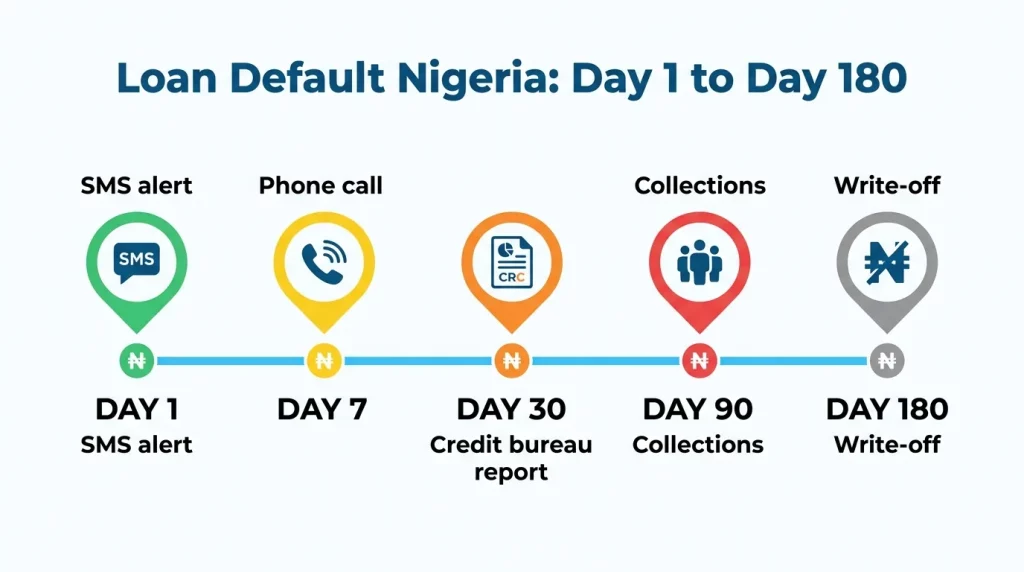
For most Nigerian loan apps — Fairmoney, Carbon, PalmCredit, Branch, and regulated lenders like LendSafe — the practical trigger is Day 1 of a missed payment. That is when late fees begin accumulating. The formal “default” classification for credit bureau purposes, however, typically begins around Day 30.
The number to remember: Day 30 is the line that changes your credit record.
Understanding exactly where you sit on this timeline is the single most important thing you can do when facing loan default Nigeria. Most borrowers assume they are already at the point of no return when, in reality, they have days — sometimes weeks — to course-correct.
2. The First 24–72 Hours After a Missed Payment
Understanding the exact sequence of events removes the fear of the unknown. Here is what typically happens after defaulting on a loan in Nigeria:
- Hour 1–6: Automated SMS and push notification. “Your repayment of ₦18,500 was due today.”
- Hour 6–24: A late penalty is applied. Common daily penalty rates across Nigerian consumer lenders range from 1% to 5% of the outstanding balance per day. On a ₦50,000 loan, that is ₦500 to ₦2,500 added every single day.
- Day 1–3: Automated calls begin. Some apps attempt to contact emergency contacts at this stage — a practice the FCCPC has flagged as potentially abusive.
- Day 3–7: A human recovery agent may contact you directly. This is your best window for restructuring conversation.
- Day 7–30: Persistent contact, escalating penalties, and preparation of your BVN data for credit bureau submission.
The critical insight: in the first seven days, almost everything is still reversible. The financial and reputational damage from loan default Nigeria compounds sharply after Day 30.
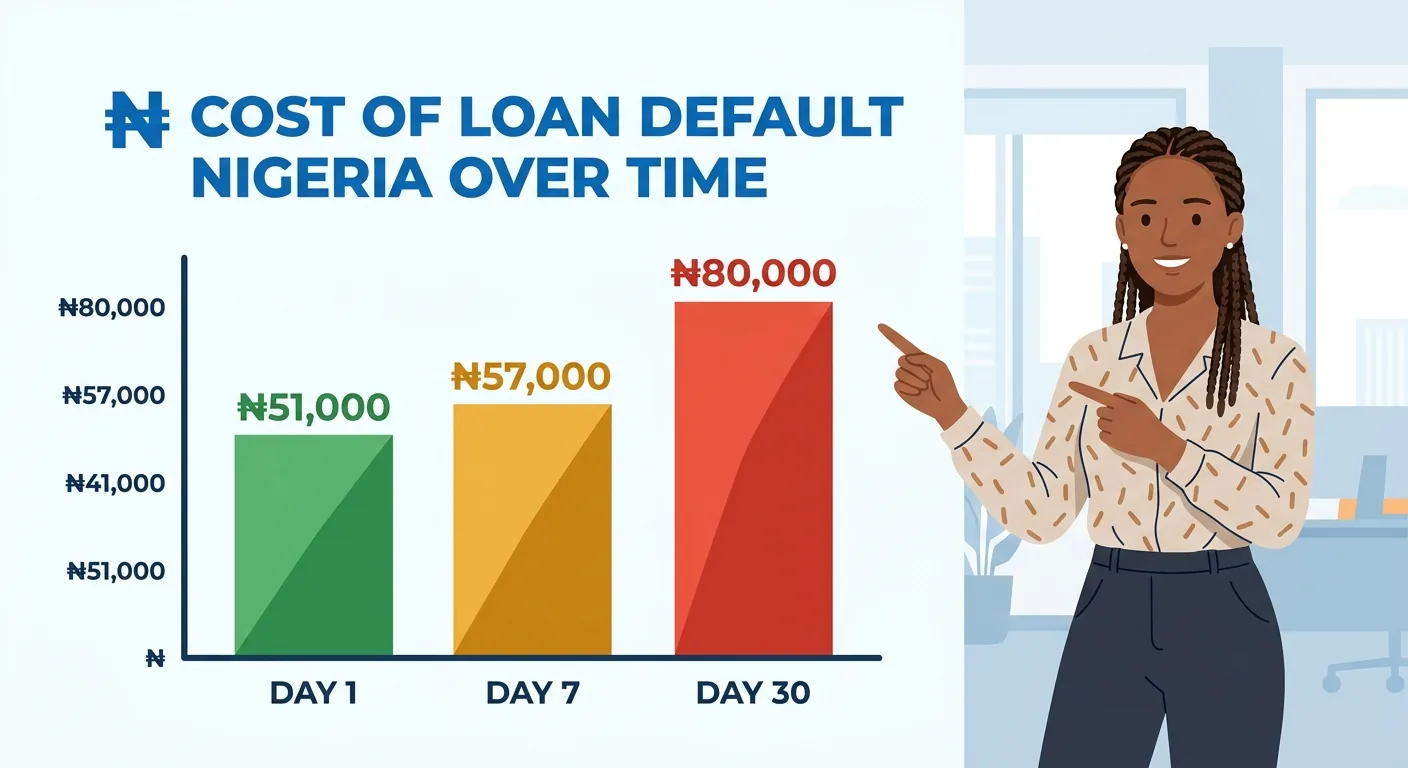
Worked ₦ Example — The Real Cost of Waiting:
You owe ₦50,000. You miss the payment date. Your lender charges a 2% daily penalty.
- Day 1: ₦50,000 + ₦1,000 = ₦51,000
- Day 7: ₦50,000 + ₦7,000 = ₦57,000
- Day 30: ₦50,000 + ₦30,000 = ₦80,000
That is a 60% increase in what you owe — in one month — from inaction alone. This is why loan default Nigeria escalates so rapidly for borrowers who go silent.
3. What Lenders Can Legally Do — And What They Cannot
This is where many Nigerians are deliberately kept confused. Understanding this boundary clearly is one of the most empowering things you can do when dealing with loan default Nigeria.
What CBN-licensed lenders CAN legally do:
- Charge late fees and penalties disclosed in your original loan agreement
- Report your missed loan payment in Nigeria to CRC Credit Bureau or FirstCentral Credit Bureau after Day 30
- Contact you and your listed emergency contacts to request repayment
- Pursue civil debt recovery through Nigerian courts
- Engage a licensed debt recovery firm
What NO lender — including loan apps — can legally do:
- Disclose your personal loan details to your contacts — this violates the Nigeria Data Protection Act (NDPA) 2023
- Post your photo, name, or debt information on social media or WhatsApp groups — this is harassment and defamation, and has attracted FCCPC sanctions
- Threaten you with arrest for a civil debt — loan default Nigeria is not a criminal offence. Police cannot lawfully arrest you for an unpaid personal loan unless specific fraud is proven
- Impersonate EFCC, ICPC, or law enforcement officers — this is a criminal offence committed by the lender
- Charge fees beyond what was disclosed in your signed loan agreement
If any lender violates these boundaries, file a formal complaint immediately:
Federal Competition and Consumer Protection Commission (FCCPC)
🌐 fccpc.gov.ng
📧 info@fccpc.gov.ng
📞 07002255372
Document everything — screenshots of messages, call recordings, WhatsApp threads — before you report. These records are your legal protection in any loan default Nigeria situation.
4. What Happens to Your Credit Bureau Record (CRC + FirstCentral)
This is the consequence that outlasts every phone call and penalty fee. When a lender reports your loan default Nigeria to CRC Credit Bureau or FirstCentral Credit Bureau, the following happens:
- A negative entry is logged against your BVN — the same BVN connected to every bank account, mobile money wallet, and financial service you use
- Every lender who checks your bureau report before approving future credit will see this negative entry
- Your credit score drops — the magnitude depends on loan size, number of missed payments, and overall credit history
- The negative entry can remain on your record for 3–7 years, depending on severity and resolution status
The Redemption Path:
Full repayment — including penalties — triggers a legal obligation for the lender to update your status from “default” to “repaid.” This does not erase the record instantly, but changes its classification. Your credit score begins recovering from that point.
After repayment, request a written confirmation letter from the lender. Then verify the update directly on your CRC report at creditregistry.ng. Bureau updates from a loan default Nigeria resolution can take 30–60 days to reflect.
According to the CBN’s 2023 Financial Stability Report, Nigeria’s credit bureau coverage has expanded significantly, meaning more lenders now actively check and report to bureaus than at any previous time. A credit bureau blacklist in Nigeria is no longer avoidable through lender-switching — your BVN follows you everywhere.
5. Can Lenders Take You to Court in Nigeria?
Yes — and here is the honest picture of when they actually do.
For loans under ₦500,000, taking an individual borrower to court is often not economically rational for lenders. Legal fees, court delays, and enforcement costs frequently exceed what they would recover from small-balance loan default Nigeria cases. Nigeria’s courts are slow — a civil debt case can take 18–36 months to resolve.
However, for larger loan amounts or institutional borrowers, court action is real. The process flows through:
- Magistrate Court for smaller civil claims
- State High Court for larger disputes
The process typically begins with a formal letter of demand from the lender’s solicitors. If you receive one, do not ignore it. Ignoring a letter of demand — and subsequently ignoring a court summons — results in a default judgment, giving the lender legal authority to pursue your assets without you present to defend yourself.
The practical 2026 reality: Licensed loan apps overwhelmingly prefer repayment arrangements over court action in loan default Nigeria cases. Courts are expensive and slow. Your most powerful tool is proactive, documented communication — started early.
6. Debt Collector Harassment: What Is and Is Not Legal (FCCPC Angle)
Debt collector harassment in Nigeria is the single most reported consumer lending complaint received by the FCCPC. The commission has issued public warnings and sanctions against multiple high-profile loan apps for illegal contact practices targeting borrowers facing loan default Nigeria.
Your rights under FCCPC guidelines and the NDPA 2023:
- You can demand written-only communication. Send a written request stating you will only accept communication via email or app message. Legitimate lenders must comply.
- You can dispute the debt amount. If penalties appear miscalculated, request a full written breakdown of every charge applied since your due date.
- You can file a formal FCCPC complaint if a collector uses threatening language, contacts people not listed as your references, calls outside reasonable hours (before 7 AM or after 9 PM), or exposes your financial information to third parties.
The FCCPC can sanction lenders, mandate refunds of illegal charges, and in serious cases pursue criminal prosecution. This regulatory mechanism is real — use it if a lender crosses the legal line during any loan default Nigeria situation.
7. Step-by-Step: What to Do RIGHT NOW If You’ve Missed a Payment
Whether your due date was yesterday or is tomorrow morning, execute this plan immediately when facing loan default Nigeria:
Step 1 — Do not go silent.
Disappearing signals to lenders that you are evading. It triggers faster escalation. Going quiet is the single most expensive decision you can make in a loan default Nigeria scenario.
Step 2 — Calculate your exact shortfall.
Is it the full ₦18,500 you cannot pay, or just ₦6,000 of it? Knowing the exact gap determines what you propose next.
Step 3 — Contact them before they call you.
Send a message through the app, email, or support line. Being proactive changes the dynamic entirely.
Step 4 — Propose a realistic partial payment.
Paying even 30–40% of what is owed signals good faith and often pauses escalation to your contacts and the bureau.
Step 5 — Request a formal grace period or restructured plan in writing.
Ask for their agreement in writing. Keep a copy. Verbal agreements are unenforceable and offer you no protection.
Step 6 — Protect your next income cycle.
Prioritise this repayment above all discretionary spending. Every additional week of loan default Nigeria adds compounding penalties to your total.
8. How to Negotiate a Loan Restructure — The Exact Words to Use
Loan restructuring in Nigeria is a normal, accepted practice — not a last resort for desperate borrowers. Most lenders prefer a restructured repayment over an unrecoverable loan default Nigeria outcome. Here is a message template you can send today:
“Good day. My name is [Full Name], account registered under [phone number/email]. I want to be fully transparent: I am currently experiencing a short-term income gap that prevents me from meeting my repayment of ₦[amount] due on [date].
I am fully committed to repaying this loan. I am requesting a restructured repayment arrangement: I can pay ₦[partial amount] by [near date] and clear the remaining ₦[balance] by [following date]. Please confirm whether this arrangement is possible and provide written confirmation of the agreed terms.
Thank you for your understanding and cooperation.”
This tone — direct, accountable, solution-focused — produces measurable results. It demonstrates willingness to repay, reduces lender anxiety, and creates a written record of your good-faith effort. Loan renegotiation in Nigeria is far more accessible than most borrowers realise — especially when you approach it with the right language before your loan default Nigeria status becomes formal.
9. What Happens If You Default With LendSafe
LendSafe operates as a CBN-compliant consumer lending platform. Our loan default Nigeria process is designed around two non-negotiable principles: transparency first, human contact before escalation.
If you miss a payment with LendSafe:
- You receive an automated notification — no immediate threat of contact to your emergency list
- A human support agent reaches out within 48 hours to understand your specific situation
- First-time borrowers in genuine, documented hardship are offered a structured grace window
- We do not use threatening language, contact your workplace without legal basis, or expose your financial data to any third party
- Credit bureau reporting strictly follows the CBN’s 30-day minimum guideline — we do not report early to pressure you.