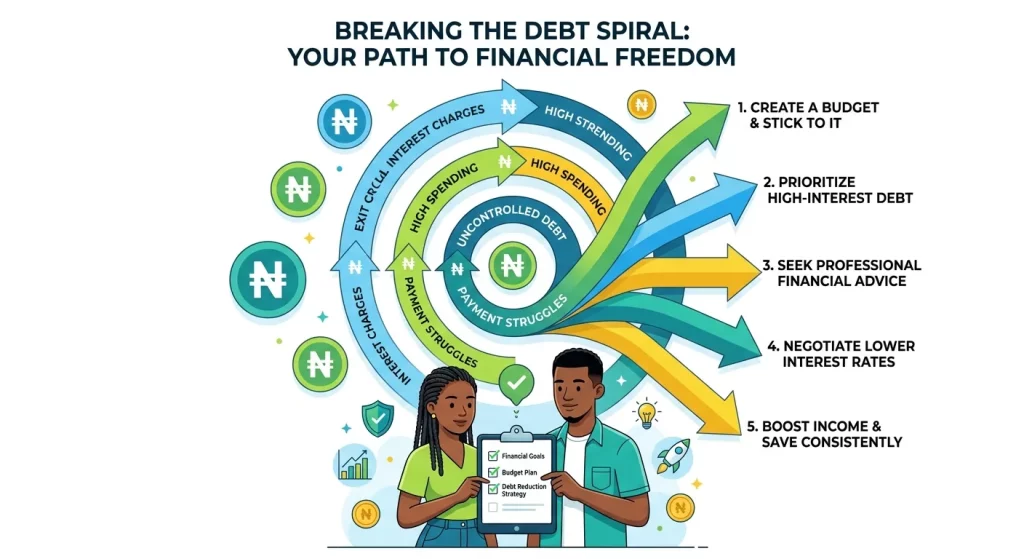
You took one loan to fix an emergency. Fair enough — that is exactly what personal loans exist for.
But then payday came and after repaying that loan, you were short again. So you took a second loan, smaller this time, just to cover food and transport until things stabilised. Then your data ran out, your landlord called, and the third app was already on your phone.
Now you have three apps deducting from your account on different dates, you are not sure which one is due next, and your salary disappears before you can breathe.
This is the debt spiral — and debt management in Nigeria is the only structured way out. It is not a character flaw. It is a pattern, and patterns can be broken with the right steps.
This guide explains exactly how the spiral starts, what makes it so hard to see from inside, and the precise method to stop it without destroying your credit score or your peace of mind.
What a Debt Spiral Actually Is (It Is Not Just Owing Money)
Owing money is normal. A debt spiral is structurally different.
A debt spiral occurs when borrowing money no longer solves your problem — it only delays and multiplies it. The clearest signal: your total debt is growing even though you are repaying every month.
Here is how it looks in real ₦ terms:
| Month | New Loan Taken | Repayment Made | Remaining Debt |
|---|---|---|---|
| January | ₦30,000 | ₦12,000 | ₦18,000 |
| February | ₦20,000 (new) | ₦15,000 | ₦23,000 |
| March | ₦25,000 (new) | ₦18,000 | ₦30,000 |
| April | ₦15,000 (new) | ₦20,000 | ₦25,000 |
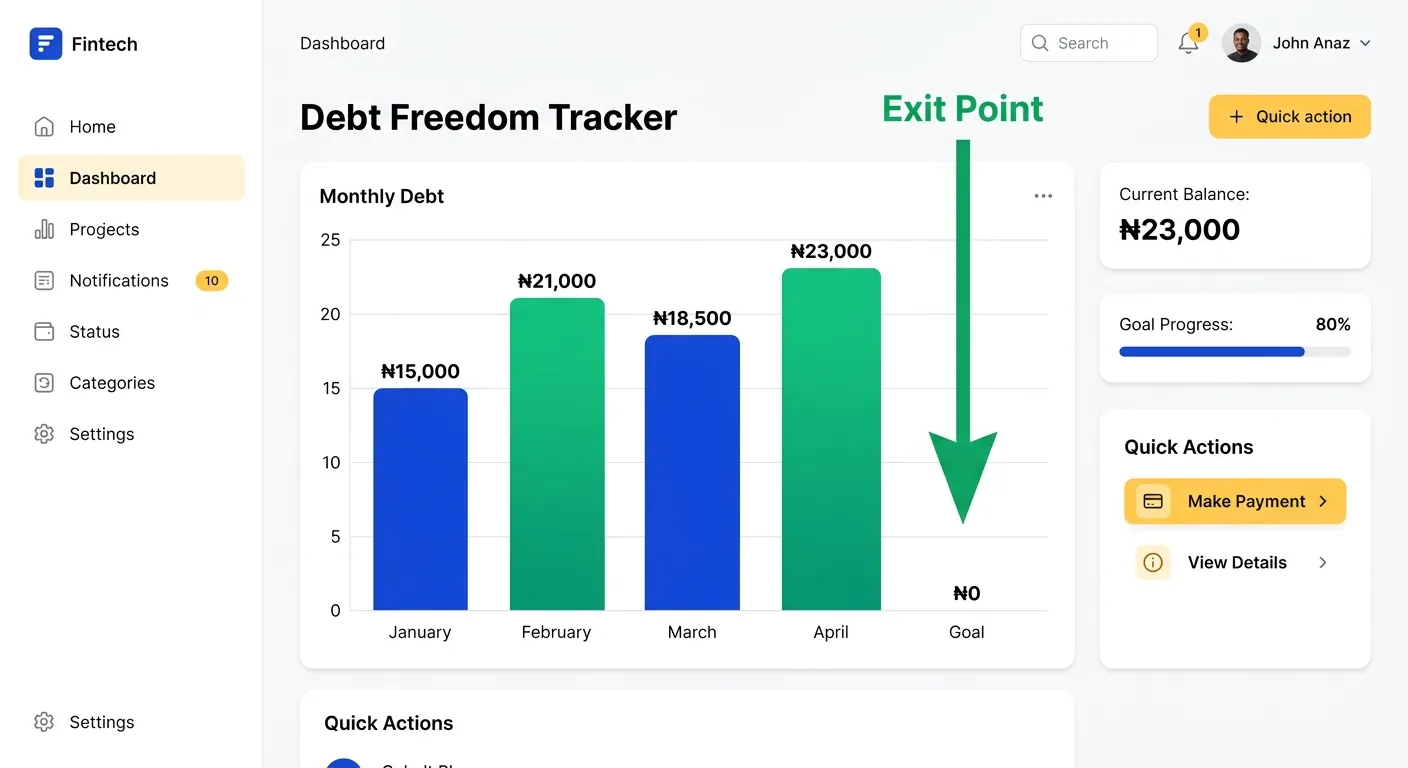
Notice: you are repaying every month, you feel like you are managing, but your total debt has not dropped — it has fluctuated without resolving. That is the hamster wheel. Effective debt management in Nigeria starts by recognising this table in your own bank statements.
The 4 Stages of a Nigerian Debt Spiral
Understanding which stage you are in determines which exit strategy applies.
Stage 1 — The First Emergency (Reasonable)
You borrow ₦30,000–₦50,000 for rent, hospital bills, school fees, or a broken phone. You intend to repay from next salary. This is normal borrowing behaviour — not yet a crisis.
Stage 2 — The Shortfall After Repayment (Danger Zone Begins)
Repaying the first loan leaves you with less than you need for the rest of the month. You borrow again — smaller, “just this once” — to bridge the gap. This is where most loan traps in Nigeria are born. The debt cycle begins quietly here.
Stage 3 — Multiple Active Loans (The Spiral Is Confirmed)
You now have two or three loan apps with active balances, different due dates, and different interest rates. At this stage, 40–60% of your monthly income goes directly to debt repayments before you spend a single naira on living essentials. Overlapping loans trap millions of salary earners across Nigeria in exactly this position.
Stage 4 — Loan to Repay a Loan (The Deepest Trap)
You take a new loan specifically because another loan is due and your account is empty. You are no longer borrowing for a need — you are borrowing to stay still. This is the clearest marker of a full debt spiral in Nigeria, and the point where the 5-step plan below becomes urgent.
Why the Spiral Is Especially Dangerous in Nigeria Right Now
Three structural factors make debt management in Nigeria harder in 2026 than in previous years.
1. Daily interest compounds fast.
Many Nigerian loan apps charge between 1% and 5% per day or 15%–30% per month. According to the Federal Competition and Consumer Protection Commission (FCCPC), dozens of digital lenders operate outside regulated rate ceilings. A ₦20,000 loan left unresolved for 60 days can swell to ₦32,000–₦36,000.
2. Multiple apps mean multiple data access points.
Each app grants access to your contacts, SMS, and sometimes gallery. When you default, some lenders still use contact-shaming despite FCCPC regulations explicitly banning the practice. The social pressure accelerates panic borrowing — a well-documented feature of the debt cycle in Nigeria.
3. No formal financial safety net.
Nigeria’s social security infrastructure remains thin. There is no unemployment benefit and no income buffer. When salaries are delayed — as happens disproportionately in public-sector households — debt becomes the only available tool for managing household cash flow.
The 5-Step Debt Management Plan for Nigeria (Designed for Real Incomes)
These are the steps that work for salary earners, artisans, and daily-wage workers. This is practical debt management in Nigeria — not generic financial advice.
Step 1 — Stop the Bleeding Immediately
The first and hardest rule: no new loan until you have counted what you already owe.
Write every loan in your notes app or on paper:
– Lender name
– Amount owed today — current balance including accumulated interest, not the original figure
– Due date
– Monthly interest rate
Most people inside a debt spiral do not know their true total debt. They know their repayments but not their balances. This step alone is clarifying — and often shocking. If you feel tempted to take a new loan right now, pause and ask one question: will this reduce my total debt or add to it?
Step 2 — Rank Loans by Danger, Not by Size
In Nigeria, not all debts escalate at the same speed. Rank them this way:
- Loans with daily compounding interest — highest urgency
- Loans from apps that accessed your contacts — immediate social risk
- Loans from individuals or office colleagues — relationship damage accelerates
- Loans from regulated banks or ethical apps — formal process, slower escalation
Pay the most dangerous first — not the largest, not the oldest. This ranking system is the core of effective loan repayment prioritisation in Nigeria.
Step 3 — Freeze Your Budget to Three Categories Only
While in exit mode, spending shrinks to:
- Food — cheapest version that keeps you functional
- Transport — work commute only
- Debt repayments — ranked as above
If your salary is ₦80,000 and repayments total ₦45,000, you have ₦35,000 for food and transport. It is tight — but survivable for 60–90 days when treated as a sprint. Every naira spent outside these three categories while you are in a debt cycle in Nigeria extends your exit timeline.
Step 4 — Negotiate Before You Default
This is the step most Nigerians skip because it feels embarrassing. It is the most powerful move available.
Contact your lender before the due date — not after going silent. Most regulated lenders, including FCCPC-registered app lenders, have restructuring or rollover options. They will not offer these after you disappear for two weeks.
Say clearly: “I cannot pay the full amount on [date]. I can pay ₦X now and ₦Y in 30 days. Can we confirm this in writing?”
Document every agreement — even a WhatsApp screenshot serves as evidence. If a lender refuses and instead threatens or contacts your colleagues, report them immediately to the FCCPC complaints portal. Harassment is prohibited under Nigerian consumer lending regulations regardless of whether the debt is legitimate.
Step 5 — Build a ₦5,000 Stop-Gap While Repaying
Counter-intuitive but essential: save a small buffer simultaneously with repaying debt.
Even ₦1,000 per week — ₦4,000 per month — kept in a separate wallet breaks the core trigger of the debt spiral in Nigeria: emergency happens → borrow immediately.
A ₦5,000–₦10,000 buffer absorbs small shocks — transport emergencies, airtime, minor medical costs — that would otherwise push you back to a loan app. This is not wealth-building at this stage. It is spiral-breaking.
When to Consider Debt Consolidation in Nigeria
Debt consolidation means taking one loan at a lower rate to close multiple high-rate loans simultaneously.
This works when:
– You have three or more active loans with overlapping due dates
– At least one carries a high daily interest rate
– You qualify for a meaningfully lower rate through an employer cooperative, salary advance scheme, or a transparent regulated personal loan
The critical rule: consolidation only makes sense if the new rate reduces your monthly interest burden by 30% or more. Calculate your current weighted average monthly interest — add all monthly interest charges and divide by total outstanding balance. If consolidation drops that figure by 30%+, proceed. If the gap is smaller, prioritise Steps 2–4 of the debt management plan above.
The Honest Truth About Debt Management in Nigeria
If you are ₦150,000 in debt across multiple apps and earning ₦80,000 per month, you are not exiting in one month. You are looking at three to five months of uncomfortable living — tight food budget, zero entertainment, awkward conversations with lenders.
But three to five months from now, you could be debt-free with a ₦10,000 buffer in place.
Or, three to five months from now, you could be ₦250,000 in debt if you keep borrowing to repay borrowing.
Proper debt management in Nigeria is not about perfection — it is about stopping the additions. Every month you do not add a new loan is a month the spiral weakens. Every month you borrow again is a month it tightens.
The exit exists. It requires a specific plan, not another loan.
Quick Reference: Debt Spiral Exit Checklist
- [ ] List every loan: lender, current balance, due date, interest rate
- [ ] Stop all new borrowing today — no exceptions
- [ ] Rank loans by danger: daily-interest and contact-access apps first
- [ ] Freeze budget to food, transport, and repayments only
- [ ] Contact lenders before due dates to negotiate restructuring
- [ ] Document all agreements; report harassment to FCCPC
- [ ] Save ₦1,000/week into a separate buffer while repaying
- [ ] Consider consolidation only if new rate reduces burden by 30%+