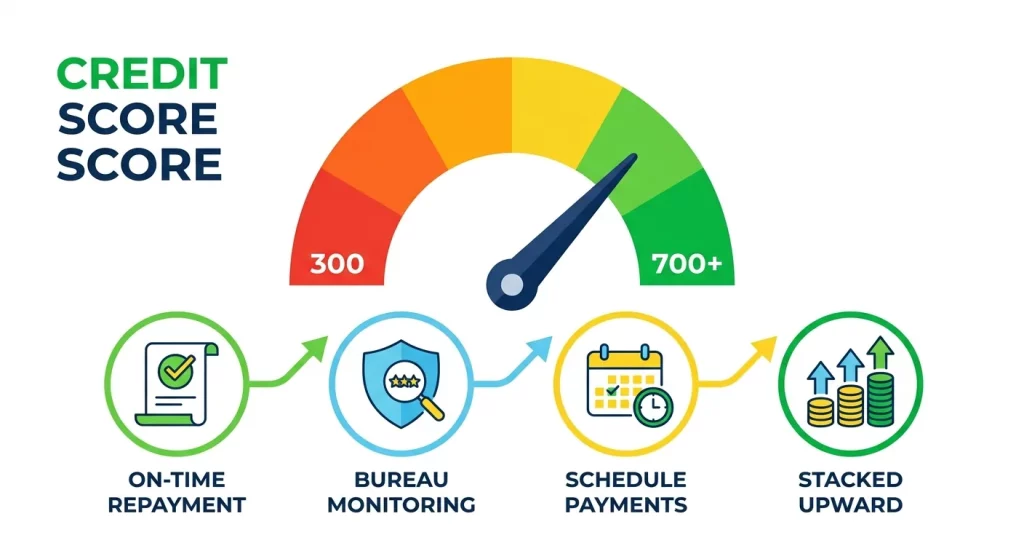
How long does it take to rebuild credit score Nigeria lenders trust? This guide answers your question step by step, using how Nigeria’s two main credit bureaus — CRC Credit Bureau and FirstCentral Credit Bureau — actually calculate and update your profile.
What Your Credit Score in Nigeria Actually Measures
Before you can fix something, you need to understand what it tracks.
CRC and FirstCentral both receive repayment data from banks, microfinance institutions, and registered digital lenders. Every time you borrow from an institution that reports to a bureau, your repayment behaviour is logged. Pay on time: positive entry. Pay late: negative entry. Default completely: a serious negative entry that sits on your file for up to five years.
Your score is that history compressed into a three-digit number. Lenders use it to decide two things: whether to approve you at all, and what interest rate to charge.
- Above 650: most doors open
- Below 500: most doors close
- Below 400: you are left with informal lenders or high-rate apps that do not report to bureaus — meaning borrowing from them will not help you rebuild credit score in Nigeria at all
Why Your Score Is Low: The Honest Diagnosis
There are four common causes in the Nigerian context:
1. You defaulted on a loan app. The most common trigger. A single loan default in Nigeria can drop your score by 80 to 120 points.
2. You stacked multiple simultaneous loans. Even if you repaid all of them, the pattern signals financial distress to bureau algorithms.
3. You have no credit history at all. A thin file — almost no borrowing history — produces a low score because there is nothing positive to show. This affects many corpers, first-time salary earners, and artisans who have always used cash.
4. Someone used your BVN fraudulently. If a loan was taken in your name without your knowledge, it sits on your bureau file and drags your score down. This requires a formal dispute, not a repayment plan.
Knowing which category applies tells you which part of the plan below to prioritise.
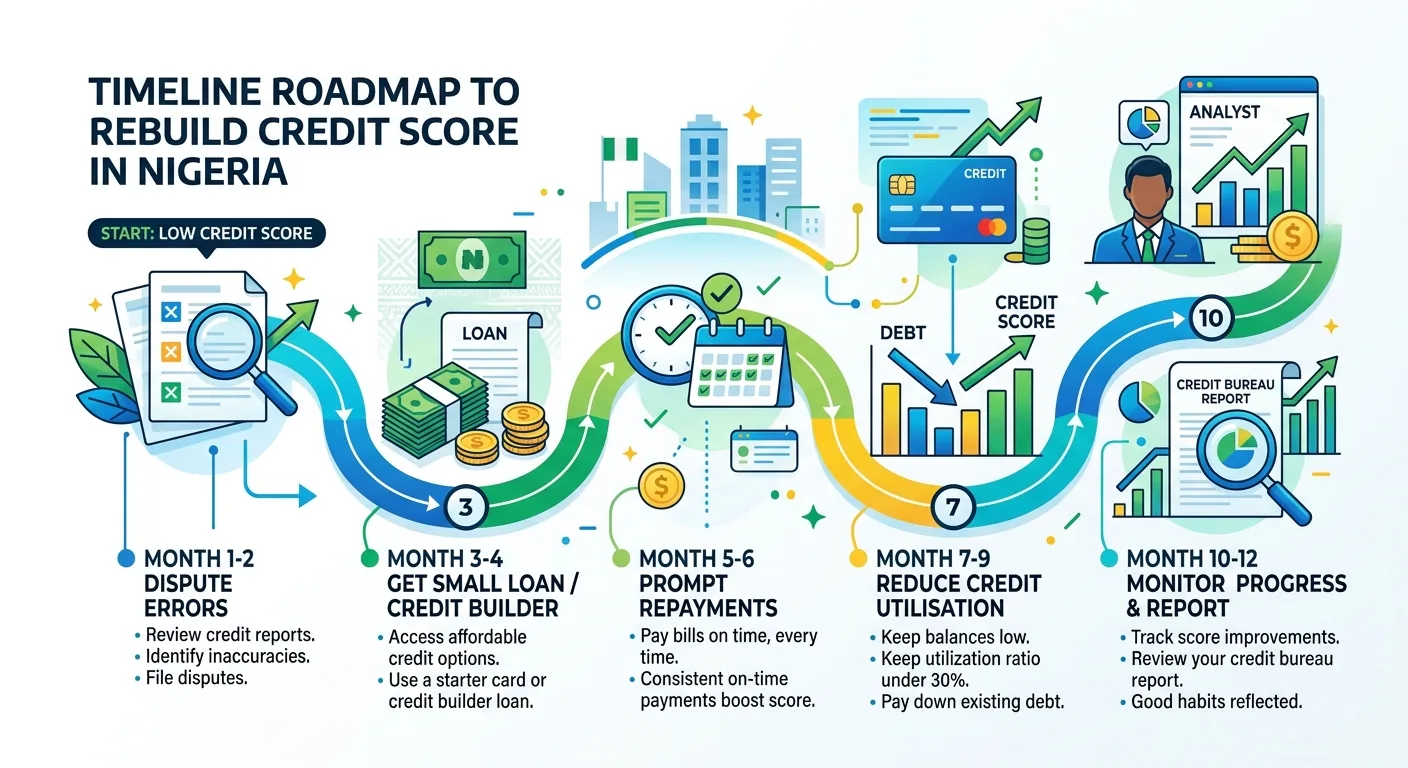
The 6–12 Month Rebuild Roadmap
To rebuild credit score in Nigeria, consistent positive behaviour recorded over time is the only mechanism that works. The timeline below reflects how CRC and FirstCentral actually update their data.
| Phase | Timeframe | Primary Focus |
|---|---|---|
| Stop the bleeding | Months 1–2 | Dispute errors, settle defaults |
| Build positive entries | Months 3–5 | Small loans, early repayments |
| Compound the gains | Months 6–9 | Manage utilisation, no new accounts |
| Review and apply | Months 10–12 | Pull bureau report, dispute errors, apply strategically |
Step 1: Clear or Restructure Existing Defaults First
The single most damaging item on a bureau file is an unresolved default. A default two years old and still unpaid weighs more against you than a recent late payment you eventually cleared.
Contact any lender you defaulted with. Many FCCPC-registered lenders have settlement or restructuring options they do not advertise. You can often negotiate to pay a percentage of the outstanding amount in exchange for the lender updating your bureau entry from “default” to “settled.”
A settled default still shows on your file, but it signals that you took responsibility — a distinction credit officers notice when reviewing your CRC bureau Nigeria report manually.
For suspected BVN fraud, file a dispute directly with CRC or FirstCentral using their official dispute portals. Fraudulent entries can be removed entirely, recovering your score within 30 to 60 days of the investigation concluding.
Step 2: Build Positive Repayment History With Small Loans
This step surprises people. To fix your credit, you need to borrow again — but strategically.
Bureaus improve your score when they see consistent, on-time repayments recorded against your BVN. The only way to create those entries is to borrow from a lender that reports to CRC or FirstCentral, repay perfectly, and let the positive data accumulate.
Borrow only what you can repay comfortably. If your monthly income is ₦80,000 and expenses are ₦65,000, your breathing room is ₦15,000. Do not borrow more than ₦10,000 during the rebuild phase. This is about creating a clean repayment record in Nigeria, not meeting a large need.
Use only FCCPC-registered lenders. Unregistered apps may not report to bureaus. Some report only defaults, not repayments — giving you all the downside with none of the upside.
Repay three to five days early, every single time. Early repayment eliminates any risk of a technical late entry caused by bank transfer delays — a frustratingly common problem in Nigeria.
Space your applications out. Apply for one small loan, repay it fully, wait four to six weeks, then apply again. Multiple simultaneous applications trigger hard enquiries on your BVN credit check record and signal desperation.
After three to four successful repayment cycles, most people see their bureau score move upward by 60 to 100 points over four to five months.
LendSafe reports repayment data directly to the bureaus. Every loan you repay on time becomes a documented positive entry on your FirstCentral credit report or CRC file.
Step 3: Reduce Credit Utilisation and Stop Stacking Apps
Credit utilisation is how much of your available credit you are currently using. If you have four apps each with ₦15,000 limits and you are at maximum balance on all four, your utilisation is 100 percent — bureaus score that very poorly.
Target: keep active loan balances below 30 to 40 percent of your total available credit at any given time.
Practical actions:
– Close loan app accounts you are not actively using, especially ones you previously defaulted on
– Do not open new accounts during the rebuild phase — each triggers a hard enquiry
– If you must borrow for an emergency, use one primary lender, keep the amount low, and repay within the agreed period
Managing utilisation alongside building repayment history is what accelerates the process to rebuild credit score Nigeria from slow improvement to measurable monthly gains.
Step 4: Monitor Your CRC and FirstCentral Reports Actively
Most Nigerians never check their bureau reports until they get declined. During a rebuild phase, checking every two to three months verifies that your positive actions are being recorded and no new errors have appeared.
CRC and FirstCentral both allow individuals to request reports through their official portals. One annual request is free; additional checks range from approximately ₦1,000 to ₦2,500. Given that a single error can erase months of rebuild progress, paying ₦1,500 for a mid-year check is one of the highest-return decisions you can make.
What to look for:
– Loan entries you do not recognise (potential BVN fraud)
– Defaults listed as “open” that you have already settled
– Late payment flags on accounts where you have been paying on time
– Incorrect personal information linked to your BVN
Dispute any error immediately through the bureau’s formal channel. Keep records of every submission and response.
Mistakes That Reset Your Rebuild to Zero
Borrowing from unregistered apps. Perfect repayment is invisible if the lender does not report to a bureau.
Missing one repayment because “it was just once.” One missed repayment can wipe out two months of positive entries. Treat every due date as non-negotiable.
Applying everywhere when you need cash urgently. Multiple hard inquiries in a short window can lower your score by 15 to 30 points per cluster — the exact opposite of what you need.
Ignoring the bureau report and hoping the score fixes itself. It does not. Errors persist indefinitely unless you formally dispute them.
Where LendSafe Fits Into Your Rebuild Plan
If you are in the early stages of rebuilding and need a loan today — not in six months — LendSafe is built for exactly that position.
LendSafe is FCCPC-compliant and reports repayment data to the credit bureaus. Every loan you repay on time through LendSafe becomes a documented positive entry on your CRC or FirstCentral file. You are not just solving today’s cash problem — you are building the repayment history Nigeria’s bureaus use to score you upward.
Apply in under three minutes. Same-day disbursement. And every on-time repayment helps you rebuild credit score in Nigeria the right way.
[Check Your Eligibility on LendSafe — Fast, Fair, Bureau-Reporting Loans]
The 12-Month Summary
| Month | Action | Expected Score Movement |
|---|---|---|
| 1–2 | Dispute errors, settle defaults | +20 to +50 points |
| 3–4 | First small loan, repaid early | +30 to +50 points |
| 5–6 | Second and third repayment cycles | +40 to +60 points |
| 7–9 | Reduce utilisation, no new accounts | +20 to +40 points |
| 10–12 | Pull bureau report, dispute new errors | +10 to +30 points |
| Total | Consistent behaviour, no setbacks | +120 to +230 points |
Starting from 350, twelve months of consistent action can realistically bring you to 520 to 580 — where most registered digital lenders will approve larger amounts at standard rates. Starting from 450, that discipline can get you above 650 — where bank loans and formal credit products become accessible again.
The score is not fixed. It is a record of behaviour. And behaviour is something you control starting today.
Frequently Asked Questions
How long does it take to rebuild credit score in Nigeria?
Realistically, six to twelve months of consistent positive repayment behaviour. Disputes on fraudulent entries can deliver faster improvements — sometimes within 30 to 60 days — but organic score growth takes sustained effort over multiple loan cycles.
Does checking my own credit report lower my score?
No. Pulling your own CRC or FirstCentral report is a soft enquiry and does not affect your score. Only lender-initiated hard enquiries — when you apply for credit — can temporarily affect it.
Can I rebuild my score if I cannot afford to repay old defaults?
Partially. Settling defaulted debts at a negotiated amount improves your bureau entry from “open default” to “settled,” which significantly reduces its weight in the scoring algorithm over time.
Do all Nigerian loan apps report to credit bureaus?
No. Only FCCPC-registered digital lenders and licensed financial institutions are required to report accurately. Always confirm bureau reporting before using an app specifically for credit-building purposes.
LendSafe Nigeria — Fast, Fair, FCCPC-Compliant Loans for Real Nigerians.
Always borrow responsibly. Only take what you can repay.