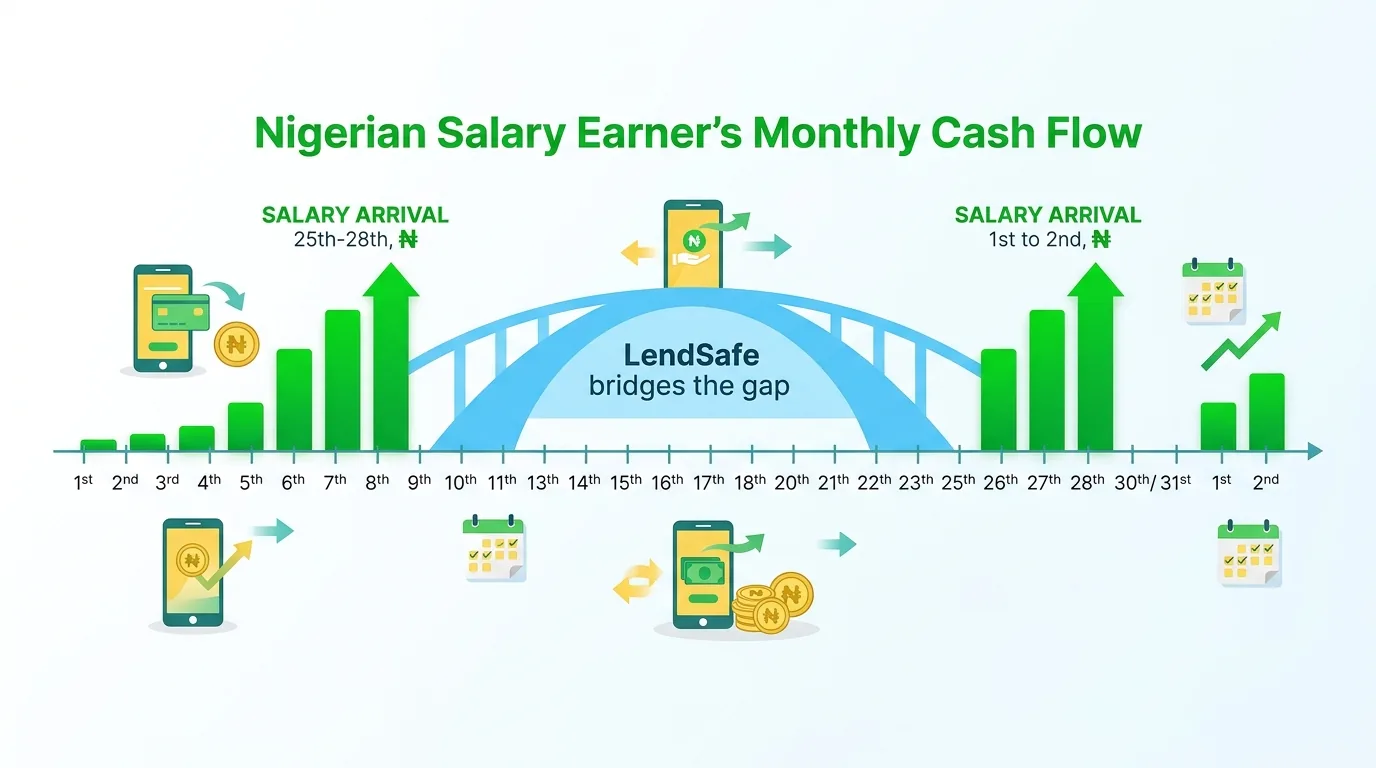
Your account reads ₦3,200. Rent is due Friday. Salary drops on the 28th — and today is the 19th. Nine days. Zero options. Sound familiar?
Every salary earner in Nigeria has been here. You are not broke because you are reckless. You are broke because rent cycles, school fees, NEPA bills, and market prices do not care what day your employer pays you. The gap between your last naira and your next payday is exactly where bad borrowing decisions get made.
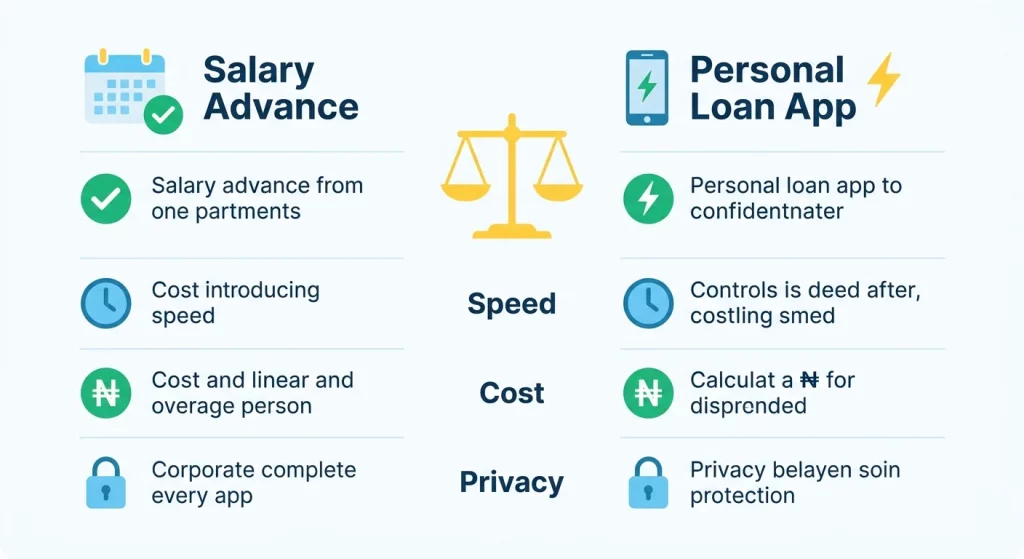
Two options keep surfacing: ask your employer for a salary advance, or get a personal loan from an app. Most people pick one without understanding what they are actually choosing. This guide on salary advance vs personal loan Nigeria breaks it down so you pick the right tool — the one that solves today’s problem without destroying next month.
What Is a Salary Advance in Nigeria?
A salary advance is when your employer pays part of your earned salary before the official payday. You are not borrowing new money — you are collecting wages you have already worked for, just earlier than scheduled.
How it typically works:
– You submit a written request (an advance salary request letter) to HR or your line manager
– The company approves a portion — usually 50%–70% of your net monthly salary
– The amount is automatically deducted from your next salary payment
– No external lender, no loan app, no credit check involved
Who offers this? Federal and state civil service organisations, large private sector employers (banks, telecoms, FMCG companies), and structured NGOs. Smaller employers — local businesses, private schools, most SMEs — often have no formal HR advance policy. For millions of informal workers — domestic staff, artisans, market traders, and contract workers — this option simply does not exist.
What Is a Personal Loan in Nigeria?
A personal loan is money borrowed from a lender — a bank, microfinance institution, or loan app — deposited directly into your account and repaid with interest over an agreed period.
In 2026, the most accessible form of personal loan for salary earners in Nigeria is the loan app. Platforms like Carbon, FairMoney, Renmoney, Branch, and LendSafe operate 24/7 and disburse funds in minutes. They require only your BVN and bank account details — no employer involvement, no collateral, no guarantor.
Interest rates on these platforms typically range from 2% to 30% per month, depending on your credit profile and the lender. Personal loans through apps are available to salary earners, corpers, artisans, students, and domestic workers — anyone with a BVN and an active bank account.
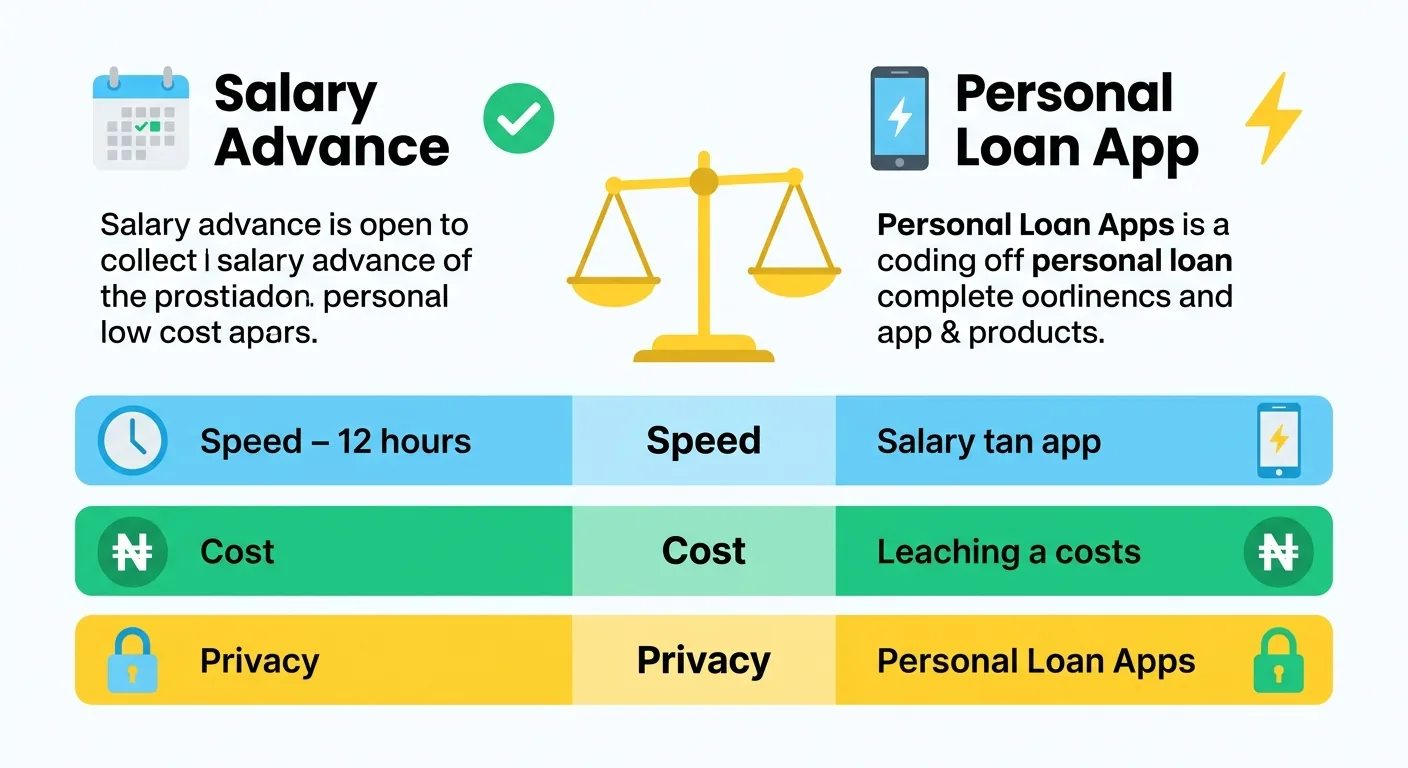
Side-by-Side Comparison: Salary Advance vs Personal Loan Nigeria
| Factor | Salary Advance | Personal Loan (App) |
|---|---|---|
| Speed | 1–5 business days | 5 minutes to 24 hours |
| Availability | Only if employer has a policy | Almost anyone with a BVN |
| Cost / Interest | Usually zero | 2%–30% per month |
| Maximum Amount | 50–70% of monthly salary | ₦5,000 to ₦5,000,000+ |
| Repayment | Auto-deducted from next salary | Fixed weekly or monthly schedule |
| Credit Check | None | BVN + credit bureau |
| Privacy | Employer knows your situation | Completely private |
| Weekend Access | No | Yes |
| Works for Informal Workers | Rarely | Yes |
When a Salary Advance Is the Better Choice
1. Your employer has a clear, no-drama advance policy.
Zero interest is impossible to beat. If HR processes advances without gossip or career implications, this is the cheapest money you will ever access — full stop.
2. You need a small amount within your earned salary.
If your net pay is ₦80,000 and you need ₦30,000 for a utility bill or transport gap, a salary advance is perfectly sized. You are not paying interest on money you have already earned.
3. You want zero footprint on your credit profile.
Salary advances are internal employer arrangements. They do not appear on your CRC or FirstCentral credit bureau file. If you are actively building your credit score, this keeps your report clean.
4. Your next salary can comfortably absorb the deduction.
If ₦80,000 comes in and ₦30,000 is deducted, you still have ₦50,000 for fixed costs. That math works. If it does not — see the next section.
When a Personal Loan Is the Better Choice
1. Your employer has no advance policy — or you do not want them involved.
Many Nigerians avoid the advance salary request letter because they fear being labelled financially unstable. A personal loan is 100% private — your employer never knows.
2. You need money today, not in three to five business days.
HR approval cycles take time. Loan apps do not. If your child’s school fees deadline is tomorrow morning or your landlord is threatening to change the padlock tonight, a quick loan before payday from an app can deposit cash in under 10 minutes.
3. You are a non-salaried worker.
Corpers, artisans, domestic workers, market traders, and Keke riders have no employer to request an advance from. Personal loan apps were built precisely for this category of borrower.
4. You need more than one month’s salary.
Medical emergencies, urgent repairs, or family crises can cost multiples of your monthly income. Loan apps — depending on your credit history — can provide significantly more than any advance salary request would cover.
5. You need flexible repayment across 2–6 months.
Spreading repayment prevents your next salary from arriving already broken. A 3-month plan on ₦60,000 means roughly ₦22,000–₦25,000 per month rather than one ₦60,000 hammer on payday.
The Hidden Costs Most Borrowers Miss
Salary advance hidden cost: Your next salary arrives smaller. If net pay is ₦80,000 and you took a ₦40,000 advance, your 28th is now a ₦40,000 payday. If fixed costs exceed that amount, you have immediately created next month’s crisis — and this is exactly how perpetual advance cycles begin.
Personal loan hidden costs to watch:
– Processing fees: Some lenders deduct 1%–5% upfront. You receive less than you applied for.
– Insurance fees: Added to your principal with minimal explanation.
– Late payment penalties: A single missed repayment day can add 1%–5% of your outstanding balance immediately.
– Rollover traps: Some apps encourage “loan renewal” — which is actually a larger new loan that resets your debt cycle.
The honest rule: Focus on the total repayment amount, not the advertised rate. If you borrow ₦20,000 and repay ₦26,000 in 30 days, your real cost is ₦6,000 — regardless of how the lender labels it. The FCCPC’s Digital Lending Guidelines require transparent disclosure of this figure before you accept any loan offer.
What Lenders and Employers Actually Check
For a salary advance (HR review):
– Employment status and tenure — usually minimum 3–6 months in the role
– Whether you have an existing outstanding advance
– Department manager’s written approval
– Your salary grade and the policy cap on advance amounts
For personal loan apps (automated credit check):
– Your BVN — linked to your national identity and bank history
– Bank statement — last 3–6 months of deposits and withdrawals
– Credit bureau record — existing debts, defaults, repayment behaviour
– Monthly income estimated from real deposits, not employer confirmation
The key difference: salary advances judge your employment status; personal loans judge your financial behaviour. A consistent income showing on your bank statement — even from freelance work or trading — can qualify you for a personal loan that HR could never approve.
When Your Employer Says No: The LendSafe Option
You wrote the advance salary request letter. HR said they will “escalate it.” Three days have passed. Rent is due tomorrow.
This is exactly why LendSafe Nigeria exists — built for the in-between moment when your salary is coming but is not here yet, and when HR’s process is slower than your landlord’s patience.
- Apply in under 3 minutes using your BVN and bank account details
- No collateral, no guarantor, no employer approval required
- Funds disbursed directly to your bank account — often within minutes
- Full repayment schedule shown before you accept — zero hidden surprises
- FCCPC-registered and operating under CBN consumer protection guidelines
You know the salary is coming. LendSafe closes the gap. You repay when it lands. Clean and simple.
👉 Check your eligibility on LendSafe Nigeria
Final Verdict: Salary Advance vs Personal Loan Nigeria
| Your Situation | Best Option |
|---|---|
| Advance policy exists, next salary absorbs deduction comfortably | Salary Advance — it is free |
| Need money in hours, not days | Personal Loan App |
| Informal worker, corper, artisan, domestic staff | Personal Loan App |
| Need more than one month’s salary | Personal Loan App |
| Want zero credit bureau footprint | Salary Advance |
| Next salary would be crippled by full deduction | Personal Loan App — spread over 2–3 months |
| Employer has no advance policy | Personal Loan App |
| Privacy is a priority | Personal Loan App |
When weighing salary advance vs personal loan Nigeria, the answer is context-dependent. A salary advance wins when it is free, genuinely available, and your next salary can absorb the deduction without creating a new shortfall. In every other scenario — which covers the majority of Nigerians in 2026 — a transparent personal loan app delivers the speed, privacy, and repayment flexibility that HR simply cannot match.
The goal is not to borrow more. The goal is to borrow smart, solve the immediate problem, and repay before it compounds into next month’s crisis.
Frequently Asked Questions
Can I get a salary advance if I am a corper?
NYSC allawee is not processed through a traditional HR system, so a formal salary advance Nigeria request is not available to most corpers. A personal loan app that accepts BVN and bank account income — like LendSafe — is the practical alternative.
Does taking a personal loan affect my salary advance eligibility later?
Not directly. Salary advances are employer decisions, not credit bureau decisions. However, if your bank statement shows heavy existing debt, some HR departments may factor this in informally.
What is the maximum salary advance amount in Nigeria?
Most structured employers cap advances at 50% of your net monthly salary for a first request. Civil service rules typically allow one advance per quarter.
Is a salary advance taxable in Nigeria?
No. A salary advance is a prepayment of already-earned wages, not additional income, and does not attract PAYE tax beyond your normal salary deductions.
Ready to bridge the gap before your salary arrives?
👉 Apply on LendSafe Nigeria — 3 minutes, funds tonight, no guarantor required
LendSafe Nigeria — Licensed, Transparent, Fast.