That “quick loan” can quietly cost you double — if you skip these seven checks.
You found a loan app. You entered your BVN, uploaded your ID, and got approved in under three minutes. Now a long screen of text is staring at you — the loan agreement.
Your rent is due tomorrow. Your boss hasn’t paid you. You’re tempted to scroll straight to the bottom and tap Accept.
Do not do that yet.
Knowing how to read loan terms Nigeria borrowers encounter every day is the single most valuable financial skill you can develop before touching any loan app. In 60 seconds of honest reading, you can spot the difference between a loan that costs you ₦3,000 and one that costs you ₦18,000 — on the same ₦20,000 borrowed.
This guide shows you exactly what to look for, line by line, before you tap that final button.
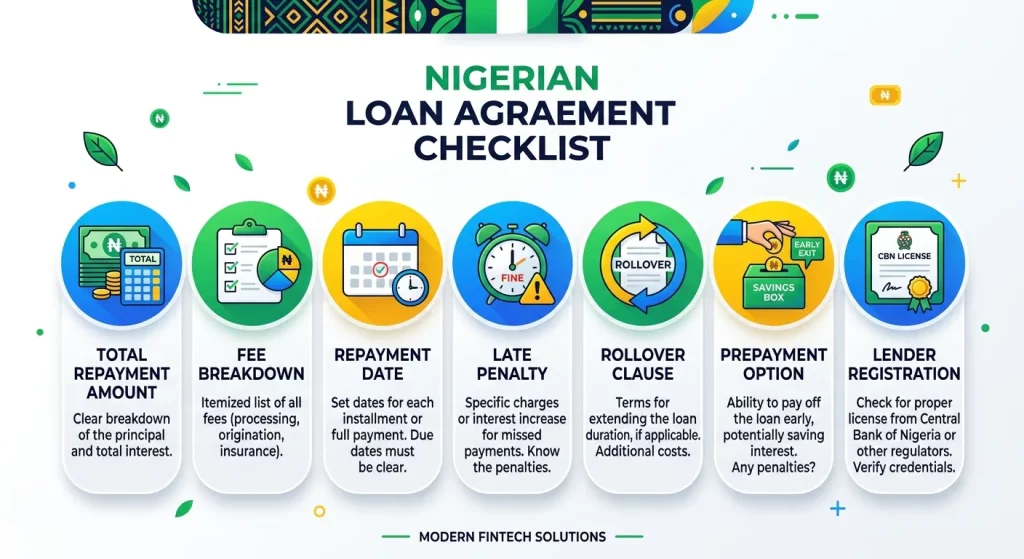
1. Find the Total Repayment Amount First — Not the Interest Rate
Most loan apps show you a percentage. “4% monthly.” “1.5% daily.” “Zero interest — only a service fee.”
Those numbers mean nothing without one figure: the total amount you will repay.
Before anything else, scroll through the loan agreement until you find a line like:
- Total repayment: ₦24,500
- Amount due on [date]: ₦27,000
- Principal + fees + interest = ₦X
Subtract the amount you’re borrowing. That difference is your real cost.
Worked example: You borrow ₦20,000 for 30 days. The app advertises “5% monthly interest” — which should mean ₦1,000. But the total repayment shown is ₦26,400. You’re actually paying ₦6,400, because processing fees, insurance fees, and VAT were stacked on top of the headline rate and never mentioned upfront.
Always do this subtraction. It takes ten seconds and prevents the single most common loan shock in Nigeria.
2. Separate the Interest Rate from the Fees
Nigerian loan agreements typically bundle several charges together — appearing as separate line items, or sometimes not appearing at all until after you’ve accepted.
Here’s what to look for:
| Charge | What it means | Danger level |
|---|---|---|
| Processing / origination fee | Deducted upfront before you receive money | HIGH |
| Management fee | Monthly admin charge on top of interest | MEDIUM |
| Insurance fee | Sometimes mandatory, not always disclosed | MEDIUM |
| Late payment fee | Charged per day or per week after due date | VERY HIGH |
| VAT (7.5%) | Applied to service fees, not principal | LOW but compounds |
A processing fee is particularly deceptive. If you borrow ₦20,000 and a ₦2,000 processing fee is deducted upfront, you receive ₦18,000 — but you repay ₦20,000 plus interest calculated on the full ₦20,000. Your effective interest rate has already jumped before repayment even starts.
What to do: Add up every fee individually. Write the total in your notes app. Compare it to the amount you’re actually receiving, not the headline loan amount.
Understanding how to read loan terms Nigeria lenders attach to every product means looking past the headline number to find what’s hiding underneath it.
3. Check the Repayment Date — and What Happens if You Miss It
This is where many Nigerians get trapped by loan contract fine print.
Find the specific due date in the agreement. Then ask honestly: will your salary or next income actually arrive before that date?
If the app says repay in 14 days but your salary drops every 28th — and today is the 18th — that timing mismatch must be solved before you sign, not after.
Now find the late payment penalty clause. Common language:
- “A penalty of 1% per day will be applied on all overdue amounts”
- “A flat ₦500 late fee applies per week”
- “Rollover is available at the current rate”
1% per day on ₦20,000 = ₦200 every single day you’re late. Miss by 30 days: ₦6,000 extra, stacked on top of your original repayment. That’s how a ₦20,000 loan becomes a ₦30,000+ obligation without a single warning.
Regulatory note: Lenders registered with the FCCPC and CBN are required under the FCCPC Digital Lending Guidelines 2022 to clearly disclose all penalty charges before acceptance. If a loan agreement hides or omits the late fee, that lender may be operating outside compliance.
4. Understand the Rollover Clause — This Is How Debt Spirals Start
A rollover means you missed your repayment date, so the lender “rolls” your balance into a new loan term — usually with fresh fees attached.
Some apps frame this as a convenience. It is not always a convenience.
When a loan rolls over in Nigeria, you may face:
- A new processing fee on the full outstanding balance
- Compounded interest — calculated on unpaid interest from the previous term
- A missed-payment penalty from the original term plus a setup fee for the new one
If your loan agreement contains the words “rollover,” “renewal,” or “restructuring,” read every line of that clause before proceeding. Calculate the worst case: what will you owe if you cannot repay on time and the loan rolls over once?
If that number feels alarming — good. Plan around it.
5. Look for the Prepayment Clause
A prepayment clause tells you whether you can repay early and whether doing so reduces your cost.
Some Nigerian lenders allow early repayment and reduce interest accordingly. Others charge full interest regardless of when you pay. A few impose a prepayment penalty — charging you extra for settling quickly.
What the language looks like:
- “Early repayment is permitted with no additional charge” → Excellent. Confirm the exact savings formula.
- “Full interest applies regardless of repayment date” → You pay the total amount no matter how fast you clear it.
- “A prepayment fee of X% applies to early settlement” → Factor this into your decision.
When reviewing personal loan fine print Nigeria platforms generate, the prepayment clause determines whether paying early saves you real money or simply restructures the same total cost.
6. Read the Contact Permissions Section Word for Word
Since the FCCPC’s 2022 enforcement actions — and continued regulatory pressure through 2025–2026 — Nigerian loan apps are prohibited from accessing borrowers’ contact lists to shame or coerce repayment.
Despite this, some apps still attempt to embed this permission inside the loan terms and conditions Nigeria borrowers are handed.
Watch for:
- “You consent to us contacting your provided references” → Legitimate, standard.
- “You grant access to your device contact list” → Red flag under current FCCPC rules.
- “You consent to disclosure of your loan status to third parties for collection purposes” → Ask: exactly which third parties?
If the loan contract explicitly requests contact list access as a condition of lending, verify that lender’s compliance status on the FCCPC licensed lender register at fccpc.gov.ng before proceeding.
LendSafe Nigeria does not access your contact list. Repayment reminders go directly to you — not your employer, your family, or your neighbours.
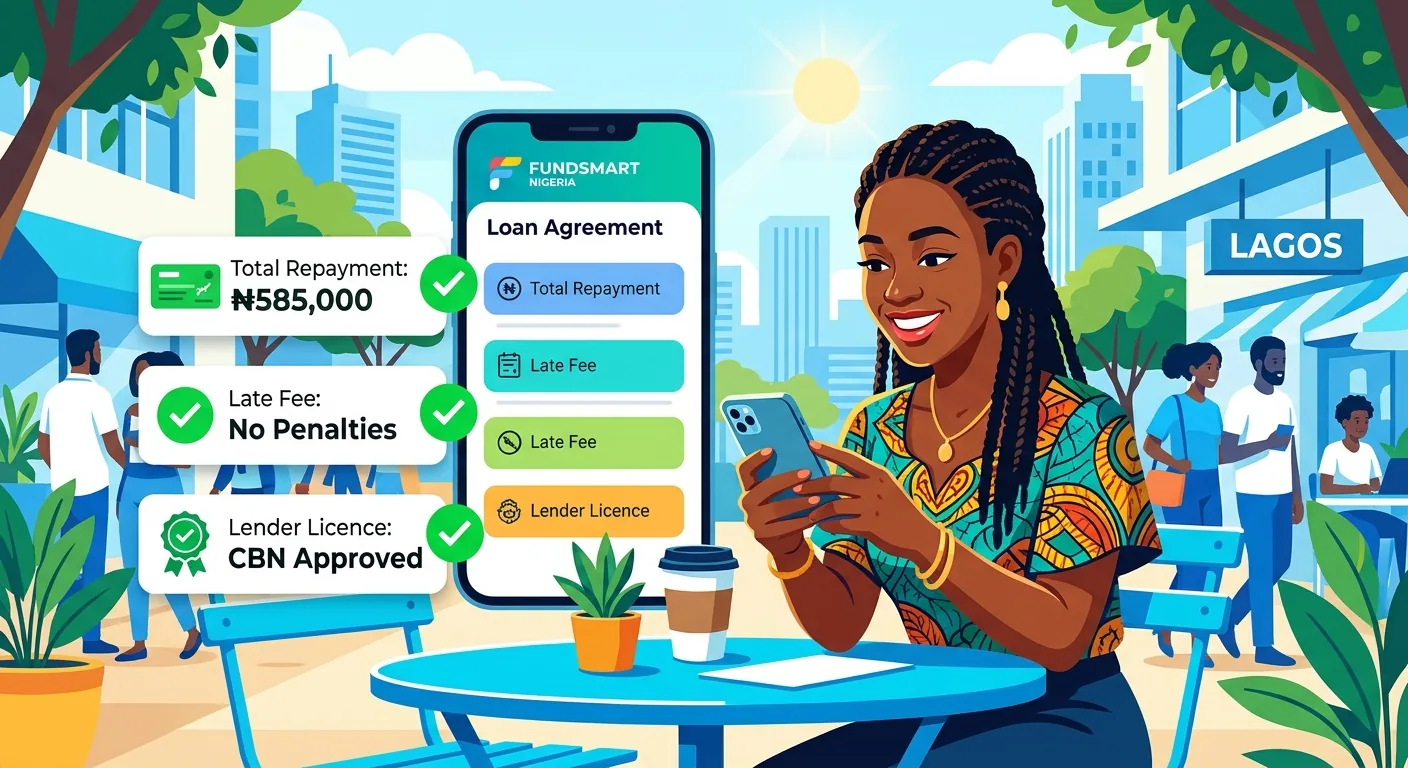
7. Confirm the Lender’s Registration Details in the Agreement
This is the fastest scam check any Nigerian borrower can run — under 30 seconds.
Every legitimate digital lender in Nigeria must hold registration with either:
- CBN (Central Bank of Nigeria) — for microfinance banks and licensed finance houses
- FCCPC — under the Digital Lending Guidelines 2022, for consumer loan platforms
A compliant loan agreement will display:
- RC number from the Corporate Affairs Commission
- CBN or FCCPC licence reference number
- Physical office address (not solely a website or social media handle)
- Customer complaint channel — a working email, phone line, or formal portal
If two or more of these are missing — particularly the CBN or FCCPC reference — treat it as a serious warning. Unlicensed lenders carry no legal accountability, and you have no regulator to approach if the loan fees Nigeria lenders charged turn out to be unlawful.
Verify any lender directly:
– CBN: cbn.gov.ng → Financial Policy & Regulation → Licensed Institutions
– FCCPC: fccpc.gov.ng → Regulated Entities
Quick-Scan Checklist: Before You Tap “Accept”
Use this every time. Under two minutes.
- [ ] Total repayment amount found — subtracted from loan amount to get real cost
- [ ] All fees listed separately — processing, management, VAT, insurance
- [ ] Repayment date confirmed — matches my actual income date
- [ ] Late fee per day or week — noted in ₦ terms
- [ ] Rollover clause reviewed — worst-case scenario calculated
- [ ] Prepayment option confirmed — know what early repayment costs or saves
- [ ] Contact permissions checked — no contact list access requested
- [ ] Lender registration visible — RC number and CBN/FCCPC licence present
LendSafe Nigeria is a CBN-compliant personal loan platform built for Nigerians who need fast, transparent credit — with no hidden fees and no contact list access. Read the full LendSafe loan agreement before you borrow, and use our loan cost calculator to see your exact repayment total before you tap Accept.