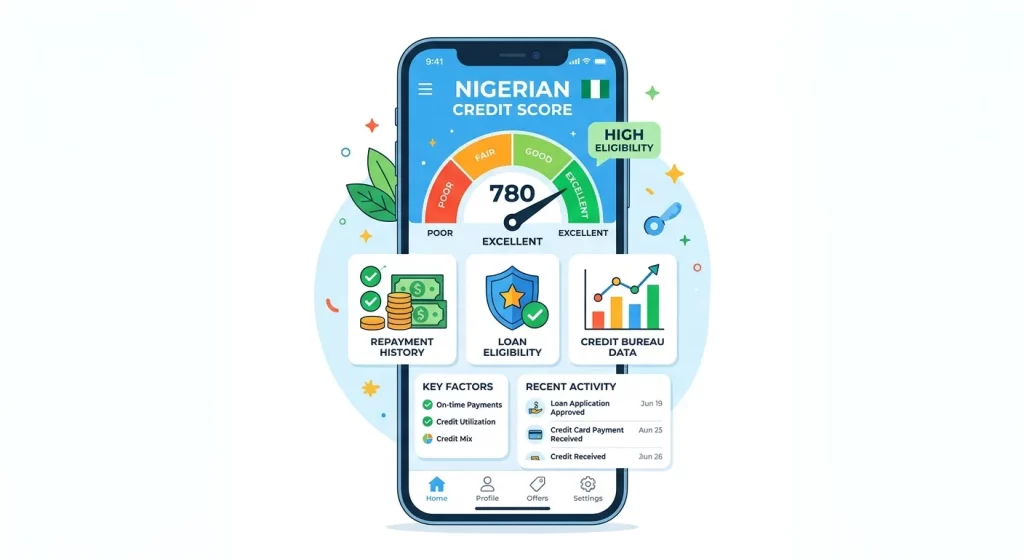
You applied for a loan. You waited. Then came the message: “Application unsuccessful.” No reason. No explanation. Just a door closed in your face while your rent, school fees, or hospital bill is still sitting there, unpaid.
Millions of Nigerians go through this every year. And in most cases, the reason behind the rejection has a name — your credit score Nigeria lenders are quietly checking every single time you apply.
The frustrating part? Most people have never seen their own credit score. Many do not even know it exists. Yet every time you apply for a loan — whether from a bank, a fintech app, or a cooperative — a lender is checking a number attached to your name, your BVN, and your borrowing history.
This guide breaks down what a credit score Nigeria borrowers carry actually means, what damages it without your knowledge, what a “good” score looks like, and what you can realistically do to fix yours starting today.
What Is a Credit Score in Nigeria — Plain English
A credit score is a number. That number tells a lender, in seconds, how likely you are to repay a loan based on your past financial behaviour.
Think of it like a report card — but instead of Mathematics and English, it tracks how you have handled borrowed money. Did you repay on time? Did you default? Do you have multiple unpaid loans right now? All of that gets recorded, summarised into a score, and handed to any lender who requests it.
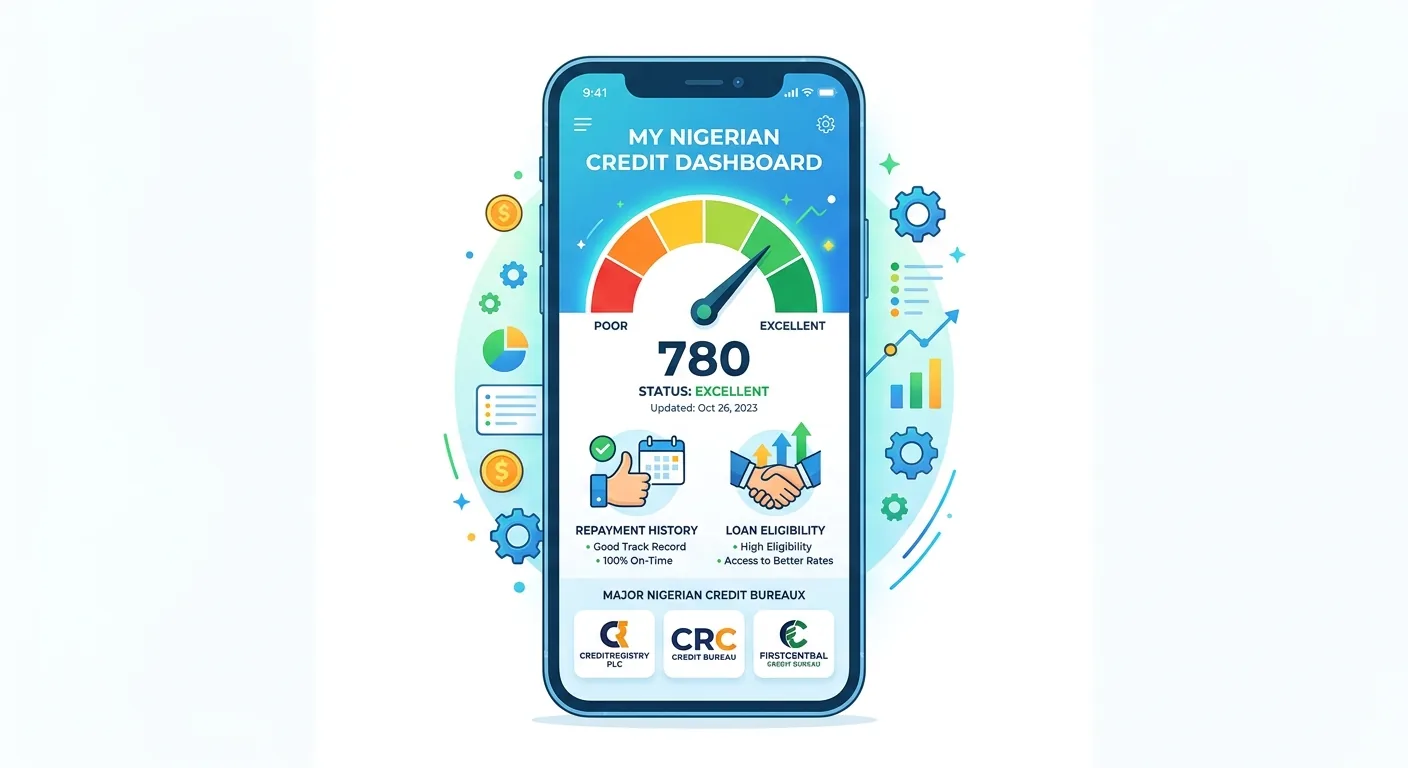
In Nigeria, your credit score is not calculated by your bank directly. It is calculated by licensed credit bureaux — independent companies that collect borrowing data from banks, fintechs, telecoms, and other lenders, then compile it into a profile attached to your BVN.
The score exists to answer one question on behalf of every lender: “Is this person safe to lend to?”
Who Calculates Your Credit Score in Nigeria
Two major credit bureaux operate in Nigeria under direct CBN licensing:
CRC Credit Bureau
CRC is one of the oldest bureaux in Nigeria. It aggregates loan data from commercial banks, microfinance banks, and registered fintechs. If you have ever taken a bank loan or used a licensed loan app, there is likely a file on you at CRC. Visit them at www.creditregistry.ng.
FirstCentral Credit Bureau
FirstCentral is used extensively by fintech lenders and digital platforms. Many loan apps on the Google Play Store report to FirstCentral. This bureau also covers non-bank credit data, including some utility and telco payment records. Access your report at www.firstcentralcreditbureau.com.
Both bureaux are regulated under the CBN’s Credit Reporting Act 2017. By law, every licensed lender in Nigeria is expected to report borrower behaviour — good and bad — to at least one of these bureaux.
What this means practically: even if you have never walked into a bank, if you borrowed from any licensed loan app, your repayment behaviour has probably already been reported and is shaping your loan eligibility in Nigeria right now.
What a “Good” vs “Bad” Credit Score Looks Like in Nigeria
Both CRC and FirstCentral use their own scoring models, but the general interpretation across Nigerian lenders follows this band:
| Score Range | What It Signals |
|---|---|
| 700 – 850+ | Excellent — low risk, fast approvals |
| 600 – 699 | Good — most lenders will approve |
| 500 – 599 | Fair — approval possible, may face higher rates |
| 400 – 499 | Poor — high risk, most lenders decline |
| Below 400 | Very poor — near-automatic rejection |
Important caveat: Every lender sets their own internal cut-off. A fintech app might approve a 520 score that a commercial bank rejects at 620. This is why some loan platforms position themselves as accessible to borrowers with imperfect credit history.
Over 60% of adult Nigerians who have interacted with formal credit have at least one negative entry on their bureau file — meaning a poor or damaged credit score Nigeria is far more common than most people realise.
What Goes Into Your Credit Score — The 5 Real Factors
Credit bureaux in Nigeria do not publish their exact algorithm, but based on global bureau practice and confirmed lender feedback, your score is shaped by five core inputs:
1. Repayment history (most important)
This is the single biggest factor. Every on-time repayment improves your score. Every missed or late payment pulls it down. Even one default on a ₦5,000 loan three years ago can still appear on your bureau file today.
2. Outstanding debt
How much you currently owe across all lenders. If you have three active loans running simultaneously, your debt burden looks objectively overloaded and your score drops accordingly.
3. Length of credit history
Someone who has successfully borrowed and repaid loans for five years has a thicker, more trusted file than someone who just started. Lenders prefer a longer track record because it reduces uncertainty.
4. Number of recent credit applications
Every time a lender does a “hard check” on your bureau profile, it leaves a footprint. Multiple hard checks in a short period signal financial distress and reduce your score slightly with each one.
5. Types of credit used
A mix of credit types — small personal loans, salary advances, structured bank credit — builds a richer credit report Nigeria lenders trust more than a single-source borrowing history.
6 Things That Silently Wreck Your Credit Score in Nigeria
Most Nigerians with a poor credit score do not know what broke it. These six situations are the most common silent killers:
1. Defaulting on a small loan app loan
You borrowed ₦3,000 from a loan app two years ago. Life happened. You never repaid. It felt small — it was not. That default is sitting on your bureau file and flagging you as high-risk every time a new lender checks your credit score Nigeria profile.
2. Applying to 7 apps in one weekend
When you are desperate for cash and try every available app, each formal credit check leaves a hard inquiry on your file. Five hard checks in 48 hours signals distress to bureaux and pulls your score down cumulatively.
3. Having multiple active loans simultaneously
Owing money to three or four lenders at once overloads your debt-to-income profile — even if each individual loan amount is small.
4. Guaranteeing someone else’s loan and they defaulted
If you signed as a guarantor on someone else’s loan and they failed to repay, that default can appear on your credit profile too — particularly with formal bank and microfinance lenders.
5. Closing your oldest credit account
Counterintuitive but real: when your oldest loan account is fully repaid and that lender’s record is removed, your credit history becomes shorter — which can slightly reduce your bureau score.
6. BVN or phone number mismatches across platforms
When your name, BVN, or registered phone number is inconsistently recorded across lenders, bureau matching breaks down. Good repayment records may not attach to your profile; someone else’s negative record may attach incorrectly. Always use the same BVN and phone number — without exception.
How Loan Apps Use Your Credit Score — What They Actually See
When you hit “Apply” on a loan app in Nigeria, here is what happens in the background within seconds:
The app queries a credit bureau using your BVN, retrieves your bureau score and credit history summary — active loans, defaults, repayment behaviour — then runs that data against its own internal algorithm, which also weighs your phone data, connected bank statement, and device history. A decision is returned, often in under 60 seconds.
The critical insight: your credit score Nigeria lenders retrieve is not the only input, but it is usually the first gate. If your score falls below the app’s minimum threshold, the other data points never get considered. You are declined before the algorithm reads anything else about you.
This is why improving your credit score is not just a nice-to-have. For anyone who needs access to emergency loans in Nigeria — now or in the future — it is a practical financial survival tool.
How to Check Your Own Credit Score in Nigeria
You have a legal right under CBN guidelines to access your own credit information. Here is how:
CRC Credit Bureau: Visit www.creditregistry.ng. First-time annual report is available at a regulated fee (typically ₦1,000–₦3,000 depending on report type).
FirstCentral Credit Bureau: Visit www.firstcentralcreditbureau.com. Same process — online portal, BVN required.
Once you have your credit report Nigeria file, do three things immediately:
- Check for errors — loans you did not take, defaults that belong to someone else
- Identify your oldest unpaid debt — this is your highest-priority repayment target
- Look for any lender you do not recognise — this may indicate BVN fraud or mismatched records
If you spot an error, you can formally dispute it through the bureau. The process takes 30–60 days but can remove incorrect negative entries that are unfairly dragging your score down.
How Long Does It Actually Take to Improve Your Score — Realistic Timeline
Month 1–2: Repay any small outstanding defaults. Even partial repayment and renegotiation updates your file status. Stop applying to multiple apps at once. Use one trusted platform.
Month 3–4: Your file begins showing recent on-time repayments. The most recent data weighs more heavily than older entries. Positive repayment behaviour starts visibly shifting your credit score Nigeria trajectory.
Month 6: Most borrowers who consistently repay one or two small loans see a meaningful score improvement in this window — enough to move from “poor” to “fair” territory and unlock more lenders.
Month 12: With a clean six-to-twelve month repayment record, most Nigerian fintech lenders will treat you as a low-to-medium risk borrower again. Bank products become accessible.
The rule that never changes: Every repayment you make on time is a positive data point. Every default — no matter how small — is a negative one. The score is a mathematical reflection of your behaviour, which means your behaviour is the only lever that actually works.
Where LendSafe Fits Into Your Credit Journey
LendSafe reports repayment behaviour to credit bureaux — and this is a feature, not a threat.
Every loan you repay successfully through LendSafe is a positive entry on your bureau file. Over time, those entries build a creditworthiness track record that opens doors with every other licensed lender in Nigeria — not just LendSafe.
LendSafe is built for low-to-middle income Nigerians who may not have a perfect credit history. The platform considers more than just your bureau score, including income signals and recent financial behaviour. But the fastest way to unlock higher loan limits and better terms is to build a consistent repayment record starting from your very first loan.
Your first successful repayment is not just clearing a debt. It is writing the first positive line of a financial track record that follows you for years.
Start your first LendSafe loan today and let every repayment work for your future.
Quick FAQ
Q: Can I get a loan with zero credit history in Nigeria?
Yes. Some fintechs — including LendSafe — offer first-time borrowers a small starter loan based on alternative data like income signals and phone behaviour. It is your entry point into building a positive credit score Nigeria lenders will recognise over time.
Q: Does checking my own score hurt it?
No. Checking your own credit report is a “soft inquiry” and has zero impact on your credit score. Only formal loan applications trigger hard inquiries.
Q: Can a loan app blacklist me across all other apps?
Not through a centralised blacklist. But if you default on a licensed lender that reports to CRC or FirstCentral, that default is visible to every lender who checks those bureaux. Most lenders will decline you until the default is resolved or aged out.
Q: How long does a default stay on my record in Nigeria?
Under current CBN guidelines and bureau practice, negative entries typically remain on your credit file for up to 5 years from the date of the event. However, lenders weigh recent data far more heavily — a default from four years ago matters significantly less than one from last month.
Q: What if I repay but my score does not improve?
Request your bureau report and verify that your lender actually reported the repayment. Some smaller or unregistered lenders do not report to bureaux at all — meaning your good behaviour goes completely unrecorded. This is a core reason to borrow from CBN-licensed platforms like LendSafe that actively report all repayments to bureaux.
Final Word
Your credit score Nigeria lenders check is not a verdict on your character. It is a data report on your borrowing behaviour — and data can be changed.
If your score is low right now, it is likely because of a few specific entries: a default during a difficult period, too many simultaneous applications, or simply no credit history at all. Every one of those situations is fixable — not overnight, but within a realistic timeline if you start the right steps today.
Understand what is on your file. Dispute what is wrong. Repay what you owe — even partially and gradually. Use one trusted lender consistently. Let time do the rest.
Your next loan approval, your next salary advance, your next emergency access to cash — all of it gets easier when your bureau file tells the right story about you.
Start writing that story today.
Ready to take your first step? Download LendSafe Nigeria and apply in minutes. For borrowers with imperfect credit history, LendSafe considers more than just your bureau score — because a single number does not tell your whole story.