Debt management in Nigeria is not a topic most people discuss openly — but it should be. Because right now, millions of Nigerians are trapped in a cycle that looks like ordinary borrowing but functions like quicksand: every move you make to get out pulls you deeper in.
This guide is not about shame. It is about mathematics, strategy, and the specific steps you can take — starting this week — to stop the spiral before it costs you your salary, your relationships, and your peace of mind.
1. The Trap Most Nigerians Don’t See Until It’s Too Late
It starts small. ₦15,000 from a loan app to cover transport and food three days before salary. You repay it. Life goes on.
Then the next month, your NEPA bill and your data subscription fall due the same week your rent reminder arrives. You borrow ₦30,000 this time. You repay — but your salary is already ₦30,000 shorter before the month even begins. So by the 20th, you’re broke again. You borrow ₦40,000.
By month six, you are not borrowing for emergencies. You are borrowing to exist. And every loan you take to solve today’s problem is creating next month’s crisis.
This is the Nigerian debt spiral. It is not a character flaw. It is a mathematical trap — and understanding it is your first real act of debt management in Nigeria.
2. What Is a Debt Spiral? (Plain Language, Nigerian Context)
A debt spiral is when borrowing stops being a one-time solution and becomes a permanent fixture in your monthly cash flow.
Here is the simple version:
You borrow → you repay → repayment empties your account → you borrow again.
The brutal part? Every time you re-borrow, you often borrow more because the previous repayment left you with less. Interest compounds. Fees stack. Your outstanding balance grows faster than your income.
In Nigeria, this spiral is accelerated by three structural factors:
- High loan interest rates — According to the Central Bank of Nigeria’s consumer credit framework, many digital lenders charge effective annual rates between 60% and 300%, far above what most borrowers calculate when they see a “5% monthly” fee
- Short repayment windows — 7 to 30-day windows force you back to the app before you have financially recovered from the last loan
- Zero emergency savings buffer — A 2023 EFInA Access to Finance survey found that fewer than 30% of Nigerian adults have any formal savings account they actively use. When every unexpected cost is a borrowing event, the spiral never pauses
Understanding this structural reality is the foundation of sound debt management in Nigeria. The spiral is not personal. But it is not permanent either.
3. The 5 Personal Situations That Start the Loan Cycle in Nigeria
Most people enter the loan cycle not because they are reckless but because real life hit them without warning:
① Salary delay — An IPPIS processing error, an employer’s cash flow crisis, or a delayed contractor payment. You borrowed to survive. The loan repaid itself from your salary — but nothing remained for the next cycle.
② Medical emergency — A parent collapsed and the hospital demanded ₦50,000 before admission. You borrowed from two apps simultaneously. Three months later, you are still managing double repayments.
③ School fees deadline — Your child’s school issued a final notice. You borrowed at 20% monthly interest because the deadline was non-negotiable. You repaid, but your savings account hit zero.
④ Broken income-generating equipment — Your phone died, your generator packed up, or your okada engine failed. Without it, you earn nothing. The replacement loan was necessary — but it still became a debt chain.
⑤ Structural monthly shortfall — No emergency occurred. Your expenses simply and consistently exceed your income. Groceries, transport, data, electricity — this is the daily reality for many Nigerians earning between ₦60,000 and ₦150,000 per month in 2026.
Every one of these situations is valid. But if any of them has repeated itself more than twice, you are likely already inside the loan cycle — and proactive debt management in Nigeria is no longer optional.
4. Warning Signs You’re Already Inside the Debt Spiral
Check how many of these statements are currently true for you:
- [ ] You have an outstanding loan balance on two or more platforms simultaneously
- [ ] You borrow money before the 25th of almost every calendar month
- [ ] You have used a new loan to cover part of an existing loan repayment
- [ ] Your total monthly loan repayments exceed 30% of your take-home income
- [ ] You avoid checking your bank balance or opening loan app notifications
- [ ] You feel temporary relief when a loan is approved, followed immediately by anxiety
- [ ] You have received at least one threat of contact to your employer or phone contacts
If you ticked 3 or more, you are in the debt spiral. That is not a moral judgment — it is a financial diagnosis. And diagnoses are most useful when made early, before the cost of doing nothing compounds further.
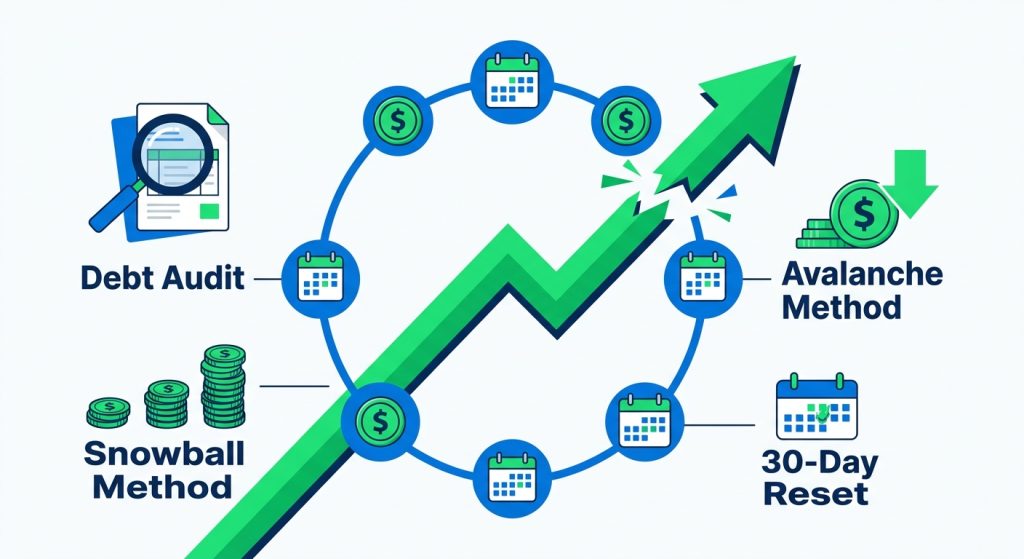
5. Step 1 — Face the Numbers: Your Personal Debt Audit
Effective debt management in Nigeria begins with one uncomfortable task: writing down everything you owe with complete transparency.
Set aside 20 minutes. List every debt:
| Lender | Amount Owed (₦) | Monthly Interest | Due Date |
|---|---|---|---|
| App A | 25,000 | 15% | July 10 |
| App B | 18,000 | 10% | July 15 |
| Family member | 10,000 | 0% | When possible |
| Cooperative | 40,000 | 2% | End of month |
| TOTAL | 93,000 | — | — |
Now calculate your debt-to-income ratio: divide your total monthly repayments by your monthly take-home pay.
Example: If your salary is ₦120,000 and your monthly repayments total ₦42,000, your debt-to-income ratio is 35%. The globally accepted danger threshold is 30–35%. Above that, you are statistically at high risk of default within three to six months.
For a full breakdown of how debt-to-income ratios function in the Nigerian lending context, see our guide: Understanding Your Debt-to-Income Ratio as a Nigerian Borrower.
This audit is not about guilt. It is the map you need before you can plan a real exit route. No effective approach to debt management in Nigeria works without it.
6. Step 2 — Choose Your Repayment Strategy: Snowball vs Avalanche
Once you know what you owe, you need a structured repayment approach. Two evidence-backed methods exist for debt management in Nigeria and globally.
🏔 The Avalanche Method (Mathematically Optimal)
Pay the minimum balance on all debts, but direct every extra naira toward the highest-interest debt first.
₦ Example using the table above:
– App A at 15%/month → Attack first with all surplus cash
– App B at 10%/month → Pay minimum only
– Cooperative at 2%/month → Pay minimum only
– Family member at 0% → Pay last
Why it works: You eliminate the most expensive debt first, reducing total interest paid over time. If App A charges 15% on ₦25,000, you are paying ₦3,750 every month in interest alone. Clearing it fast saves real money.
Best for: Borrowers with income discipline who can stay the course even when progress feels slow.
❄️ The Snowball Method (Psychologically Powerful)
Pay the minimum balance on all debts, but direct every extra naira toward the smallest outstanding balance first, regardless of interest rate.
₦ Example:
– Family member: ₦10,000 → Clear immediately (zero-interest, fastest win)
– App B: ₦18,000 → Attack next
– App A: ₦25,000 → Follow
– Cooperative: ₦40,000 → Last
Why it works: According to research published by the Harvard Business Review on debt repayment psychology, closing individual accounts completely produces a motivation effect that makes people more likely to stay consistent — even if total interest paid is slightly higher.
Best for: Anyone who has been living inside the debt spiral for more than three months and needs psychological momentum to keep going.
Nigerian Reality Check: Both methods assume you have at least some surplus income to redirect toward debt. If you are currently borrowing just to cover basic living costs, Step 3 must come first.
7. Step 3 — Negotiate, Restructure, or Pause Before You Default
This is the most underused tool in personal debt management in Nigeria: proactive communication with your lender before you miss a payment.
Responsible lenders — particularly FCCPC-registered and CBN-licensed institutions — have options that most borrowers never think to ask about:
- Due date extension — Request a 7–14 day shift on your repayment date. This alone can prevent a default penalty of ₦2,000–₦5,000.
- Reduced monthly installment — Ask to restructure the loan over a longer term to lower each payment. You pay slightly more total interest but avoid the spiral of defaulting.
- Hardship grace period — Some regulated lenders offer a brief interest pause for documented financial hardship. It is rare, but it exists and is worth asking for.
What you should not do:
– Go silent and avoid calls
– Change your registered phone number
– Borrow from a third app to repay the first two
The FCCPC (Federal Competition and Consumer Protection Commission) has regulations governing how digital lenders can treat borrowers in Nigeria. If a lender contacts your employer without consent or publicly shames you, that may constitute a regulatory violation. Document all interactions in writing.
8. Step 4 — Plug the Holes: Why You Keep Borrowing Every Month
Sustainable debt management in Nigeria is not just about repaying what you already owe. It is about stopping new debt from forming each month.
Ask yourself honestly: Why do I run out of money before the month ends?
The answer usually falls into one of three categories:
① Your income is structurally insufficient for your cost of living in 2026
This is real and not your fault. If your net salary is ₦85,000 and your non-negotiable fixed costs — rent, food, transport, data, electricity — total ₦90,000, no budgeting technique resolves that gap. You need either a higher income source or a meaningful reduction in fixed costs. Side income, skills upskilling, or relocating to cheaper housing are real options — not easy ones, but genuine ones.
② Irregular but predictable expenses ambush you every quarter
School fees in January and September. Generator repairs in harmattan. Rent renewal. Christmas spending. None of these are genuine surprises — they happen on a predictable schedule. Yet most people have no sinking fund for them. Even setting aside ₦3,000 per month toward a “known future expense” account prevents three or four annual borrowing events.
③ Small spending leaks are draining ₦15,000–₦25,000 per month invisibly
Airtime top-ups every two days instead of a weekly data bundle. Eating out four times a week when home-cooked meals cost half as much. Impulse transfers and gifting that you do not track. These individual amounts look small but they accumulate to the exact sum you borrow every month.
The fix: track every single expense for 30 consecutive days in a notes app, a spreadsheet, or paper. No filtering. Everything. Most Nigerians who complete this exercise find ₦10,000–₦20,000 in spending they did not consciously register — which is the foundation of practical debt management in Nigeria at the household level.
9. Choosing the Right Loan Product While You Rebuild
If you genuinely need a bridge loan during your debt recovery period — salary has not arrived, a non-negotiable bill appeared, a family emergency struck — the type of lender you choose matters enormously for your overall debt management in Nigeria strategy.
A predatory loan app offering seven-day repayment at 25% monthly interest will deepen your spiral, not solve it. What you need is a lender that:
- Shows you the total cost in naira before you accept — not just a percentage rate
- Gives you a realistic repayment window aligned with your actual salary cycle
- Does not harvest your contact list or threaten to expose you to your employer
- Is verifiably registered with the CBN and FCCPC so you have legal recourse if things go wrong
SmartLoans.ng provides personal loan comparisons and access to transparent, regulated lending products in Nigeria. Before you take any short-term loan during your recovery period, check your options carefully — one borrowing decision can either support your exit from the spiral or extend it by six months.
10. Your 30-Day Debt Reset Plan
| Week | Priority Action | Target Outcome |
|---|---|---|
| Week 1 | Complete full debt audit. List every lender, balance, interest rate, and due date. Calculate your debt-to-income ratio. | Know your exact total. No more financial avoidance. |
| Week 2 | Contact your highest-interest lender. Ask about extension, restructuring, or hardship options. Choose snowball or avalanche strategy. | Reduce default risk. Have a written repayment plan. |
| Week 3 | Track every single expense for 7 consecutive days. Identify at least 2–3 spending leaks. Redirect recovered cash to highest-priority debt. | Find ₦5,000–₦15,000 in recoverable monthly spend. |
| Week 4 | Make one full additional repayment on your target debt. Open a separate savings pocket and deposit ₦1,000–₦2,000 as your first emergency buffer. | First tangible debt reduction. First savings milestone. |
| After 30 days | Reassess: Are you borrowing less frequently? Is your debt-to-income ratio lower? Adjust strategy as needed. | Confirm the system is working. Recalibrate if not. |
The Final Truth About Debt Management in Nigeria
The loan cycle does not break by willpower alone. It breaks through structure: knowing your numbers, choosing a repayment strategy, negotiating proactively with lenders, and cutting the inflow of new debt at its source.
Effective debt management in Nigeria in 2026 looks like small, consistent actions repeated over several months — not a dramatic single decision. It involves setbacks, recalibration, and genuine honesty about what your income can and cannot support.
But the spiral is not permanent. It is a pattern. And every pattern can be interrupted.
Start with Step 1 this week. Write down every debt you owe. Look at the total. That single act of clarity is already more meaningful debt management in Nigeria than most people ever attempt — and it is the foundation everything else is built on.
Looking for a transparent, FCCPC-compliant short-term loan while you work through your debt recovery plan? Visit SmartLoans.ng to compare regulated loan options with clear naira costs, no hidden fees, and no contact harassment — before you borrow.