You have more than one loan open. Your salary just entered. And every app is sending you notifications.
You know you can’t pay all of them fully. So you start guessing — pay this one first, ignore that one, send something small to the third. By week two, you’re out of money and two apps are already charging you late fees.
This is how debt compounds in Nigeria. Not because you’re irresponsible. But because nobody taught you the order.
This guide covers the two most effective loan repayment strategy Nigeria borrowers actually use — the Debt Snowball and the Debt Avalanche — and tells you exactly which one fits your situation right now. We’ll use real ₦ numbers, real Nigerian loan scenarios, and zero financial jargon.
Why Repayment Order Actually Matters (More Than You Think)
Most people treat loan repayment like a queue — whoever sends the most aggressive SMS wins your salary. That’s not a strategy. That’s panic.
Here’s what your loan repayment order determines:
- How much total interest you pay across all your loans
- How quickly you become debt-free — weeks, months, sometimes years of difference
- Whether your credit bureau profile improves or keeps accumulating damage
- Your psychological ability to keep going without abandoning the plan midway
According to the Central Bank of Nigeria (CBN), non-performing loans in the consumer lending segment remain a significant concern — partly driven by borrowers who take multiple loans without a structured repayment plan. The difference between a random approach and a structured loan repayment plan Nigeria can amount to tens of thousands of naira over six months, especially at the interest rates Nigerian loan apps charge. When you’re earning ₦60,000–₦120,000 a month, that gap is real money you cannot afford to lose.
First: Get a Clear Picture of What You Owe
Before you pick from any loan repayment strategy Nigeria has available, write this down — even in a notebook or your phone’s notepad. For each open loan, record:
- Lender name (LendSafe, PalmCredit, Branch, Carbon, Kiakia, etc.)
- Outstanding balance — what you still owe today
- Monthly interest rate or daily rate
- Due date
- Minimum payment required to avoid a penalty
Most Nigerians skip this step because seeing the total feels terrifying. Do it anyway. You cannot fight what you refuse to face.
The scenario we’ll use throughout this guide:
| Loan | Balance Owed | Monthly Rate | Due |
|---|---|---|---|
| App A (PalmCredit) | ₦15,000 | 15% | 5 days |
| App B (FairMoney) | ₦45,000 | 10% | 14 days |
| App C (Branch) | ₦8,000 | 12% | 20 days |
- Monthly take-home salary: ₦85,000
- Money available for loan repayment: ₦30,000 (after rent, food, transport)
This is a realistic snapshot for a mid-level salary earner in Lagos or Abuja. Let’s run both strategies against it.
Strategy 1: The Debt Snowball — Pay the Smallest Loan First
How It Works
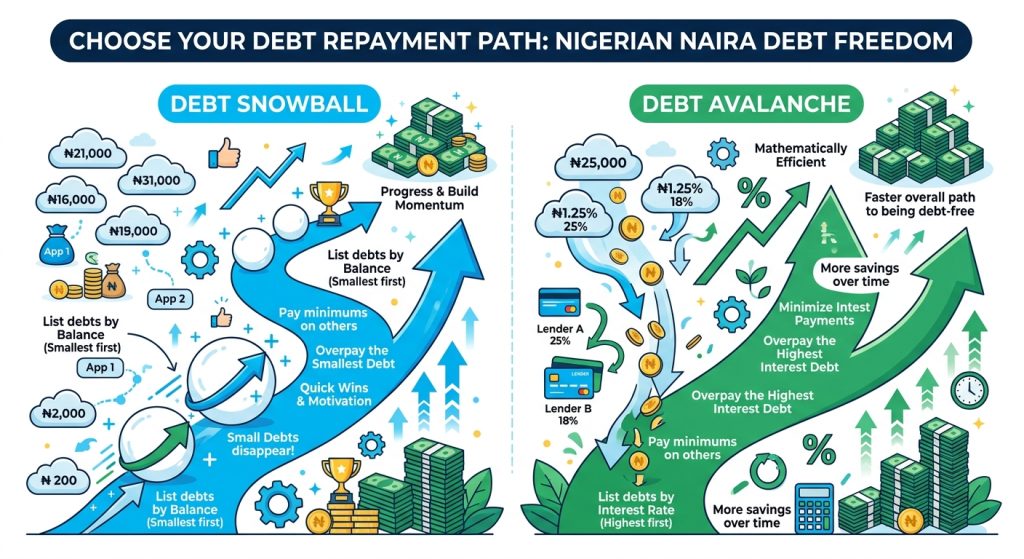
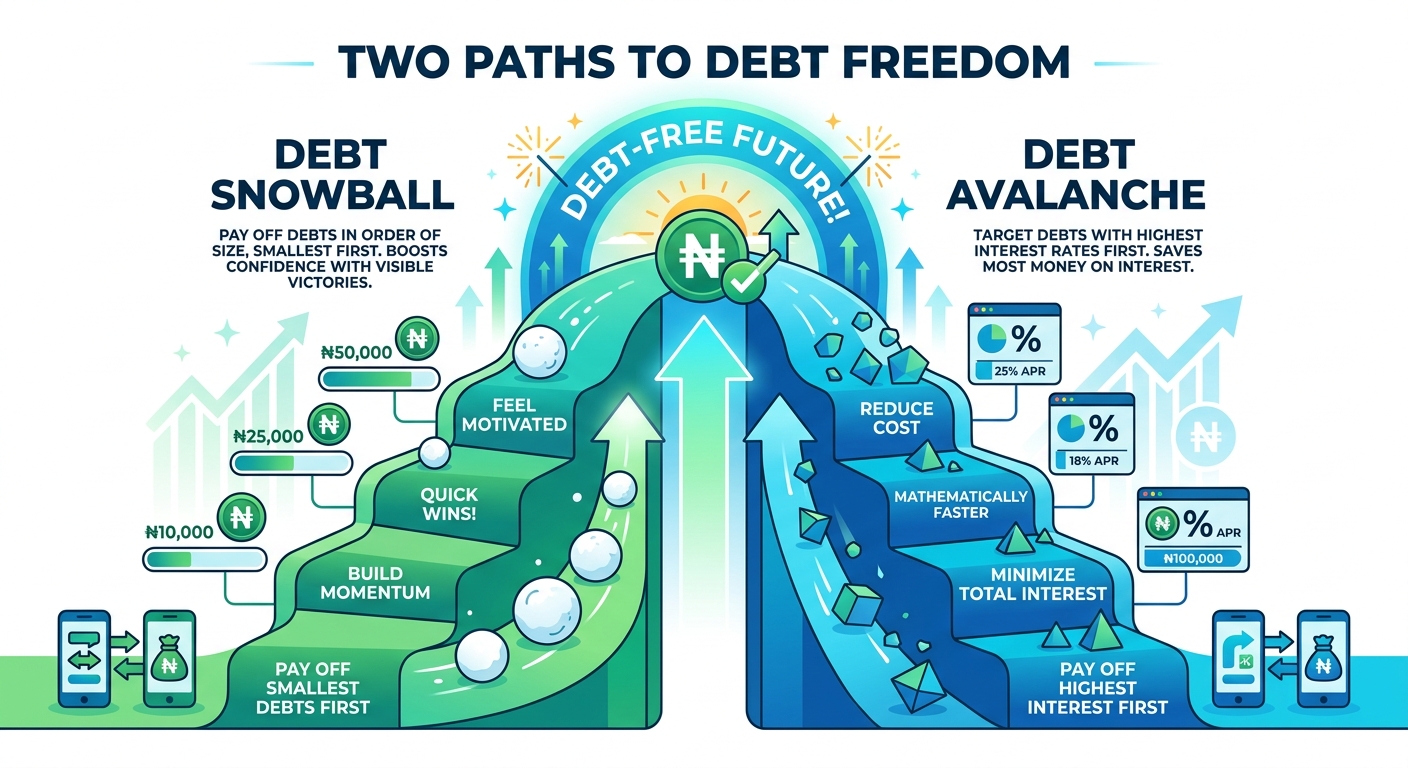
You pay the minimum required amount on every loan to stay protected from penalties. Then you throw every extra naira at the loan with the smallest outstanding balance — not the highest interest rate, not the oldest debt — the smallest balance.
Once that loan is cleared, you roll what you were paying on it into the next smallest loan. The snowball gets bigger as you knock out each debt.
Applied to Our ₦ Example
With ₦30,000 available and ranked by balance:
– Smallest: App C — ₦8,000 → target first
– Middle: App A — ₦15,000 → next
– Largest: App B — ₦45,000 → last
Month 1:
– Pay minimum on App B → ₦5,000
– Wipe out App C completely → ₦8,000
– Remaining ₦17,000 → attack App A (₦15,000) → cleared, with ₦2,000 left over pushed into App B
– Result: Two loans closed in one month
Month 2–3:
– All ₦30,000 attacks App B (₦45,000 balance)
– Cleared in approximately 2 more months
Total: All three loans cleared in roughly 3 months. Two apps deleted. Enormous psychological relief.
Why the Snowball Works for Nigerian Borrowers
The snowball is psychologically powerful — and psychology matters enormously in Nigerian loan culture, where debt carries real social shame and anxiety. When you close App C and App A in month one, you feel progress. That emotional momentum keeps you disciplined for the harder stretch ahead.
Research consistently shows that people who experience early wins in debt repayment are more likely to complete their full repayment journey. The snowball method is specifically designed to manufacture those wins.
Best for you if:
– You have several small loans across multiple apps
– You’ve tried repaying debt before and quit because it felt endless
– Your loan interest rates are similar across all debts (within 3–5%)
– You need a motivational milestone to stay committed
Strategy 2: The Debt Avalanche — Attack the Highest Interest Loan First
How It Works
You pay the minimum required amount on all loans to avoid penalties. Then every extra naira goes toward the loan charging you the highest interest rate — regardless of whether it’s your biggest or smallest balance.
Once the most expensive loan is cleared, you move to the next highest-rate debt. This is mathematically optimal: you cut off the money drain at its source first.
Applied to Our ₦ Example
Ranked by interest rate:
1. App A (PalmCredit) — 15% monthly → attack first
2. App C (Branch) — 12% monthly → second
3. App B (FairMoney) — 10% monthly → third
Month 1:
– Minimum on App B → ₦5,000
– Minimum on App C → ₦2,000
– Remaining ₦23,000 → hammer App A (₦15,000) → cleared with ₦8,000 surplus → push into App C → App C reduced to near ₦0
Month 2:
– App C eliminated entirely
– Full ₦30,000 attacks App B
– Cleared in approximately 2 more months
Total time: approximately the same as Snowball — but you paid significantly less interest.
Here’s the crucial difference: At 15% monthly on ₦15,000, every extra month you don’t target App A costs you ₦2,250 in interest. If App A had run two extra months under the Snowball approach, you’d have paid ₦4,500+ in unnecessary interest on that one loan alone. That’s a month’s worth of data subscriptions or your child’s school transport fees.
Why It Matters With Nigerian Loan App Rates
Nigerian loan apps charge some of the most aggressive short-term interest rates in the world — typically 10% to 30% per month. The Federal Competition and Consumer Protection Commission (FCCPC) has issued repeated guidelines on digital lending transparency specifically because these rates can trap borrowers in cycles of debt.
At those rate levels, the avalanche method doesn’t just save money in theory — it saves you thousands of naira per month on mid-range balances.
Best for you if:
– Your loan interest rates vary significantly — more than 5% difference between debts
– You have a stable income and can stay disciplined without quick emotional wins
– You’re focused purely on minimizing total interest paid
– You’re calm enough to plan 3–6 months ahead without needing milestones
Snowball vs. Avalanche: Which Loan Repayment Strategy Fits Your Situation?
| Your Situation | Best Strategy |
|---|---|
| Multiple small loans across different apps | Snowball |
| One high-rate loan + smaller, cheaper ones | Avalanche |
| You’ve quit repayment plans before | Snowball |
| You’re disciplined and hate paying extra fees | Avalanche |
| Rates are similar across all loans | Snowball (motivation tiebreaker) |
| One loan rate is 20%+ while others are under 12% | Avalanche (urgency) |
| You’re under emotional debt stress right now | Snowball |
| You’re calm and planning 3–6 months ahead | Avalanche |
The honest truth: For most low-to-middle income Nigerians juggling 2–4 loan apps simultaneously, the Snowball method wins in practice — because the method you actually stick with beats the mathematically perfect method you abandon after three weeks. The best loan repayment strategy Nigeria borrowers rely on are the ones they can execute consistently, salary after salary.

The Third Option: Debt Consolidation
If you have four or more loans open and you’re genuinely confused about who to pay, consolidating into one single loan can simplify the chaos — one repayment, one due date, one lender.
This only makes sense if:
– The consolidation loan has a lower effective interest rate than your average current rate
– You get a longer repayment window that makes monthly payments manageable
– You are disciplined enough to not reborrow from other apps once old ones are cleared
Critical warning: Many Nigerians consolidate, feel the relief of clearing old apps, then open new loans within weeks. That doubles the debt hole. Consolidation is a tool, not a cure.
5 Rules to Follow No Matter Which Strategy You Pick
1. Always Pay the Minimum on Every Loan First
Before you execute any of the loan repayment strategy Nigeria experts recommend, protect yourself from late fees and credit bureau damage on all open loans. Pay minimums everywhere, then direct surplus funds to your target debt.
2. Monitor Auto-Debit Around Salary Date
Some Nigerian loan apps auto-debit more than the minimum — especially if your salary hits the same account your loan is linked to. Know exactly what each app will pull before your salary disappears into fees.
3. Do Not Open New Loans While Repaying Existing Ones
Unless it is a genuine emergency, do not borrow while actively trying to clear debt. Opening a new loan app while closing three others is how people stay trapped for years.
4. Track Your Progress Every Salary Day
Spend 10 minutes monthly reviewing your loan list. Watching App C drop from ₦8,000 to ₦3,000 to ₦0 is real motivation. What gets tracked gets managed.
5. When One Loan Closes, Roll the Payment Forward
This is the single most critical rule in any loan repayment plan Nigeria salary earners should follow. When you close App C, the ₦8,000 you were allocating monthly must go straight to the next loan — not a new purchase, not entertainment, not “treating yourself.” Every naira redirected to debt shortens your repayment timeline.
What Happens to Your Credit Score as You Repay
Nigeria has three active credit bureaus: CRC Credit Bureau, FirstCentral Credit Bureau, and TransUnion Nigeria. Every time you clear a loan on schedule, your credit file improves. Every missed payment or default gets recorded and held against your profile for years.
The Credit Reporting Act of 2017 mandates that all licensed lenders report borrower behavior to these bureaus. Your repayment decisions today directly determine what loan amounts, interest rates, and lender tiers you qualify for in the future.
The borrowers who qualify for ₦500,000 at single-digit monthly rates are the same people who closed ₦10,000 loans on time three years ago. Your repayment behavior today is your loan price tomorrow.
How to Handle It When Salary Drops and You Can’t Meet Minimums
This situation is real for millions of Nigerian workers — delayed salaries, IPPIS deductions, commission shortfalls. Here’s what to do:
- Contact the lender before the due date. Apps like Branch and FairMoney have in-app extension or grace period requests. Asking before default is far better than going silent.
- Prioritize the highest-rate loan even for a partial payment. Partial is better than zero.
- Do not borrow from a new app to pay an existing one. This is how short-term debt becomes permanent debt.
- Document the shortfall. If it’s employer-related (delayed NYSC stipend, government salary delay), some lenders will accept employer documentation as context.
Frequently Asked Questions
Q: Which loan repayment strategy saves the most money in Nigeria?
The Debt Avalanche saves the most money mathematically because it eliminates the highest-interest debt first. At Nigerian loan app rates of 10–30% per month, even one or two extra months of exposure to a high-rate loan can cost thousands in unnecessary interest.
Q: Can I switch from Snowball to Avalanche midway?
Yes. If you’ve cleared two small loans using the Snowball and now face one remaining high-interest debt, switch to Avalanche — throw everything at the most expensive remaining loan. These are tools, not contracts.
Q: What if my loan is already overdue?
Contact the lender immediately. Many Nigerian lenders will restructure an overdue loan before escalating to credit bureau reporting or recovery agents. Silence makes overdue situations significantly worse. The FCCPC digital lending guidelines also provide protections against harassment from unlicensed recovery agents.
Q: How do I know what my actual interest rate is?
Check your loan agreement or app dashboard under “loan details.” Look for a monthly rate, daily rate, or total repayment amount. Divide the total interest charged by your principal, then by the number of months — that gives you your effective monthly rate.
Q: Are there loan repayment strategy Nigeria salaried workers specifically should follow?
Yes. Salaried workers should time repayments to land within 48 hours of salary credit — before discretionary spending erodes available cash. Automating transfers to a separate “loan repayment” wallet immediately after salary entry is one of the most effective behavioral strategies for maintaining discipline.
Start Today, Not on the First of Next Month
The most common response to financial stress is delay: “Let me wait until next salary to start a proper plan.”
That delay costs you money every single day. If App A is charging 15% monthly and your salary just arrived, every day you postpone targeting that loan is naira leaving your account for nothing.
The best loan repayment strategy Nigeria borrowers follow don’t require financial expertise — they require a list, a decision, and the discipline to follow it one salary at a time. Whether you choose Snowball for the motivational wins or Avalanche for the mathematical edge, both strategies beat the alternative: paying whoever shouts loudest and wondering where your salary went.
Pick your strategy. Write your loan list. Pay minimums across the board. Then attack your target with everything you have left.
This article is for informational purposes only. Loan terms, interest rates, and lender policies vary. Always verify current rates directly with your loan provider before making repayment decisions. CBN regulations and FCCPC guidelines govern licensed digital lenders in Nigeria.