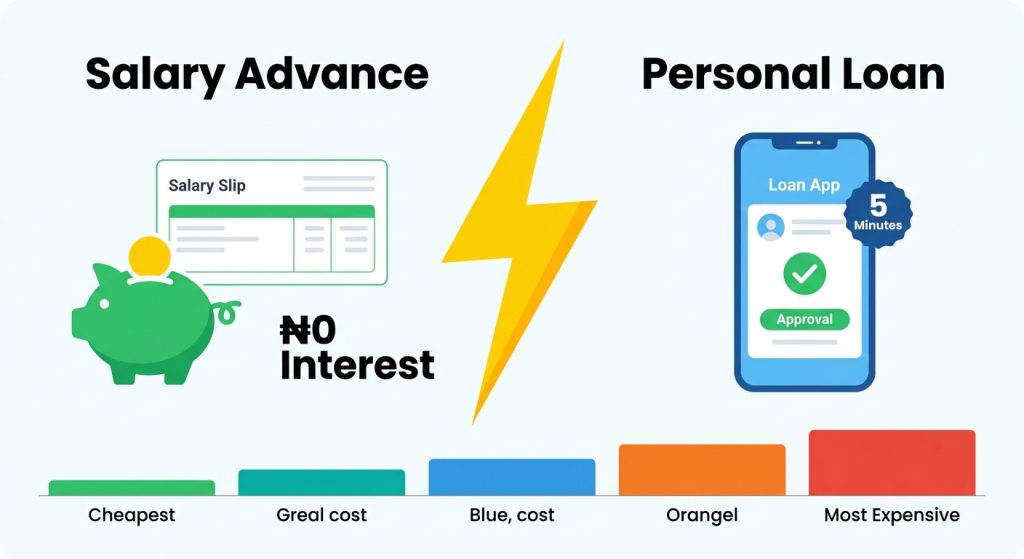
It is the 18th of the month. Your landlord sent a WhatsApp message three days ago. Your child’s school fees deadline is this Friday. The NEPA prepaid meter hit zero yesterday. Your salary drops on the 28th — ten full days away. You have exactly ₦4,300 in your account.
This is not a financial failure. This is a timing problem. And timing problems have specific solutions — if you choose the right one.
The salary advance vs personal loan Nigeria decision sits in front of you right now: walk to HR and request an advance, or open a loan app. Both put money in your account. But they are not the same product, they do not cost the same amount, and they carry completely different risks to your career, your credit score, and your next payday. This breakdown gives you the real naira numbers, eligibility rules, repayment mechanics, and a decision table so you stop guessing and start acting.
What Is a Salary Advance in Nigeria?
A salary advance — also called a payroll advance or employer loan — is money your employer releases to you ahead of your scheduled payday. You are collecting part of the salary you have already earned before the end-of-month disbursement date.
How it typically works:
- You submit a formal written request to HR or your line manager
- Your company reviews and approves — same day at some organizations, 3–5 working days at others
- The amount is usually capped at 50% of your monthly gross salary
- On payday, the company deducts what you collected before crediting the remaining balance to your account
Larger Nigerian companies, federal government agencies, and structured parastatals on the Integrated Payroll and Personnel Information System (IPPIS) typically have documented salary advance policies. Many private SMEs and informal employers handle it case-by-case — approval depends entirely on your relationship with management and the company’s cash flow that specific week.
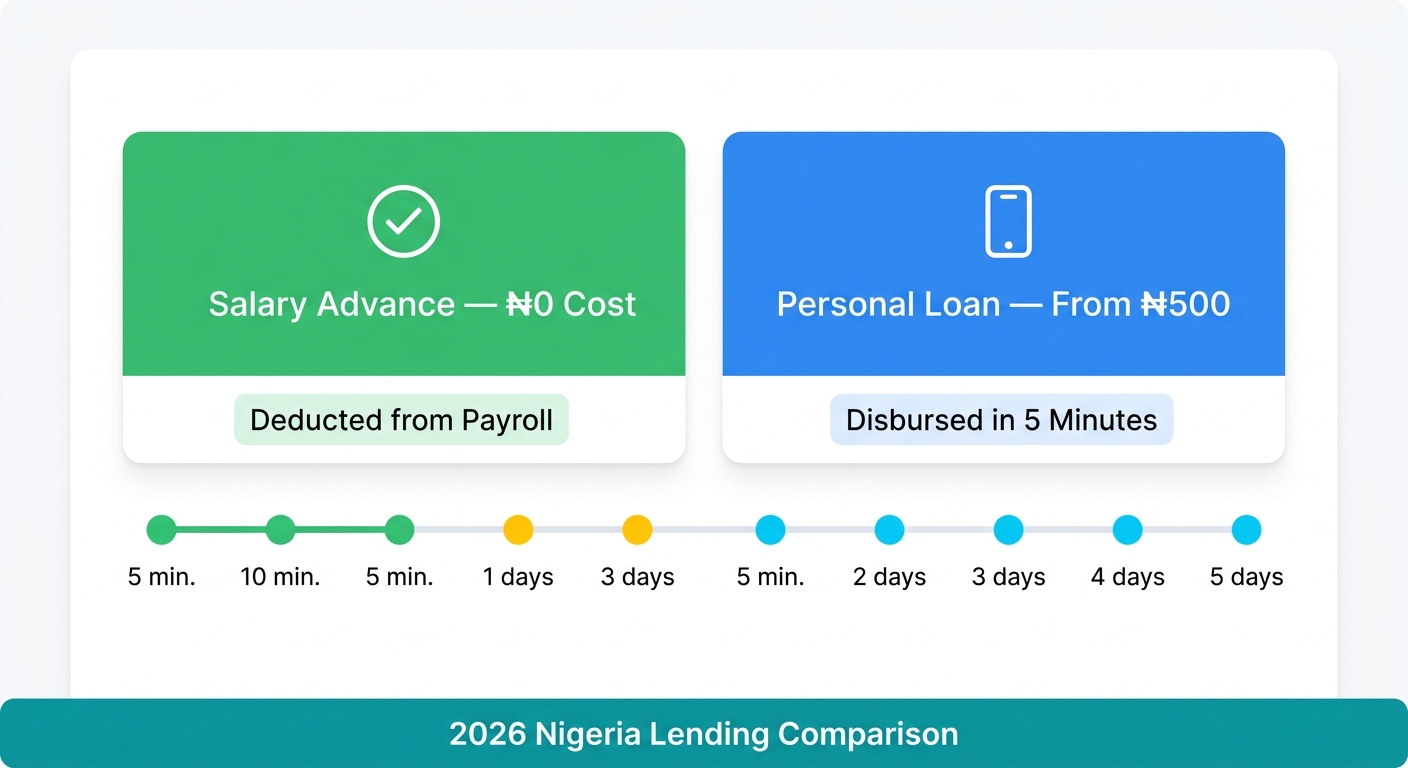
Key cost characteristic: In its traditional form, a salary advance in Nigeria carries zero interest because you are technically accessing money you have already earned.
However, a growing number of Nigerian employers now partner with fintech payroll platforms — such as Earnipay and similar payroll-linked services — that approve digital advances within minutes and charge a flat processing fee of 1–3% rather than a monthly interest rate.
When you compare salary advance vs personal loan Nigeria on cost alone, the traditional employer advance wins every time — but only if your employer actually offers it.
What Is a Personal Loan in Nigeria?
A personal loan is money borrowed from a financial institution — a commercial bank, microfinance bank, or licensed digital lender — that operates entirely independently of your employer. You apply on your own, receive the funds, and repay on an agreed schedule.
How it typically works in Nigeria:
- You apply via a bank branch, mobile banking app, USSD code, or smartphone loan app
- The lender verifies your BVN, reviews your bank statement, checks your credit bureau record at CRC Credit Bureau or FirstCentral Credit Bureau, and assesses your income pattern
- Approval and disbursement on loan apps can take as little as five minutes; commercial bank personal loans typically take 24–72 hours
- You repay in agreed installments — weekly or monthly — or in a single lump sum
Personal loans for salary earners span multiple tiers: GTBank QuickCredit, Access Bank PayDay Loan, and FirstBank FirstAdvance are well-known bank examples. Licensed digital lenders and microfinance banks also serve this segment extensively.
Key cost characteristic: Personal loans always carry interest and fees. The range in Nigeria runs from approximately 1.5–2% per month at a commercial bank to 15–30% per month on predatory, unlicensed applications. Where you borrow determines what you pay — and that gap is enormous.
This cost variance is precisely why the salary advance vs personal loan Nigeria comparison matters so much for your financial wellbeing before you commit to either option.
Speed: Which One Puts Cash in Your Hand Faster?
When your landlord is calling and the school gate locks by Friday morning, speed is not optional.
| Traditional Salary Advance | Fintech Payroll Advance | Bank Personal Loan | Licensed Loan App | |
|---|---|---|---|---|
| Approval time | 1–5 working days | 5–30 minutes | 24–72 hours | 5–30 minutes |
| Disbursement after approval | Same day or next day | Instant | Same day | Instant |
| Documents required | HR form, sometimes payslip | None (employer pre-verified) | Bank statement, ID, payslip | BVN, bank statement |
| Available weekends and public holidays | No | Yes | No | Yes |
| Works without employer involvement | No | No | Yes | Yes |
Speed verdict: If your employer already uses a fintech-linked payroll advance platform, that combination of speed and zero interest is the best possible outcome in any salary advance vs personal loan Nigeria scenario. If not, a licensed loan app matches that disbursement speed, operates at 2am on a Sunday, and requires no HR approval chain.
Cost Comparison: What Each Option Actually Costs on ₦50,000
Real naira figures communicate more than percentages. You need ₦50,000. You repay in 30 days. Here is what each path costs you.
Option A: Traditional Salary Advance (employer direct)
– Interest: ₦0
– Processing fee: ₦0
– Amount repaid: ₦50,000 exactly
– Total cost: ₦0
Option B: Fintech-Linked Payroll Advance
– Flat processing fee: 1–3%
– On ₦50,000: ₦500–₦1,500
– Total cost: ₦500–₦1,500
Option C: Commercial Bank Personal Loan (e.g., GTBank QuickCredit)
– Monthly interest: approximately 1.5–2%
– On ₦50,000 for 30 days: ₦750–₦1,000
– Plus possible management fee
– Total cost: ₦1,000–₦2,500
Option D: Licensed Loan App (FCCPC-registered, mid-tier)
– Monthly rate: 5–10%
– On ₦50,000 for 30 days: ₦2,500–₦5,000
– Total cost: ₦2,500–₦5,000
Option E: Unlicensed Predatory App (avoid entirely)
– Monthly rate: 20–30%+
– On ₦50,000 for 30 days: ₦10,000–₦15,000
– Contact-list harassment if you miss by one day
– Total cost: ₦10,000+ plus significant personal stress
Cost ranking — cheapest to most expensive:
1. Traditional employer salary advance — completely free
2. Fintech payroll advance — small flat fee, still affordable
3. Bank personal loan — moderate cost, CBN-regulated
4. Licensed loan app — higher cost, fast and employer-independent
5. Unlicensed predatory app — maximum cost, maximum risk
The CBN Consumer Protection Framework requires licensed lenders to disclose all fees upfront before you accept any offer. If a lender cannot clearly state your total repayment amount before you sign, treat that as a major warning sign regardless of which side of the salary advance vs personal loan Nigeria comparison you are approaching from.
Who Qualifies? Eligibility Side by Side
This is where many salary earners discover their options are more limited than they assumed.
Salary Advance — Who qualifies:
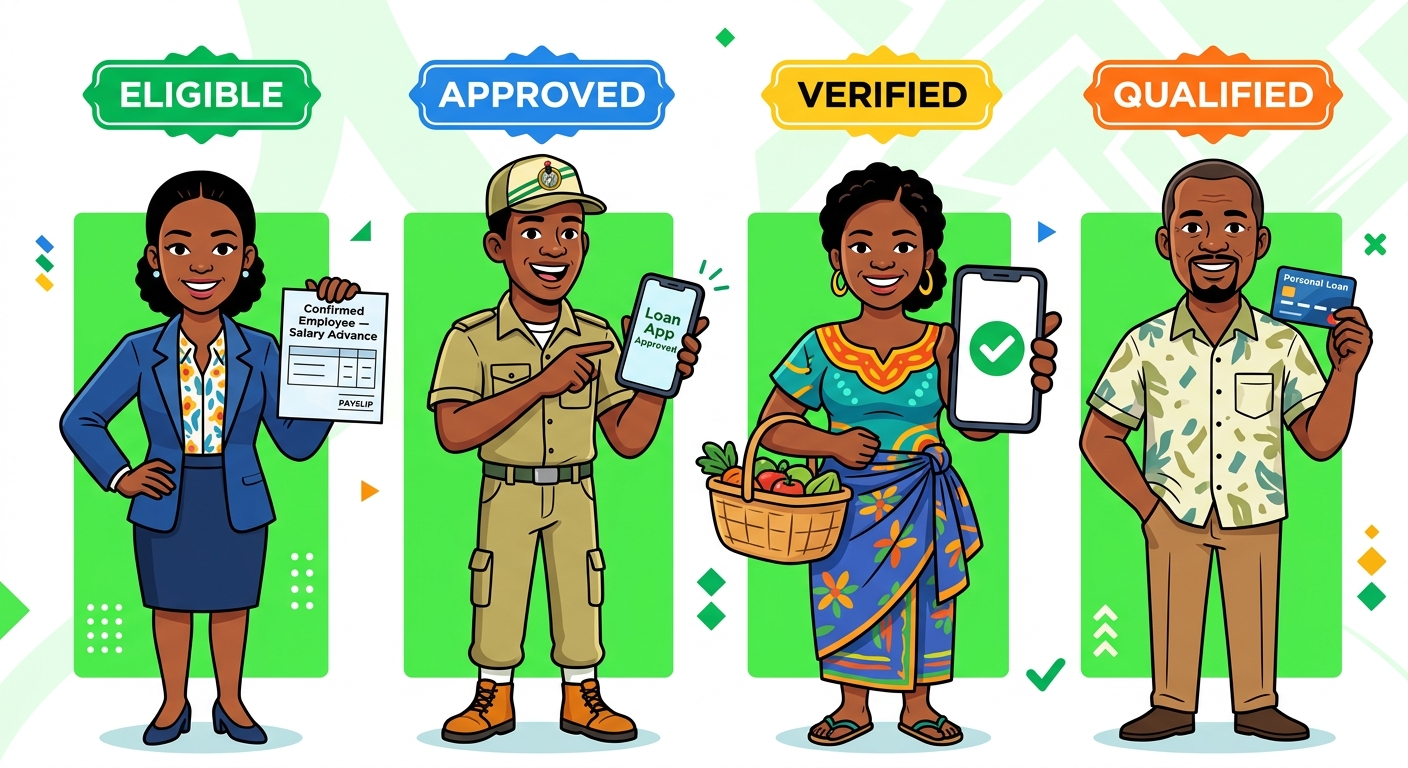
– Confirmed employees only — probationers are typically excluded at structured organizations
– Your company must actually offer the benefit — many Nigerian SMEs and informal employers do not
– Minimum tenure of 6 months is a common requirement
– Your employer must have sufficient operating cash flow that week — during economic pressure months, even eligible employees get turned down
– Government workers on IPPIS face additional bureaucratic approval layers
Personal Loan from Licensed App or Bank — Who qualifies:
– Any Nigerian adult with a valid BVN and an active bank account
– Salary earners, traders, artisans, NYSC corps members, contract workers, and many gig workers
– Consistent income inflows on bank statements over 3–6 months typically satisfy verification
– No employer permission required
– No minimum tenure at your current employer on most app-based lenders
– Poor credit history reduces your limit but does not automatically disqualify you on all platforms
Eligibility verdict: In the salary advance vs personal loan Nigeria access comparison, personal loans are significantly more inclusive. If you are self-employed, a new hire, a freelancer, or employed by an informal business without formal payroll, a licensed personal loan is your realistic primary option.
Repayment: How Each One Takes Money Back From You
Repayment structure determines whether your loan solves your problem or creates a second one on payday.
Salary Advance repayment:
– Deducted automatically from your salary before it is credited to your account
– No flexibility on timing — the deduction happens at source on payday
– No late payment fees because there is no mechanism to be late
– Critical risk: If the advance was large relative to your salary, you receive very little on payday and immediately face another cash shortfall — triggering the next advance request
Personal Loan repayment:
– You initiate the transfer on the due date, or the lender direct-debits your linked account
– Missing a repayment triggers late fees, penalty interest, and — critically — negative reporting to CRC or FirstCentral Credit Bureau, affecting your borrowing ability for months or years
– More flexibility exists: responsible lenders allow restructuring or extensions if you communicate before the due date
– Repayment schedules can align with your actual payday cycle
The payroll cycle trap: Many Nigerian salary earners take a ₦90,000 advance, receive only ₦30,000 on payday after the ₦90,000 deduction from a ₦120,000 salary, and are immediately worse off than before. They request another advance the following week. This is still a debt cycle — it just operates invisibly inside the payroll system, making it easier to rationalize and harder to exit.
Before committing to either side of the salary advance vs personal loan Nigeria equation, read our detailed guide on how to read loan terms in Nigeria so you understand exactly what every repayment clause means before you sign.
Hidden Risks Nobody Warns You About
Salary advance risks:
- Professional perception damage: Requesting advances repeatedly — especially from informal employers — can signal financial instability and affect promotion decisions, salary review outcomes, and access to sensitive responsibilities
- Verbal agreement disputes: Many Nigerian small business owners agree to an advance conversationally, then dispute the amount later. Always get written confirmation — even a WhatsApp message stating the amount agreed — before the funds move
- Termination exposure: If you resign or are dismissed with an outstanding advance balance, your employer is legally entitled to recover the full amount from your final salary, severance, or leave allowance — leaving you with nothing at the moment you need funds most
- No emergency fallback: Once you exhaust your employer’s advance allowance for the month, that option is completely closed with no second tier available
Personal loan risks:
- Cumulative interest is real money: ₦50,000 at 8% monthly for three months costs ₦12,000 in interest alone — a figure many borrowers minimize when they focus only on the monthly rate rather than the total repayment amount
- Credit bureau permanence: The FCCPC and CBN now mandate that licensed lenders report all payment behavior to credit bureaus. A single missed repayment can reduce your credit score for 12–24 months and affect future loan eligibility, mortgage pre-qualification, and some employer background checks
- Predatory apps still operating: Despite active FCCPC enforcement against illegal digital lenders, unlicensed apps continue to appear on the Google Play Store. They access your full contact list at installation and use it aggressively if you default — messaging your employer, family, and colleagues
- Overborrowing is frictionless: When approval takes five minutes and is entirely private, borrowing ₦80,000 for a ₦40,000 problem is dangerously easy. The discipline of borrowing only what you need — not what you qualify for — is entirely your responsibility
For a full breakdown of predatory lending tactics still operating in Nigeria, cross-reference our guide on loan interest rates Nigeria 2026 before accepting any offer.
Decision Table: Salary Advance vs Personal Loan Nigeria — Match Your Situation
Stop overthinking it. Find your situation in the left column and act on the right.
| Your Situation | Best Option |
|---|---|
| Confirmed employee, employer offers formal advances | Salary advance — it is free money early |
| Employer is informal or has no advance policy | Licensed personal loan app |
| New hire under 6 months’ tenure | Licensed personal loan app |
| Corper, contract worker, or freelancer | Licensed personal loan app |
| Need cash in the next 2 hours, any day of the week | Licensed loan app — disbursement in minutes |
| Already took a salary advance last month | Calculate remaining payday amount first — be careful |
| Need more than 50% of your monthly salary | Personal loan — most employers cap advances at 50% |
| Worried about credit bureau impact | Salary advance — does not appear on your credit report |
| Employer’s cash flow is unreliable or delayed | Personal loan — do not gamble on employer liquidity |
| Have bad credit history | Some licensed apps still approve; salary advance bypasses credit check entirely |
| Employer uses fintech payroll platform (Earnipay, etc.) | Payroll advance — fast, low cost, no HR awkwardness |
How LendSafe Fits Into This Decision
LendSafe is built for exactly the moment described in the opening of this article — when your salary has not arrived yet and life does not pause for payday.
If your employer does not offer advances, if you need money faster than an HR approval chain can process, or if you want a private and dignified solution that does not require your line manager to know your personal financial situation, LendSafe provides a licensed, CBN-framework-compliant personal loan directly on your phone.
- Application completed in under 5 minutes
- No collateral required
- Disbursement directly to your bank account
- Repayment terms structured to align with your payday cycle where possible
- No contact-list access or harassment — your privacy is fully protected
Before applying for anything — salary advance or personal loan — run through this checklist:
✅ Do I actually need this exact amount, or am I borrowing more than the emergency requires?
✅ Can I fully repay on the due date without creating a new shortfall the following payday?
✅ Have I calculated the total repayment amount — not just the monthly rate — before accepting?
✅ Is this lender licensed by the CBN and listed on the FCCPC consumer credit registry?
✅ Have I confirmed whether repayment will be direct-debited and on which exact date?
Also review our breakdown of current loan interest rates in Nigeria so you know what a fair rate looks like before any lender quotes you a number.
LendSafe Nigeria is a licensed digital lender. Always verify any lender against the FCCPC consumer credit registry before submitting your BVN or bank account details to any platform.